News
Dollar demand falls 35% as naira holds firm

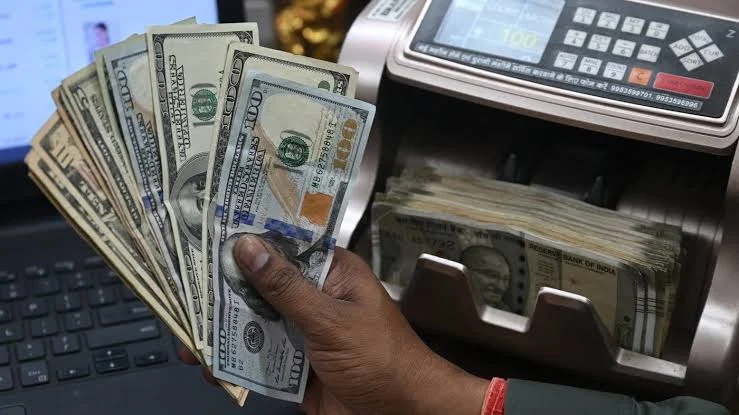
Demand for foreign exchange by end-users in Nigeria fell by 35.23 per cent to $3.42bn in April 2026, easing pressure on the dollar market as the naira recorded modest gains.
Data from the Central Bank of Nigeria showed that foreign exchange utilisation across economic sectors declined during the month, while the naira strengthened at the official market.
The monthly average exchange rate improved 1.38 per cent to N1,361.22 per dollar in April from N1,379.98 in March. At the end of the month, the naira closed at N1,374.94 per dollar at the Nigerian Foreign Exchange Market, compared with N1,386.72 at the end of March.
Visible imports accounted for 41.92 per cent of total FX utilisation, while invisible imports represented the remaining 58.08 per cent.
Industrial activities were the largest users of foreign exchange among visible imports, accounting for 37.44 per cent of total utilisation. Manufactured products followed with 21.85 per cent, oil imports with 20.11 per cent and food products with 14.47 per cent.
Transport-related imports accounted for 3.54 per cent, while minerals and agriculture represented 1.47 per cent and 1.12 per cent respectively.
Within invisible imports, financial services dominated, accounting for 91.51 per cent of total utilisation. Business services represented 4.37 per cent, transport services 2.58 per cent and communication services 0.84 per cent.
The decline in demand was accompanied by weaker activity in the official foreign exchange market. Average FX turnover fell 26.97 per cent to $442.54m in April from $605.93m in March.
Despite the lower demand and turnover, Nigeria recorded a stronger net foreign exchange position during the month.
Net FX inflows rose to $5.85bn in April from $4.16bn in March, driven largely by a sharper decline in outflows.
Aggregate FX inflows fell to $8.71bn from $9.70bn, but total outflows dropped more significantly to $2.86bn from $5.54bn.
The banking system recorded a net outflow of $180m, down substantially from $1.66bn in March, while autonomous sources generated a net inflow of $6.02bn.
The CBN said the country’s external reserves remained broadly stable at $48.32bn at the end of April, compared with $48.35bn in March.
The reserves provided about 10 months of import cover, significantly above the international benchmark of three months.
The combination of weaker end-user demand for dollars, reduced FX outflows and stronger net foreign exchange inflows suggests easing pressure in the currency market and helped the naira’s relative stability in April.





Vehicle in Custody of Ghanaian Government Authority Used in Reportedly Foiled Labone Bank Robbery as Ghana Police Face Mounting Questions Over Nigerian Involvement Narrative – Secrets Reporters Nigeria

Satellite Town Development Department Abuja: Secrets Reporters Uncover ₦15.29m Financial Irregularities as Retired Officer Keeps Government Hilux – Secrets Reporters Nigeria

₦3.26bn in Revenue and Account Irregularities Uncovered Under Mr Abdullahi O. Attah as Chairman – Secrets Reporters Nigeria

Ministers, Governors, Lawmakers You Rely On Are Not Working In Your Best Interest – Jonathan Vatsa Warns Tinubu

Alleged drug trafficking: Tinubu joins US Justice Department’s request for 10-day delay in release of records

“If you can’t pay for your flight ticket and don’t have a job, don’t marry” — Female pastor advises ladies

“Your prayer point is different from mine” – Businessman says as he proudly flaunts his thriving business

“He tried to lure me into having sex with him, but I refused” — Funke Etti recounts alleged ordeal with movie director

“You’ll fly her in, lodge her and still give her ₦3m” – Lady questions men’s spending on women for sexual pleasure

Crisis rocks Edo Assembly as workers protest planned repeal of financial autonomy for house, judiciary

Trump Announces ‘Crushing’ Economic Operation Against Iran

Osun APC Forum Writes Tinubu, Blames Oyetola for Party’s Election Defeat
NELFUND Uptake Higher In North Than South — Oyedele

No Single Security Agency Can Secure North-West Alone – IGP Disu

“You’re a good wife” – Tunde Perry hails Jarvis for promoting Peller during Kai Cenat’s livestream
BBNaija’s Sheggz Confirms Breakup With Bella Over Trust, Respect Issues

NYSC DG warns corps members against political campaigns, AI misinformation

Isese Day: Oyo Government Declares Thursday Work-Free, Felicitates Traditional Worshippers

EFCC Hands Over Recovered $150,000 To Fraud Victim In Lagos

Tinubu approves construction, rehabilitation of eight road projects [FULL LIST]

 Headlines13 hours ago
Crisis rocks Edo Assembly as workers protest planned repeal of financial autonomy for house, judiciary
- Special Report15 hours ago
Adeleke receives certificate of return, pledges N500m fund for election violence victims – The Witness Nigeria
- Entertainment19 hours ago
“Witches exist. I have gone to a meeting with witches before and came back to the house” — Kunle Omisore
- Entertainment19 hours ago
“My father rejected all my suitors for being non-catholic” — 95-year-old woman reveals why she never married
- News10 hours ago
Over ₦1.05bn in Financial Irregularities Uncovered under Alihu Nahuchi Leadership in FCT Water Board – Secrets Reporters Nigeria
- Viral23 hours ago
“Madam, no be me give you belle” — Lady recounts shocking response from man who refused pregnant woman his seat
- News9 hours ago
Prof. Josephine Anene-Okakwa Administration Saddled with ₦76.84m in Financial Irregularities at Federal College of Education (Technical), Asaba – Secrets Reporters Nigeria
- Entertainment23 hours ago
Husband panics, runs to family, priest after wife catches him with side chic and says nothing for weeks