World
Takaichi skips controversial shrine visit on 81st anniversary of country's World War II surrender

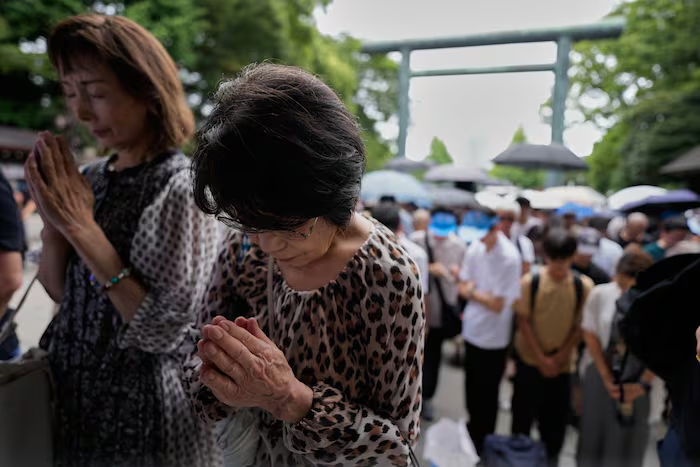
TOKYO (AP) — Japanese Prime Minister Sanae Takaichi avoided Tokyo’s controversial Yasukuni Shrine, apparently to prioritize diplomatic relations with China and South Korea, as Japan marked on Saturday the 81st anniversary of its surrender in World War II.
However, she did not mention her country’s wartime past in Asia or show remorse over it in her address.
The Yasukuni Shrine, which commemorates over 2.4 million people who died in wars, became controversial after including 14 convicted World War II Japanese war criminals. China and South Korea say visits by Japanese officials to the shrine show a lack of remorse over Japan’s wartime atrocities.
Takaichi mourned the victims of major devastation in Hiroshima, Nagasaki and Okinawa, as well as those who perished in overseas battlefronts, and thanked them for their sacrifice as the “foundation of Japan’s peace and prosperity today.”
“Japan, since the end of the war, has consistently contributed to global peace and prosperity. We will never let the tragedy of the war be repeated,” she said in her address at Budokan Hall, a walking distance from Yasukuni.
Takaichi said Japan can play a key role in addressing global challenges as “a dependable nation” in the region.
China and South Korea protest shrine visits
Japanese Defense Minister Shinjiro Koizumi, three other Cabinet ministers and three executives from Takaichi’s governing party showed up at the shrine earlier Saturday. A nonpartisan group of dozens of lawmakers also prayed there.
China’s Foreign Ministry protested to Japan over the visits, saying that Japanese politicians’ true intentions were to “change the verdict on the war criminals, cover up Japan’s war crimes, distort the historical facts and pave the way for accelerating militarization.” It urged Japan to do “serious soul searching” on history and make a clean break with militarism.
Tensions between Japan and China escalated in November when Takaichi said a Chinese attack on Taiwan could constitute “a survival-threatening situation” for Japan requiring the use of force. The comments enraged Beijing.
South Korean President Lee Jae Myung, in his speech Saturday marking the 81st anniversary of Korea’s liberation from Japanese colonial rule, said that his administration used “pragmatic diplomacy centered on national interests” and will broaden cooperation in shared interests to resolve common challenges. “Korea-Japan cooperation is now more important than ever.”
“The new bilateral relationship we are building must warmly illuminate those who are still suffering from pain in the shadows of history,” he said.
Attention this week was on whether Takaichi, who has repeatedly said she would pray at the shrine on Aug. 15 despite the controversy, would keep her pledge and show up at Yasukuni.
Defense minister prays at Yasukuni
Koizumi has regularly visited the controversial shrine on Aug. 15 and other occasions. But as a defense minister pushing to increase Japan’s military capability and weapons sales under Takaichi’s hawkish government, his visit is seen as more contentious.
The previous shrine visit by a defense minister was in 2024 by Minoru Kihara, the current chief secretary and top government spokesperson for Takaichi’s government.
Japan’s Defense Ministry prohibits group visits by service members of the Self-Defense Forces, on grounds of constitutional separation of religion and state. Koizumi said in October it is natural for anyone in any country to pay respect for those who sacrificed their lives for their nation.
Hours after his Yasukuni visit, Koizumi said on X he paid respects to the war dead for their sacrifice for the country. “I renewed my war-renouncing resolve and will continue to fulfill Japan’s postwar responsibility as a peace-loving nation.”
He is the son of popular former Prime Minister Junichiro Koizumi, whose 2006 Yasukuni visit as a serving leader outraged China.
Party executives make up for Takaichi’s absence from the shrine
The three executives from Takaichi’s governing Liberal Democratic Party prayed together Saturday at the shrine and brought offerings in a rare joint visit on the prime minister’s behalf, seen as a move to make up for Takaichi’s absence and appeal to her right-wing supporters.
Party secretary-general Shunichi Suzuki told reporters he prayed while keeping in mind the prime minister’s thoughts for “the spirits of the war dead” and that he brought Takaichi’s cash offerings in her capacity as party leader.
For Takaichi, appealing to right-wing voters is key at a time when her support is seen as falling rapidly, presumably over delayed economic measures to address rising prices, as well as scandals including alleged negative election-campaign videos and unpopular revisions to Japan’s imperial family succession rules.
Takaichi has not visited the shrine since taking office but has sent offerings twice for the shrine’s biannual festivals. On Saturday she prayed remotely toward Yasukuni from the Budokan parking lot before the ceremony, NHK television reported.
Japanese emperors have shunned the shrine
Japanese emperors have shunned Yasukuni since its 1978 inclusion of the war criminals as “martyrs,” and have expressed regrets over Japan’s wartime past, though in a nuanced way.
Emperor Naruhito, in his address Saturday at the ceremony, said he hopes the ravages of war will never be repeated while “reflecting on our past and bearing in mind the feelings of deep remorse.”
“It is my sincere hope that we shall continue to pass down the memories of the sufferings endured during and after the war.”
Pushback against remembering Japan’s wartime history
Takaichi has resisted acknowledging Japan’s wartime aggression and atrocities, and denied that coercion was used against Korean laborers and women held as sex slaves for Japanese troops. She was previously part of a campaign to remove references to wartime sexual slavery, known as “comfort women,” from school textbooks.
She has said she is from a postwar generation that bears no responsibility for Japan’s past actions and has no intention of apologizing.
The country has faced revisionist pushbacks since the 2010s under nationalistic former Prime Minister Shinzo Abe, who pushed to correct a “self-deprecating view” of Japan’s wartime history and regain national pride. Takaichi considers Abe a mentor.
Since 2013, Japanese prime ministers have stopped apologizing to Asian victims for wartime atrocities, under a precedent set by Abe.
Last year, however, former Prime Minister Shigeru Ishiba expressed “remorse” over the war and called it a mistake, though he fell short of mentioning Japan’s aggression across Asia or apologizing.
People at Yasukuni remember relatives lost in the war
At Yasukuni, some of those queuing up early Saturday were descendants of the war-dead, and for them Yasukuni is a place to remember their relatives.
As a child, Mariko Shinoda, 56, whose grandfather died as a Kamikaze pilot, came to Yasukuni with her mother every year on Aug. 15. Kamikaze pilots departed on their one-way missions saying, “Let’s meet at Yasukuni,” her mother told her.
“To me, Yasukuni is where every spirit gathers, and that’s where you get to see them on Aug. 15,” Shinoda said.
Masashi Ichimura, 48, whose grandfather went to war, often heard from his father about harsh wartime living conditions, including starvation.
“There is nothing good about the war, win or lose,“ he said. “But those who died in the war only fought for our country, and I just want to thank them for the sacrifice.”
___
Associated Press writers Hyung-jin Kim in Seoul, South Korea, and Kanis Leung in Hong Kong contributed to this report.
Copyright 2026 The Associated Press. All rights reserved. This material may not be published, broadcast, rewritten or redistributed without permission.


‘Dapper, your cup don finally full’ – Singer T.I Blaze questions music executive over N1.2bn royalties

Akwa Ibom Governor Commits To Operation Of Maintenance Facility At Victor Attah Airport, Expansion Of Ibom Air

Kidnapped Christian Worshipers in Southern Nigeria Describe Weeklong Torture by Fulani Terrorist Gang

Izeze Remains High-Spirited, Pays Fines for Inmates at Warri Custodial Centre – Secrets Reporters Nigeria

EXCLUSIVE: SecretsReporters Uncover Unaccounted ₦75m Cash Advance in Hannatu Musa Musawa’s Ministry – Secrets Reporters Nigeria

Adekunle Adebiyi: Abuja Move ‘One of Our Best Decisions’ As Squash In Diaspora Tournament Hits Semifinals

“If they ask for money, call IGP” – Police officer warns Nigerians against paying for bail, shares complaint numbers

“I returned your ₦5m birthday money” – Diadem calls out Dabota Lawson, alleges she uses bloggers to attack people

NNPC Spends ₦393.45m on Three-Years Office Rent for NNPC Board Accommodation Under the Leadership of Bala Wunti in NAPIMS – Secrets Reporters Nigeria

“You charged me ₦7m, but quoted ₦5m for someone else” – Man calls out friend over solar deal betrayal

BEA scholars demand 2025 full stipends

Osimhen Urges Galatasaray Teammates To Raise Their Level After Çorum Draw

Atiku, Obi, others’ summit shifted to August 31

Magnitude 7.7 earthquake strikes off Indonesia's coast, killing at least 40 and toppling buildings
Magnitude 7.7 earthquake strikes off Indonesia's coast, killing at least 40 and toppling buildings

Israeli airstrikes on southern Lebanon kill 11 people, Health Ministry says

Parties to conduct primaries in new Delta, Kogi constituencies

Liechtenstein changes rules to allow women to inherit throne

14 Pre-Season Friendlies To Watch Today: Full Preview, Predictions

Weekend reads: Inspirations behind elements that make visuals timeless

 Headlines23 hours ago
‘Dapper, your cup don finally full’ – Singer T.I Blaze questions music executive over N1.2bn royalties
- Politics20 hours ago
Akwa Ibom Governor Commits To Operation Of Maintenance Facility At Victor Attah Airport, Expansion Of Ibom Air
- Politics21 hours ago
Kidnapped Christian Worshipers in Southern Nigeria Describe Weeklong Torture by Fulani Terrorist Gang
- Politics19 hours ago
Adekunle Adebiyi: Abuja Move ‘One of Our Best Decisions’ As Squash In Diaspora Tournament Hits Semifinals
- Entertainment22 hours ago
“I don’t want their money”- Peller shares why he intends to collaborate with Dangote, Femi Otedola and Bill Gates
- Entertainment22 hours ago
“Peter Obi was already ahead of us in Class Three” – Former classmate opens up on his early school hustle
- Entertainment18 hours ago
“You broke up with girl because she farted” – Matchmaker blasts 47-year-old man over failed relationship
- Entertainment18 hours ago
“If you would have been patient”- Moment Peller screams during visit to man’s residence after pleading for G-Wagon