World
Houthis' Red Sea attacks pressure Saudis to back ground war Riyadh has spent 3 years trying to avoid

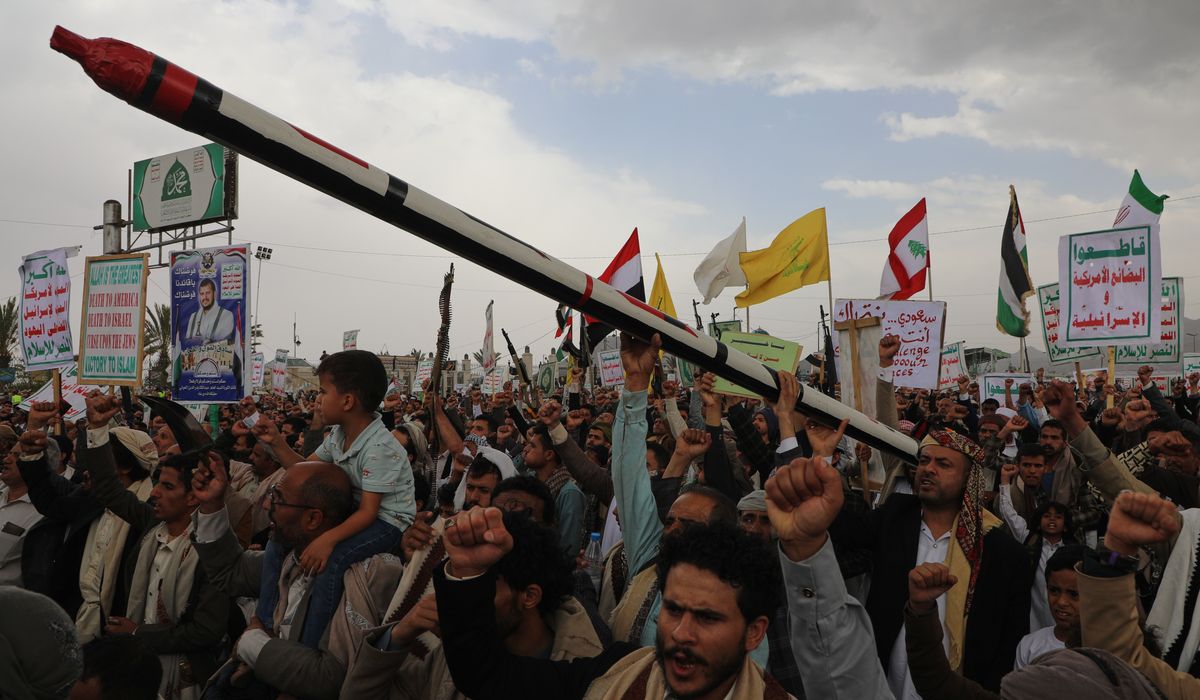
ISTANBUL — Saudi Arabia has stopped loading crude from its Red Sea coast amid ramped-up attacks from Iran-backed Houthis and is weighing whether to back a new Yemeni ground campaign to retake the shoreline from the rebel militants.
Houthi missiles and drones hit the port city of Mocha and residential districts of Marib again early Tuesday, the Yemeni army said, a third straight day of attacks on that coast.
Government naval forces destroyed an explosives-laden boat running at speed toward an oil tanker near the Mocha power station. Mocha is government-held; Hodeidah, the bigger port up the coast, is not.
The decision on a ground campaign is Riyadh’s, not Washington’s, said Mohamed Qubaty, a former Yemeni information minister.
“The Americans were waiting for the Saudis to take that decision,” he told NewsNGR.
Yanbu, the kingdom’s Red Sea export terminal, handled 92% of Saudi seaborne crude in June, after Iran closed the Strait of Hormuz. Riyadh’s escape from one chokepoint runs into another.
“The western coast is not simply another front in Yemen,” said Mr. Qubaty, acting chairman of the Southern Civil Democratic Rally, who was Yemen’s ambassador to Lebanon and Cyprus before he advised its prime ministers. “It is where the Yemeni conflict intersects directly with Red Sea security, Bab el-Mandeb, energy security and international commerce.”
Four soldiers and three civilians were killed at Mocha and 30 wounded, according to the National Resistance Forces, which shot down 11 Houthi drones during the assault. Missiles landed near a television station and a government building. The Saudi daily Okaz cited medical sources counting eight dead and 26 wounded, and a military source who said the Houthis fired 30 ballistic missiles.
The port’s director said the hits set fire to the warehouses, the quays and the fuel installations. Navigation has stopped.
Tuesday’s strikes came five days after the deadliest attack on Yemen’s government forces since a U.N.-brokered truce froze the front lines in 2022.
Missiles and drones on Thursday hit camps in Marib and in the al-Abr and al-Wadiah areas of Hadramout, near the Saudi border. One missile caught troops at morning formation in Marib, killing and wounding at least 45, a military source told Agence France-Presse. Yemen’s Defense Ministry reported 17 soldiers killed, but other media reports had as many as 58 dead.
Yahya Saree, the Houthi military spokesman, claimed their strikes had killed hundreds. Saudi Arabia is driving its forces into a futile war, he said, and the Houthis will strike any mobilization the kingdom brings into Yemen. The group declared its Red Sea blockade is in answer to what it calls a Saudi siege, a charge Riyadh denies.
Yemen faces a greater risk of large-scale conflict than at any point since the 2022 truce, U.N. envoy Hans Grundberg said Friday.
A full closure of the Red Sea’s southern gateway, the Bab el-Mandeb, would put a quarter of the world’s oil and gas supply at risk.
Riyadh has rerouted its Asia-bound crude north through the Suez Canal, a run that takes 54 days to South Korea against 24 through the Bab el-Mandeb.
A decision by Riyadh to back the Yemeni government with Saudi forces would be a game-changer.
“The government side does not lack forces,” Mr. Qubaty said from Cairo. “Its challenge has been turning those forces into a force — under coherent command, with secure communications, shared intelligence and a common strategic objective.”
“Sometimes pre-emptive violence is not a sign of confidence,” he said. “It is a sign that an adversary fears the strategic environment is beginning to turn against it.”
“Yemeni history repeatedly demonstrates that control of the western coastline can profoundly alter the balance of power in the northwestern highlands,” Mr. Qubaty said. “The 1934 campaign and the battle for Hodeidah in 2018 are important examples.”
Government forces came close to taking Hodeidah in 2018, by his assessment, before the Stockholm Agreement halted the campaign. That advance depended on air support, which he doubts the Yemeni air force could supply on its own today.
Saudi Arabia has avoided ground confrontation for three years, preferring containment. Mr. Qubaty stopped short of saying the kingdom has chosen otherwise.
“I would distinguish between preparing for contingencies and deciding to launch an offensive,” he said. “It’s obvious that the military environment is changing.”
“Saudi Arabia does not have to want another Yemen war to conclude that the status quo has become strategically untenable,” he said. “The question is whether the cost of continued containment is beginning to exceed the cost of changing the strategic balance.”
Iranian missiles have hit Saudi territory since the war began Feb. 28, and Riyadh has spent five months questioning whether the American umbrella still covers it. When Mr. Trump announced a 20% transit fee on Hormuz cargo in exchange for U.S. protection, Gulf leaders phoned the White House and he withdrew it in a day.
Riyadh signed a mutual defense agreement in Mecca on Friday with Turkey and Pakistan, counting an attack on one as an attack on all.
It followed the July 30 launch of a 14-state maritime coalition led by Riyadh. Neither the United Arab Emirates nor Oman joined.
Iran’s Foreign Ministry called the pact “a sign of a change in the perception” of the region toward the United States.
Mr. Qubaty said the pact introduces a regional element into a security architecture long dependent on Western support, but cautioned against inferring that Turkey or Pakistan would join a Yemen operation. The more consequential question, he said, is whether an indigenous regional security architecture is emerging, and whether Yemen and Bab el-Mandeb become its first practical test.
“Ankara’s position is clear: it had supported Saudi Arabia’s security and stability even before the Mecca deal was signed,” said Sinem Cengiz, a researcher at Qatar University’s Gulf Studies Center who writes on Turkish foreign policy. “Now, that support is framed within a defense cooperation.
“Even if Riyadh backs a ground campaign on Yemen’s western coast, Ankara is not automatically obliged to join the war,” she told NewsNGR. “The pact does not necessarily mean Turkey declares war.”
Turkish support could instead come through intelligence sharing, logistics for naval and air operations, and diplomatic channels via Iran, Ms. Cengiz said. “The pact is new and its operational mechanisms have not yet been tested, and therefore it remains unclear.”
“The 2024 incident is a good example of Ankara’s balancing act,” she said. The Houthis targeted a Turkish vessel with several ballistic and naval missiles. Ankara condemned the attack and noted that necessary steps had been taken to prevent a recurrence, without specifying what they were.
“Turkey only takes ground measures when it feels its national security and sovereignty is directly threatened,” Ms. Cengiz said, “such as in the case of its operations in Syria against terrorist groups during the Assad era.”
“You cannot permanently secure the Red Sea from the sea alone,” Mr. Qubaty said. “Naval forces can intercept missiles and protect shipping, but durable security ultimately requires legitimate sovereign control ashore.”
“The strategic question is no longer simply whether the next Houthi missile or drone can be intercepted,” Mr. Qubaty said. “It is whether the conditions that allow an armed non-state actor to exercise coercive leverage over Yemen, Bab el-Mandeb and international shipping are allowed to become permanent.”


Politics 29 seconds ago Raise Your Voice Consistently – Tinubu Sends Message To Clerics President Bola Tinubu has urged religious and spiritual leaders to consistently speak out against terrorism, kidnapping and banditry. NEWSNGR reports that…

Captain Idahosa Wells Living Museum Unveiled as Children Cement Legacy of Late Icon on Fifth Anniversary

Subsidy removal: Give account of revenue Nigerians lost to inflation – Rufai Oseni blasts NRS boss Adedeji

‘Stop Abusing Me, Tell Oyo People What You Want To Do Differently’ – Makinde Fires Governorship Contestants

Imo State University ASUU Embarks On Indefinite Strike Over Non- Implementation Of 2025 ASUU- FG Agreement.

“Why are you telling me?”- Lady cries out, displays amount mistakenly transferred to her Opay account

Transfer: ‘He’s indispensable’ – Michael Owen warns Man United against letting most important player leave

Exclusive: N750m Special Intervention Money Missing Under Arts Minister Hannatu Musawa, Permanent Secretary And Finance Director – Secrets Reporters Nigeria

Peller’s mum dragged for asking her son to gift her ‘lover’ money at his wedding, Daddy Freeze reacts
‘I Am Likewise Demanding Compensation’: Trump Rejects Iran’s Payback Demand, Puts Counter-Claim On Future Talks

Extreme heat is reshaping Italy's sparkling wine industry with early harvests and nighttime picking

State Department condemns new Chinese claim to disputed South China Sea shoal as 'destabilizing'

Katsina United Defender Chinedu Ozor Reportedly Shows Signs of Movement After Death Pronouncement

Houthis' Red Sea attacks pressure Saudis to back ground war Riyadh has spent 3 years trying to avoid

Massie Warns: US Should Avoid War with Iran Before It Becomes Overpowered.

Iran sends Trump a stern warning about starting war

Tiffany Haddish avoids more jail time by admitting drink-driving

A Few Minutes Saved Disaster! Trump Reveals What Happened in Iran Attack

Trump: Iran should also pay us compensation

Trump grapples with cycle of violence, diplomacy and economic pressure as Iran war nears sixth month

 World21 hours ago
‘I Am Likewise Demanding Compensation’: Trump Rejects Iran’s Payback Demand, Puts Counter-Claim On Future Talks

 Special Report16 hours ago
DSS releases, pays N3m compensation to carpenter cleared of Oyo school kidnap link – The Witness Nigeria
- Metro21 hours ago
“EFCC Arrests Fake Operative In Maiduguri Over Alleged ₦3m Fraud” — Recovers Money, Says Suspect Paraded Himself As Commission Officer
- Entertainment11 hours ago
“What’s wrong with me?” — Lady breaks up with boyfriend after he stopped her from closing window in Safari
- News15 hours ago
Despite Over ₦625 Million Monthly Allocation & Rich in Coal, Ankpa LGA in Kogi State Battles Darkness, Abandoned Hospital, Deadly Erosion, Daily Hardship Whie Council Chair Focuses on Arresting Citizens – Secrets Reporters Nigeria
- Entertainment16 hours ago
“The groom was a bus driver…” — Friends drag bride after travelling from Lagos to Calabar for wedding
- Viral14 hours ago
“I cannot wait…” — Man shares how female colleague spent ₦7,000 on shawarma despite having only ₦8,000
- Entertainment15 hours ago
“The doctors are not God” — Lady gives birth to baby boy after being told she could never get pregnant