News
Have the Brits tamed Andy Burnham?


Have the Brits tamed their politicians and leadership as well? It’s the intended question and, of course, the first among British politicians is Prime Minister Andy Burnham. Do citizens now prefer political leaders bent on acting like everyday folks to those that concentrate on doing what leaders are universally expected to do – lead? For generals who lead soldiers on battlefields, we know the answers. As for civilians in the UK, whom Burnham is eager to please, we aren’t sure anymore, hence the question. A close look at Burnham’s moves shows he’s determined to meet the expectations of every citizen, giving off the feeling that he’ll try to meet even more expectations if there are, and this disposition raises questions. One: where do we draw the line between what a national leader should be and what people expect him to be? Where does the leader draw a line between being everybody’s man and being the leader? Both questions provide an opportunity to interrogate the trend among politicians in Western democracies who adopt a somewhat anti-establishment and supposedly pro-people approach (populism). Some simply harness and ride on popular sentiments, raising hope, making promises that get them the vote, though they know half of the promises made won’t be fulfilled.
There were years in the past when one could tell what political parties and politicians in Western democracies would promise and what they wouldn’t. They were moderate, keeping their criticisms of ruling parties moderate, conscious that they would arrive in power and that unrealistic promises shown for what they are. So opposition parties largely played responsible not divisive politics, refusing to raise false hopes or make wild promises just to be different. This has changed. Parties and politicians pick any issue that’s as wild as the imagination can get, campaign on it, thereby polarising Western democracies in a way never experienced before. It’s one reason a political party, Alternative for Germany, that won the latest state election has been described as “dangerous” because it’s far-right. Yet the party doesn’t only win; nationally it’s the most popular. I’m not referencing populism for the first time on this page. I raised it back in 2016 after US President Donald Trump rode into the White House on the back of popular sentiments that other US presidential candidates wouldn’t consider or make promises about. As a journalist with political science background, the long term effects of such phenomenon in Western democracies had been of interest to me.
As Trump and his campaign advisers realised back then, populism was the only way they could beat established politicians so it was the path they trod. However, before the age of populism, the kind seen theses days, politicians had been promising something to everyone. Former US President Bill Clinton, in order to win, made campaign promises he later turned away from in his eight years in office. Clinton soon discovered that seeing issues one way outside the White House is different from how one sees them in the White House. Many politicians have experienced a similar situation. Meanwhile, at the time Trump was making populist promises, I pointed out here that the businessman cum politician was following in the footsteps of populist politicians in Europe who had latched on to some of the wilder expectations among citizens. When his margin of winning seemed narrow in late 2015, his men worked on the electorates on the fringes. These were targeted with things like disappearing messages on their personal digital devices.
Such disappearing messages got people mad enough to want to vote against the Democratic Party candidate, as the public controversy surrrounding the activity of the consulting firm, Cambridge Analytica, later revealed. Trump won in 2015. But his populist approach would bring in greater dividends in the November 2024 presidential election. However, unlike Trump, who has tested an approach that works and is consolidating in his second tenure, the current UK prime minister hasn’t come into office through the general election route. With Burnham’s party behind in the polls, he’s conducting himself to be liked ahead of the next general election, trying so much to please everyone in a way that appears forced. Having been an actor (and later a playwright) long before I came into journalism, I know there’s something actors call “overacting”. What the prime minister is doing seems needlessly high-octane, reactive, scripted and acted, rather than natural.
It shouldn’t be assumed one doesn’t understand Burnham’s effort to conduct himself like everyday folks. The approach was something I had praised the former PM, Boris Johnson, for. Johnson in his shorts regularly jogged or rode his bicycle across town in the UK essentially to keep fit; he kept the habit even after he became foreign secretary, jogging on streets in New York City when he was there on official UN engagements. I rate that as an unforced approach to being like everyday folks. Johnson had always been doing his own thing, living it simple, long before he came into public office. Add this to his informal approach to official matters – no airs, no loads – just the likeable Johnson who got things done, and the reader would understand why I wrote close to fifty pieces (columns and satires) on him on this page and elsewhere. His relaxed carriage and his looks (face and hair), coupled with his naturally ebullient disposition, come across more as unforced and unscripted Johnson.
While one doesn’t condemn Burnham for his effort to be approachable if he thinks it’s the best, it needs to be pointed out that he hasn’t contested a general election for this post, so he doesn’t know what works or if his approach will even cut it for the electorate.
Before he’ll know it, his effort at being approachable might have stripped the highest political office in the land of everything presidential without attracting the intended votes. It might have stripped all the fine lines (different from aloofness or haughtiness) that attend leadership. Worse, his approach can encourage extreme expectations (in Western democracies that traditionally avoid extremes), create more disenchantment among citizens when expectations aren’t met, become a source of instability as well as disaffection with the electoral process, and ultimately undermine democracy. Such is the point of the reality check this piece is about.
It’s worth noting that while politicians traditionally avoid extremes, a populist approach has produced “far-right” and “far-left” political parties once abhorred in the West. I think efforts to please everyone, such as Burnham is doing, can end up producing the same outcome for which “far-right” and “far-left” politicians and their parties are feared. This is the core of this piece. From his first day in Number 10, Downing Street, Burnham sends out the signal he wants to make citizens feel he’s one of them. He said he would take things out of government offices in London, and devolve power to city and town councils. He’s shown that unlike his immediate predecessor, he won’t always stay behind podiums making speeches. So, he’s been going to pubs drinking beer, as well as engaging in other similar informal activities. Burnham’s informal interactions are so many in the short period he’s been in office that they can beat the entire informal outings of some past PMs who spent a longer time in power. One isn’t certain that’s the hallmark of leadership, but if it brings people closer in the age of populism, it can pass, except that other issues of immediate concern tend to be the determinants when the electorate votes, not how affable a political leader is. And there’s no better example to cite here than Trump; he doesn’t concern himself with going to pubs or dressing like everyday folks, yet he maintains his core base of political supporters. Reason? He shows leadership on issues that matter to his voters.
There are choices Burnham has to make regarding his leadership style, and with the condition of people in the UK I don’t think emphasising the likeable, simple-fellow approach to win every voter’s heart is one of them. The things that bother citizens are more serious in nature than that. Burnham’s immediate predecessor, Keir Starmer, might have been perceived as stiff and formal (and I pointed this out in my satires long before Starmer arrived at Number 10 after which public commentators began to state the same). But if Starmer’s tenure hadn’t been filled with those official matters he bungled, as well as the effects of the US-Iran war on people, he probably would have retained some level of confidence among citizens that could see him to the next election and beyond. Plus, he didn’t strip the highest political office of its dignity with efforts to appear like everyone else.
Meanwhile, if everyday living is tough for the electorates they consider such things before they remember their PM has been a likeable fellow. My observation is that citizens respect political leaders more when they get things done while surrounding their office with some level of distance and mystery. What is insufferable is a leader who focuses on being approachable but doesn’t get things done. There are many uncomplimentary tags for such a situation, and Burnham has no need to invite them in the period citizens’ patience permits him to stay on this job. He should concentrate more on resolving issues that hit citizens hard, rather than stripping leadership of all allures that most folks still admire.




Yobe tertiary institutions’ unions issue fresh 15-day ultimatum over unpaid allowances, welfare packages

2027: I’ll put solar panels on every Nigerian’s roof within 11 months of my presidency – SDP’s Adebayo
Super Falcons: ‘Nigeria keep recycling leaders’ – Mixed reactions trail Eguavoen’s appointment as coach

2027 Presidency: There’ll be no new buildings or road Construction in Nigeria if I’m elected — Peter Obi

Islamist Gunmen Kill 12 and Abduct Schoolgirl in Night Raid on Christian Village in Northeast Nigeria

If You Knew Peter Obi Was Not Competent, Why Did You Drag Nigerians Through That Process? – Sowore Fires Datti

“My pay was over 500,000 naira” — Graduate recounts how course mate’s father employed him before NYSC

“You must refund my money” – Man fumes after lady allegedly demands ₦100k for sex after expensive date

“Single-handedly retuned…”- Woman returns bride price to ex-husband after six years, amount sparks buzz

“Help me, they want to sell Nimmy Ferrari’s house” — Late actress’ mother cries out over burial dispute

Bayelsa, HEI train teachers in emergency response

Interbank FX turnover jumps 70% to $94.43m

25 years after 9/11: Where is al Qaeda now?

Insurance must drive Nigeria’s $1trn economy – NAICOM

Recapitalisation: NAICOM dismisses N100bn fraud allegation, denies EFCC detention

Have the Brits tamed Andy Burnham?

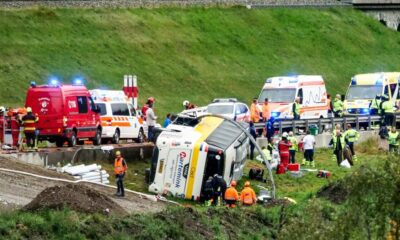
Several Killed After Dutch Tour Coach Crashes in Switzerland

Zamfara Police Honours Fallen Heroes With ₦12.15m Insurance Payout

2027: South-East Women’ll Repay Tinubu’s Gestures With Votes — Betta Edu
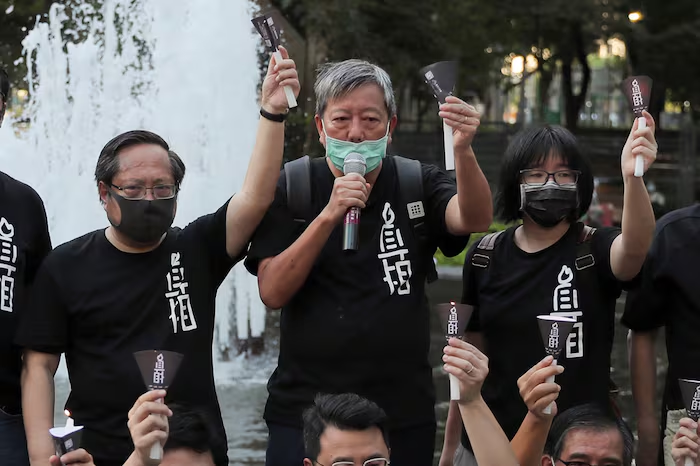
Hong Kong court sentences 3 Tiananmen vigil organizers to prison in national security case

 Headlines18 hours ago
2027 Presidency: There’ll be no new buildings or road Construction in Nigeria if I’m elected — Peter Obi
- Politics16 hours ago
2027: ‘As Commander-in-Chief, I Won’t Sit In Abuja When There Is Problem In Zamfara, Niger’ – Peter Obi
- News17 hours ago
How Folorunsho Alakija’s FAMFA Oil hid $200 Million Aircraft Fleet, faces N8.85 billion Customs Demand
- Entertainment14 hours ago
“How’s this road worthy” – Nigerians fume over state of rickety ‘Danfo’ bus carrying passengers in Lagos
- News23 hours ago
Nigeria Misses World Cup, Yet NSC Budgeted ₦6.44bn for 2026 Qualifier Support Group – Secrets Reporters Nigeria
- Entertainment16 hours ago
“I wouldn’t have married Simi if…” – Adekunle Gold opens up on tough decision he made before marriage
 News17 hours ago
Morning recap: 2027 gov campaigns begin, Army redeploys generals, Dangote, NMDPRA clash, other top stories
- News16 hours ago
Exclusive: ₦386 Billion Meant To Feed Nigeria, A Rotting Bullion Van And 77 Boxes Of Cash Nobody Checked Rocks Yemi Cardoso’s Tenure As CBN Governor – Secrets Reporters Nigeria