News
Declining headline inflation yet to ease food prices – Economist

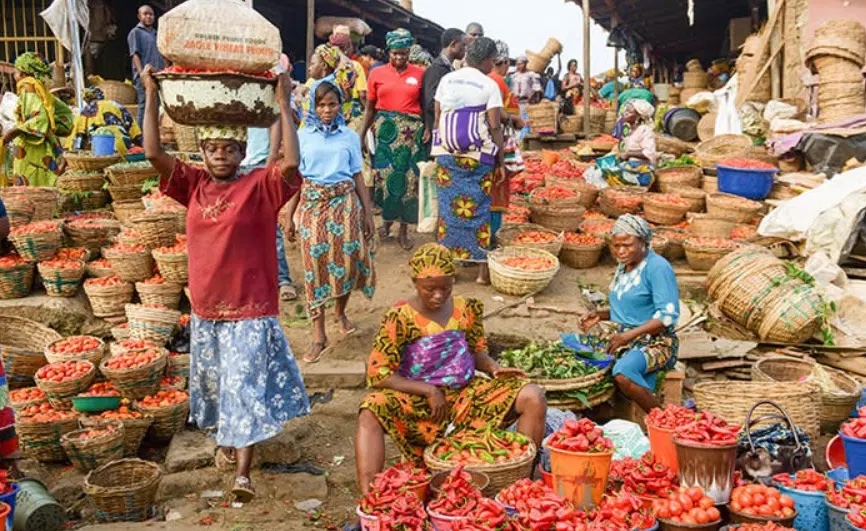
An economist, Ephraim Audu, says rising food inflation is deepening pressure on Nigerian households, in spite of the decline in headline inflation to 15.43 per cent in July.
Audu, who is also the President of Agricultural Agenda Nigeria Initiative (AANI), said this in an interview with the News Agency of Nigeria (NAN)in Abuja on Sunday.
The National Bureau of Statistics (NBS) had recently reported that headline inflation declined by 0.48 percentage points from 15.91 per cent in June to 15.43 per cent in July.
It said that core inflation, which excludes volatile agricultural produce and energy, declined to 14.97 per cent, down from 15.91 per cent.
However, food inflation rose sharply on a month-on-month basis to 5.56 per cent in July, from 3.75 per cent in June.
This is in spite of the year-on-year food inflation rate falling from 26.20 per cent in July 2025 to 20.31 per cent.
Audu said the development was particularly worrisome as prices of essential food items continued to increase.
He listed food items experiencing price increase to include rice, tomatoes, onions, pepper, garri, plantain, beef, eggs, crayfish, guinea corn, ginger and plantain flour.
He said that Adamawa recorded the highest food inflation rate at 51.36 per cent, followed by Katsina at 30.84 per cent and Zamfara at 30.65 per cent.
Audu said although headline inflation declined from 15.91 per cent to 15.43 per cent, the development had yet to translate into meaningful relief for consumers.
According to him, rising food prices continue to erode purchasing power, forcing households to spend more on basic necessities and less on healthcare, education, savings and other essential needs.
He said the trend had significant implications for poverty, food security, living standards, consumer demand, business costs and investor confidence.
Audu said that farmers were also under pressure from high input, energy and transportation costs, which could reduce their real income and discourage investment in agriculture.
He called for urgent and coordinated interventions focused on affordable agricultural finance.
He also called for intervention in mechanisation, irrigation, improved inputs, climate-resilient and regenerative agriculture, rural infrastructure, storage, processing, transportation and stronger farmer-to-market linkages.
“These measures can expand food supply, reduce production and distribution costs, strengthen smallholder farmers’ incomes and attract investment into agricultural value chains,” he said.
Audu said that failure to address the trend could allow food inflation to develop into a deeper and avoidable socioeconomic crisis.
For consumers, however, the moderation in headline inflation has yet to translate into significant relief at the market.
Mrs Mutiat Daud, a businesswoman, said the decline in headline inflation had not translated into lower food prices.
“That inflation is going down does not mean that food prices are not rising, coupled with the fact that transportation cost is increasing because of fuel prices, which has affected everything,” she said.
Daud said she recently bought five tubers of yam for N17,000 in spite of the arrival of the new yam season.
She urged the government to intensify efforts across the agricultural value chain and ensure that interventions reached their intended beneficiaries.
A public servant, Mrs Titilayo Samuel, said she had noticed slight reductions in the prices of some food items, adding that they, however, remain unaffordable for many households.
“The prices of tomatoes and tatatshe are reducing. Last month, a dustbin basket of tomatoes was going for as high as N9,000, but it is now reducing,” she said.
Samuel said prices needed to fall further and remain stable, noting that many average households are struggling to afford even two meals a day.
A civil servant, Mrs Chika Nwosu, said prices of several food items remained high, putting pressure on household budgets.
She said a mudu of beans sold for between N1,800 and N2,000, while yam remained expensive in spite of the arrival of new yam.
She, however, said that she had noticed slight reductions in the prices of some items, including okra and garri.
NAN reports that the three largest contributors to headline inflation on a year-on-year basis, according to the NBS, were food and non-alcoholic beverages at 6.18 per cent, restaurants and accommodation services at 1.99 per cent, and transport at 1.64 per cent.
The bureau attributed the month-on-month increase in food inflation to rising prices of crayfish, fresh pepper, onions, carrots, rice, water yam, tomatoes, garri, plantain, beef, eggs, guinea corn, ginger and plantain flour.
(NAN)






EPL: ‘It showed today’ – Owen Hargreaves pinpoints major issue with Man United after Hull City defeat

“The bullet struck exactly where she was sleeping” – Nigerian doctor recalls sister’s miraculous escape from death

JUST IN: Bello, They Should Ask Him What Was He Trying To Achieve Burning Cap With Symbol Of President _ Jibrin

Financial Mismanagement Rocks Federal College of Education, Yola, as SecretsReporters Uncovers ₦38.07m Worth of Financial Irregularities – Secrets Reporters Nigeria

“Tinubu Names Yari DG, Uzodimma Secretary Of 2027 APC Presidential Campaign Council” — Akpabio, Gbajabiamila, Oshiomhole Get Key Roles

“Stop Making False, Defamatory Statements About Me And My Family” — Sheggz Reportedly Serves Bella Okagbue Cease-And-Desist Notice Amid Messy Breakup

“Is This What Lagos Housing Crisis Has Become?” — Viral Video Of People Living Under Flyover Sparks Outrage, Disbelief

“I hope she won’t end up paying” – Phyna reacts to Sheggz’s legal action, asks fans to pray for Bella

How Obasanjo Considered Abandoning Second-Term Bid After South African President Got Wind Of Coup Plot – Donald Duke

“NDLEA Asks Court To Deny Bail To Three Mexicans, Seven Nigerians In ₦480bn Meth Lab Case” — Alleges Flight Risk
Troops recover body with gunshot wound in Plateau
Troops recover body with gunshot wound in Plateau

We did everything possible to save Ogogo — Yayi

EU providing Ukraine with more than $7 billion to defend against Russian missiles, drones

Who Takes All 3 Points As Fulham, Chelsea Clash In London Derby

NRC: Bogie, Wheel Defect May Have Caused Warri–Itakpe Train Derailment

Gunmen attack Rivers monarch’s palace during cultural festival

FG To Unveil $1bn Renewed Hope Social Protection…

‘It Is A Disgrace Tinubu Doesn’t Trust Anyone’ – Melaye Slams President’s Self-Appointment As Campaign Chairman

The Boat Sailed Through Despite The Troubled Waters

 News22 hours ago
Financial Mismanagement Rocks Federal College of Education, Yola, as SecretsReporters Uncovers ₦38.07m Worth of Financial Irregularities – Secrets Reporters Nigeria
- Metro24 hours ago
“Stop Making False, Defamatory Statements About Me And My Family” — Sheggz Reportedly Serves Bella Okagbue Cease-And-Desist Notice Amid Messy Breakup
- Metro24 hours ago
“Is This What Lagos Housing Crisis Has Become?” — Viral Video Of People Living Under Flyover Sparks Outrage, Disbelief
- Entertainment21 hours ago
“I hope she won’t end up paying” – Phyna reacts to Sheggz’s legal action, asks fans to pray for Bella
- Politics13 hours ago
How Obasanjo Considered Abandoning Second-Term Bid After South African President Got Wind Of Coup Plot – Donald Duke
- Metro20 hours ago
“NDLEA Asks Court To Deny Bail To Three Mexicans, Seven Nigerians In ₦480bn Meth Lab Case” — Alleges Flight Risk
- Metro24 hours ago
20-Year-Old Khalifa Aminu Builds AI Smart Glasses To Help Visually Impaired People Navigate Without Cane Or Guide
- Metro21 hours ago
“About 40 Feared Dead As Boat Carrying Farmers Capsizes In Sokoto” — Six Rescued, Search Continues For Missing Passengers