Metro
20-Year-Old Khalifa Aminu Builds AI Smart Glasses To Help Visually Impaired People Navigate Without Cane Or Guide

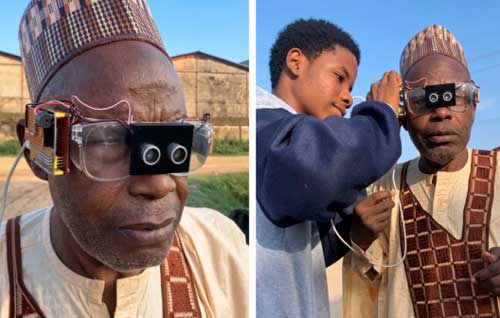
A 20-year-old Nigerian innovator, Khalifa Aminu, has developed artificial intelligence-powered smart glasses designed to assist blind and visually impaired people to navigate their surroundings with greater independence.
The device combines artificial intelligence, sensors and GPS technology to detect obstacles, provide location information and interact with users through voice commands.
According to Aminu, the glasses are designed to identify objects such as vehicles, buildings and other obstacles that could obstruct a visually impaired person’s path.
Once an obstacle is detected, the device activates an alarm and vibration system to warn the wearer, enabling the person to change direction and move towards a clearer path.
Beyond obstacle detection, the glasses are being developed to allow users to interact with AI hands-free through voice commands. Aminu said the technology can support functions such as taking photographs and videos, translating languages, navigating, reading text aloud and answering questions.
He explained that the GPS component also provides an additional safety feature for users who may become lost.
According to him, the system can determine the user’s location and transmit it to the phone of a caregiver or another designated person through WhatsApp or email.
“I created an AI Smart Glass to help blind people walk without a cane or a guide. But this is not like the smart glasses people are used to seeing,” Aminu said.
“Because this Glass combines AI, sensors, and GPS to help the user detect things in front of them, avoid obstacles, and know their location.
“But the most amazing thing is if the user gets lost, the GPS tracking system can help locate where they are from anywhere, and then send the location to the phone of the person taking care of them via WhatsApp or Email.”
Aminu said he is further developing the device by incorporating more advanced AI and voice capabilities that would allow the glasses to communicate with wearers and explain their surroundings.
“And now I am further developing it to a new level of AI + Voice, so it can speak with the user and also help them understand their surroundings,” he said.
The young innovator, who grew up in Kano, is self-taught and has developed skills across programming, electronics, artificial intelligence and robotics.
His areas of expertise include Python and C++ programming, circuit analysis, microcontrollers, Internet of Things technology, robotics, artificial intelligence and automation.
Aminu said he designed the sensory glasses using relatively affordable and locally sourced electronic components, including ultrasonic and infrared sensors.
He recently commenced real-life testing of the prototype with a visually impaired person to assess its performance outside the development environment.
“I have launched the actual test of this AI Glass that I built to help blind people and people with visual impairments,” he said in a post on X.
“I started testing it directly on the face of a person with a visual impairment to see how it would work in real life.
“And what amazed me the most is that after the blind person wore the glasses, he said that for him, it was amazing.”
Aminu subsequently shared a short clip from what he described as the first test of the device involving a visually impaired user.
He said his ambition extends beyond developing a prototype, expressing the hope that the project could attract support from technology companies and organisations capable of assisting with further development and eventual mass production.
“I’m grateful to everyone who has supported me so far. But my dream and vision go far beyond this. I want to use technology to make a real difference in people’s lives and help our society,” he said.
“I believe this project deserves to reach the world and connect with technology companies and organisations that can support us in taking it to full production.”
Aminu said his broader ambition is to use technology to develop practical solutions to real-world challenges and improve people’s lives.
The smart glasses remain a developing innovation, with Aminu continuing to test and refine their AI, navigation, sensory and voice features.


EPL: They’ll even win Champions League this season’ – Gary Neville names one player Arsenal should sign

Nigerian Government Paid $1.7 Million To Renovate São Tomé Ambassador’s House And Abandoned It – Secrets Reporters Nigeria

EPL: ‘It showed today’ – Owen Hargreaves pinpoints major issue with Man United after Hull City defeat

Money Waster: Without Clear Journey , Ex Aviation Minister Hadi Sirika Paid N219m As Touring Allowances While in Office – Secrets Reporters Nigeria

2026 JAR: Bayelsa Health Ministry Holds Joint Annual Review, Assures More Commitments On Healthcare Dev’t

OGTAN Presents Award Of Excellence To KEFFESO Trust For Human Capital Development In Host Communities

JUST IN: Bello, They Should Ask Him What Was He Trying To Achieve Burning Cap With Symbol Of President _ Jibrin

Verydarkman challenges Davido to speak up against APC in 2027

Edo Youth Tennis Championship ends on high in Benin as Sports Commission boss hails Organisers 82.ng

“What I experienced”- Man shares why he reached out to Aproko Doctor, X influencers in 2020

101-year-old great-grandma arrested for selling drugs in sachets

Transfer: Bouaddi to join Man City as Chelsea block forward from leaving club
Transfer: Bouaddi to join Man City as Chelsea block forward from leaving club

Carney warned about economic coercion. Now Trump is testing the Canadian prime minister

Primate Ayodele Warns Of Fake Polling Units During 2027 Elections

“We’re Not Talking About 100 Housing Units, We’re Talking Tens Of Thousands” — NDC’s Doherty Unveils ‘Radical’ Lagos Housing Plan

Islamist-Linked Lakurawa Suspected in Nigeria Attack That Left Dozens Dead, 100 Abducted

“APC Gives Betta Edu, Ngozi Olejeme Strategic 2027 Campaign Roles” — Former Minister’s EFCC Probe, Ex-NSITF Chair’s Trial Return To Spotlight

REVEALED: How ‘Fake’ Agency Deceived States Into Naming Coordinators

US warns Canada not to think it can win ‘devastating’ trade war

 Headlines23 hours ago
EPL: ‘It showed today’ – Owen Hargreaves pinpoints major issue with Man United after Hull City defeat
- Viral21 hours ago
JUST IN: Bello, They Should Ask Him What Was He Trying To Achieve Burning Cap With Symbol Of President _ Jibrin
- Entertainment7 hours ago
“The bullet struck exactly where she was sleeping” – Nigerian doctor recalls sister’s miraculous escape from death
- Viral22 hours ago
1. KANU’S CONVICTION UNDER FIRE: LAWYER QUESTIONS LAW USED AFTER 2022 REPEAL
- Metro19 hours ago
DSS, Other Security Forces Rescue Kidnap Victim in Imo
- News19 hours ago
Edo Govt Speaks on Claim Davido Was Barred From Entering State
- Metro20 hours ago
2027: Winning Your State for Tinubu More Important Than Becoming Campaign DG – Wike
- Metro20 hours ago
ECOWAS Mission In Guinea-Bissau Holds 5km Route March To Boost Fitness, Teamwork