News
Water should be part of national security – Minister

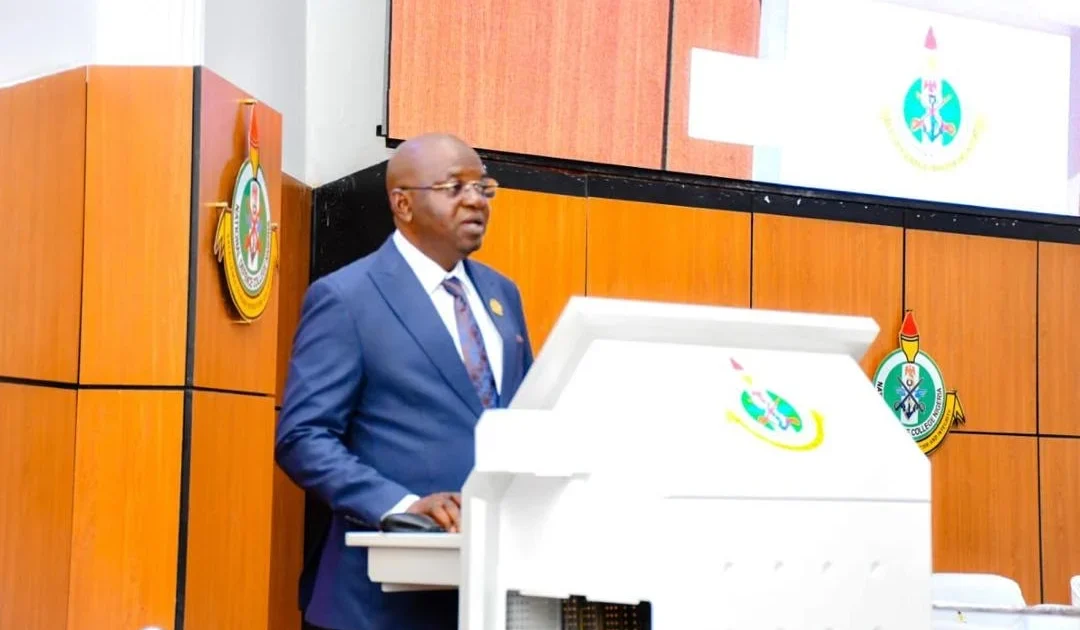
The Minister of Water Resources and Sanitation, Prof. Joseph Utsev, has called for water security to be accorded national security status, warning that flooding, drought, water insecurity and poor sanitation could trigger conflicts, displacement, public health emergencies and economic instability.
Utsev made the call on Monday while delivering a lecture titled “Water Resources Management and Sanitation as Catalysts for Sustainable National Development and Security in Nigeria” at the National Defence College, Abuja.
The minister said Nigeria could no longer afford to treat water merely as a development issue, stressing that the availability and sustainable management of water resources had direct implications for national security, food production, public health, livelihoods and economic stability.
“Water security is national security,” Utsev said, calling for its integration into Nigeria’s national security architecture.
He warned that water insecurity, unsafe water, inadequate sanitation, flooding, drought and climate variability could trigger public health emergencies and displacement, intensify competition among water users, undermine livelihoods and increase communities’ vulnerability to climate-related shocks.
The minister disclosed that the 2026 Annual Flood Outlook identified 1,249 communities in 176 Local Government Areas across 30 states and the Federal Capital Territory as high flood-risk areas.
He said the scale of the risk underscored the need for stronger preparedness, climate-resilient infrastructure and better coordination among government institutions responsible for water, agriculture, health, environment and security.
Utsev also linked water management to Nigeria’s food security efforts, saying irrigation development was critical to reducing the country’s dependence on increasingly unpredictable rainfall patterns.
He disclosed that approximately 154,000 hectares of irrigable land were currently benefiting more than 1.6 million farmers, adding that efforts were ongoing to expand irrigation coverage.
“Irrigation development is critical to reducing Nigeria’s dependence on increasingly unpredictable rainfall patterns,” the minister said.
He also highlighted the roles of the River Basin Development Authorities in irrigation, agriculture, fisheries, rural water supply, flood control, job creation, agro-processing and rural economic development.
According to him, strengthening these institutions would help Nigeria harness its water resources for agricultural production while addressing some of the socioeconomic pressures associated with water insecurity.
The minister further disclosed that the Ministry of Water Resources and Sanitation was developing a National Water Compact for 2026–2030, aimed at harmonising Nigeria’s water and sanitation policies and interventions.
He said the Compact would be built around three strategic pillars: Water for People, Water for Food and Water for the Planet.
Utsev explained that the first pillar would focus on safe water and sanitation, the second on irrigation and food security, and the third on climate resilience and sustainable water-resource management.
He said the Compact was being developed through a whole-of-government and multi-stakeholder approach involving the Federal and state governments, security agencies, River Basin Development Authorities, traditional and religious institutions, the private sector, development partners, civil society organisations and communities.
The minister said stronger coordination was necessary because water-related challenges cut across multiple sectors and could have consequences for security and development.
He also stressed the importance of water diplomacy and transboundary cooperation, noting that Nigeria shares major water resources with neighbouring countries.
According to him, stronger regional collaboration would be necessary to promote stability, economic growth and sustainable management of shared water resources.
Utsev identified five strategic priorities for strengthening Nigeria’s water security: integrating water security into national security planning; strengthening whole-of-government coordination; increasing strategic investment and sustainable financing; building climate resilience and national water intelligence; and developing the capacity of women and youths.
He said, “The resilience of the systems that sustain the people is fundamental to national security.”
The minister added that protecting water resources, expanding access to safe water and sanitation, strengthening irrigation and improving preparedness for floods and droughts were essential to securing Nigeria’s future.
His position comes against the backdrop of recurrent flooding and growing climate-related pressures on communities and agricultural production across the country. Flooding has repeatedly displaced communities, damaged infrastructure and disrupted livelihoods, while water shortages and drought continue to pose challenges in parts of Nigeria.
The government has increasingly linked water-resource management with food security, particularly through irrigation and the development of infrastructure that can support agricultural production beyond the rainy season.
Responding to the lecture, the Commandant of the National Defence College, Rear Admiral Abdullahi Ahmed, commended Utsev, saying the presentation demonstrated that water security remained central to national security.
Ahmed identified flooding, drought and resource-based conflicts as major security concerns and called for greater utilisation of Nigeria’s freshwater resources and stronger international cooperation in managing shared water systems.
The lecture was attended by the faculty of the National Defence College.
Utsev was accompanied by the Director overseeing the Office of the Permanent Secretary, Engr. Dallah Ali Ibrahim; Director of Water Supply and Support Services, Babarinde Segun Mukaila; and Director of Water Quality Control and Sanitation, Habu Jemilu.





Kano APC rally: Ahmed Bala hails TSG, Faleke, says four years not enough to consolidate Tinubu’s reforms

EPL: ‘No longer sharp, quick’ – Carragher names who to blame for Arsenal’s first goal against Chelsea

’15 Northern States Will Collapse Within Three Months’ – Ogunyemi Hits Atiku Over Subsidy Return Promise

“He married three wives so they wouldn’t conspire against him” – Pete Edochie shares uncle’s unusual strategy

“I feel like my life is under threat” – Sarah Martins calls out dispatch rider she once helped over alleged harassment

Fed Min Of Industry, Trade & Investment Records N3.07bn in Questioned Transactions as Funds Are Misapplied, Payments Bypass Controls – Secrets Reporters Nigeria

“If Peter Obi becomes President, insecurity will become a thing of the past” – Ex-military officer declares

Exclusive: No National Population Census Since 2006, Yet Agency Chairman Nasir Isa Kwarra Said He Spent ₦240 Billion To Count Nigerians – Secrets Reporters Nigeria

“My Grade Was Better Than My Friend’s, But He Got Opoku Ware” — JHS Graduate In Tears After Being Placed In 6th Choice School Despite Her Good Grades

“Even if you have been with fifty, it’s two” – Lady advises women on ‘lies’ to tell men who want to marry them

Samsung Galaxy Z Fold8 Ultra and Galaxy Z Fold8 Now Available

Black boxes recovered from Amazon cargo plane crash in Miami

New NSCDC commandant takes over in Osun

Iran says improved ballistic missile shows it will take preemptive action against threats

TECNO won 2 Global Product Technology Innovation Awards at IFA 2026

Trump's memes taunting Mexico, Canada draw backlash from leaders

NNPC commends NDLEA over N2bn cannabis bust, disowns truck

UK’s Burnham risks Trump anger with new sanctions on Israel

Evening recap: FG to give Nigerian shipowners $25m, Drivers, cooks, traders can own refinery shares, other top stories

Iran increases gasoline price for its heaviest consumers as economy struggles

 Headlines18 hours ago
EPL: ‘No longer sharp, quick’ – Carragher names who to blame for Arsenal’s first goal against Chelsea
- Politics11 hours ago
2027: If You Had The Guts To Challenge Sitting President, Why Didn’t You Come Out? – Sambo Fires Datti
- News11 hours ago
Paper Promises vs. Real Pulses: Why Nigeria’s Hypertension Crisis Demands Cash-Backing, Not Just Budget Speech-Making – Professor Emmanuel Alhassan and LISDEL
- News21 hours ago
How Ahmed Bolaji Nagode’s Led NAPTIN Swallowed ₦2.77 Billion in Public Fees That Never Reached Nigeria’s Treasury – Secrets Reporters Nigeria
- News23 hours ago
Exclusive: Nigeria’s Longest-Serving Lawmaker Nicholas Mutu Buys N1.4 Billion Buckhead, Atlanta House After 27 Unbroken Years in Nigeria’s House of Representatives – Secrets Reporters Nigeria
- News11 hours ago
Stolen funds? ₦76 Billion Paid Out To Non Existing Poor Nigerians By Bola Tinubu Government Through Nigeria’s Cash Transfer Programme – Secrets Reporters Nigeria
- Entertainment15 hours ago
“The lady fell from her seat and started crying” — Man recounts dramatic moment after ₦5 million donation in church
- News18 hours ago
RCICA Lagos: ₦303 Million Assets Uninsured, ₦7.7m Payments Tied to Regulatory Breaches Under the Leadership Of Wilfred Ikatari – Secrets Reporters Nigeria