World
Israeli settlers divert Palestinian water to fill West Bank pool

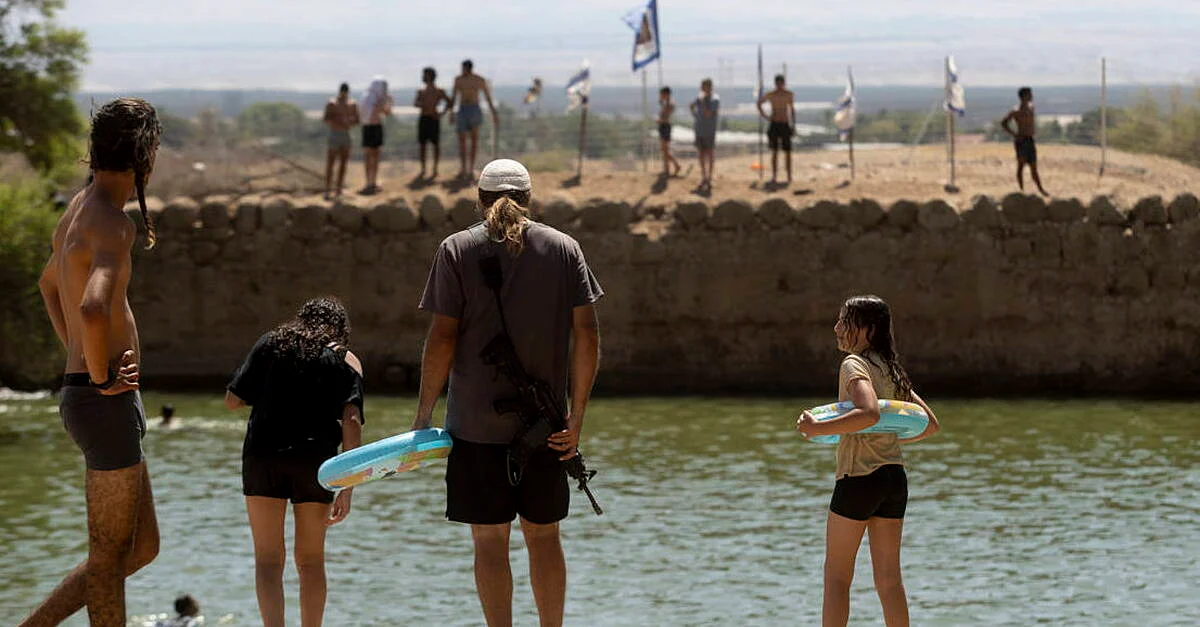
On a searing summer day, Israeli settlers splashed in a West Bank pool created by syphoning off water that had irrigated Palestinian crops, one of many seizures of water resources across the occupied territory.
The spring served as a lifeline for the nearby village of Fasayil in the fertile Jordan Valley, where Palestinians have relied on it for generations for food, employment and to supplement irregular Israeli supplies to their domestic taps.
“Our water supply remains cut off to this day, depriving us of the water we depend on for our homes, our livelihoods, and our agricultural land,” said Saad Nemer, who farms the land.
Israeli settlers seized his irrigation pipeline in June, channelling the water to an ancient pool in an archaeological site. Soon after, settlers advertised it as an Israeli tourist attraction, and Israel’s far-right finance minister pledged financial support.
“They are now in the process of developing a recreational park around the pool,” Nemer said.
The seizure of the spring at Fasayil is part of a pattern that Palestinians say is designed to make their lives in the West Bank untenable. Israeli settlers have attacked at least 160 water and sanitation sites across the Palestinian territory this year, United Nations data shows.
Nemer’s greenhouses and fields would normally be full of eggplant, zucchini and watermelons, but without water he has not been able to plant in the scorched land.
“The settlers cutting off our water has caused us losses and has meant that many families will lose their work and their livelihoods,” he said.
Nemer said that an employee had been beaten up by settlers and he himself had faced threats for attempting to approach the spring as far back as two years ago.
Yishai Shreiber, 21, an Israeli settler who had come to swim in the pool near Fasayil on an August afternoon, said Palestinians would not now dare approach.
“Now that they see this entire mass of people, all these large groups of Jews coming here to bathe, they are afraid to come here,” said Shreiber.
Shreiber said the West Bank belonged to the Jewish people, and that if Palestinians don’t want to accept Jewish authority, they should leave.
Nemer showed Reuters a 2025 land ownership document from COGAT, the Israeli military agency which enforces civilian policy in the occupied territories. He also presented a map drawn for the pre-occupation 1957 registration of his title deeds, showing that his land included both the spring and the pool. COGAT and Finance Minister Bezalel Smotrich did not respond to requests for comment.
Israel’s far-right coalition government has overseen massive settlement construction that Smotrich says is aimed at burying the idea of a Palestinian state, which has been recognised by more than 150 of 193 UN member states as encompassing the Gaza Strip and West Bank, including East Jerusalem.
The United Nations and most governments consider the settlements to be illegal under international law related to military occupation. Israel seized the West Bank in the 1967 war, but argues the territory is disputed rather than occupied.
Palestinians have experienced a sharp rise in settler violence, and Palestinian field researcher Fares Foqahaa estimated that settlers had now seized control of 95% of springs in the northern Jordan Valley, displacing communities.
In another West Bank village, Qusra, settlers still besieging three homes on Thursday had also cut off their water and electricity.
Adel Yassin, an official with the Palestinian Authority’s water authority, said that settlers target water resources as part of a systematic campaign to force Palestinians off their land.
“I see this as a water war. It is the silent bullet that kills Palestinians without a sound,” he said, referring to the process of making their livelihoods unsustainable.
In early June, Eliav Libi, a settler leader targeted with sanctions by Canada and other countries, posted a video showing the pool beginning to fill with water.
He and other settlers say the pool belonged to the biblical-era Jewish king Herod. An archaeologist with the Israeli rights group Emek Shaveh, Alon Arad, said the pool’s provenance is unclear. – Reuters


‘Dapper, your cup don finally full’ – Singer T.I Blaze questions music executive over N1.2bn royalties

Kidnapped Christian Worshipers in Southern Nigeria Describe Weeklong Torture by Fulani Terrorist Gang

Akwa Ibom Governor Commits To Operation Of Maintenance Facility At Victor Attah Airport, Expansion Of Ibom Air

Izeze Remains High-Spirited, Pays Fines for Inmates at Warri Custodial Centre – Secrets Reporters Nigeria

Adekunle Adebiyi: Abuja Move ‘One of Our Best Decisions’ As Squash In Diaspora Tournament Hits Semifinals

EXCLUSIVE: SecretsReporters Uncover Unaccounted ₦75m Cash Advance in Hannatu Musa Musawa’s Ministry – Secrets Reporters Nigeria

“If they ask for money, call IGP” – Police officer warns Nigerians against paying for bail, shares complaint numbers

NNPC Spends ₦393.45m on Three-Years Office Rent for NNPC Board Accommodation Under the Leadership of Bala Wunti in NAPIMS – Secrets Reporters Nigeria

“I returned your ₦5m birthday money” – Diadem calls out Dabota Lawson, alleges she uses bloggers to attack people

“You charged me ₦7m, but quoted ₦5m for someone else” – Man calls out friend over solar deal betrayal

Euro 2020 winner Ciro Immobile retires at 36

While Government Offices Get Millions for Generators, Communities in Bauchi Still Search for Water – Secrets Reporters Nigeria

“Officer Attempting To Ease Himself Accidentally Discharged Tear Gas At Modakeke RAC” — Police Deny Plot To Disrupt Osun Election

Osun 2026: ADC’s Salaam Alleges Agents Blocked From Polling Units in 10 LGs

My ancestry search ended in Lagos royal family — US-born Nigerian, Olomo

PHOTOS: Peter Obi Urges FG to Tackle Insecurity During Benue Visit
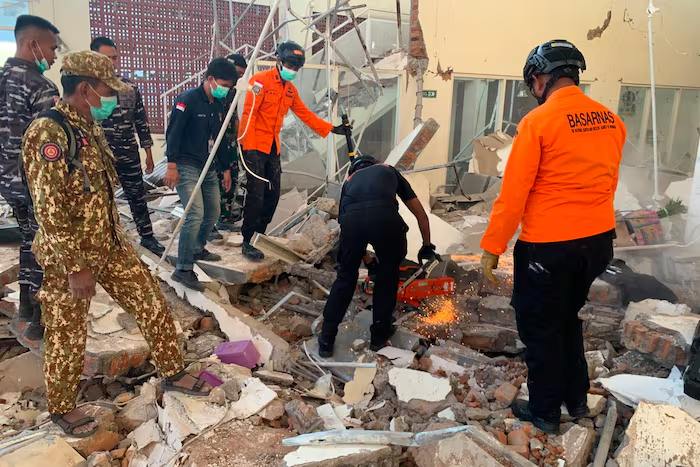
Magnitude 7.7 earthquake strikes off Indonesia's coast, killing at least 47 and toppling buildings

“INEC Restores Three Delta, One Kogi Assembly Constituencies Following Court Judgments” — Directs Parties To Conduct Primaries

How Much APC, Accord Allegedly Paid Voters in Osun Election Emerges

Osun Decides: ‘Adeleke Fighting For His Political Life’ — Shehu Sani

 Headlines24 hours ago
‘Dapper, your cup don finally full’ – Singer T.I Blaze questions music executive over N1.2bn royalties
- Politics22 hours ago
Kidnapped Christian Worshipers in Southern Nigeria Describe Weeklong Torture by Fulani Terrorist Gang
- Politics21 hours ago
Akwa Ibom Governor Commits To Operation Of Maintenance Facility At Victor Attah Airport, Expansion Of Ibom Air
- Politics20 hours ago
Adekunle Adebiyi: Abuja Move ‘One of Our Best Decisions’ As Squash In Diaspora Tournament Hits Semifinals
- Entertainment23 hours ago
“I don’t want their money”- Peller shares why he intends to collaborate with Dangote, Femi Otedola and Bill Gates
- Entertainment23 hours ago
“Peter Obi was already ahead of us in Class Three” – Former classmate opens up on his early school hustle
- Entertainment19 hours ago
“You broke up with girl because she farted” – Matchmaker blasts 47-year-old man over failed relationship
- Entertainment19 hours ago
“If you would have been patient”- Moment Peller screams during visit to man’s residence after pleading for G-Wagon