World
Eight killed and hundreds missing after avalanche triggers flash floods in Nepal

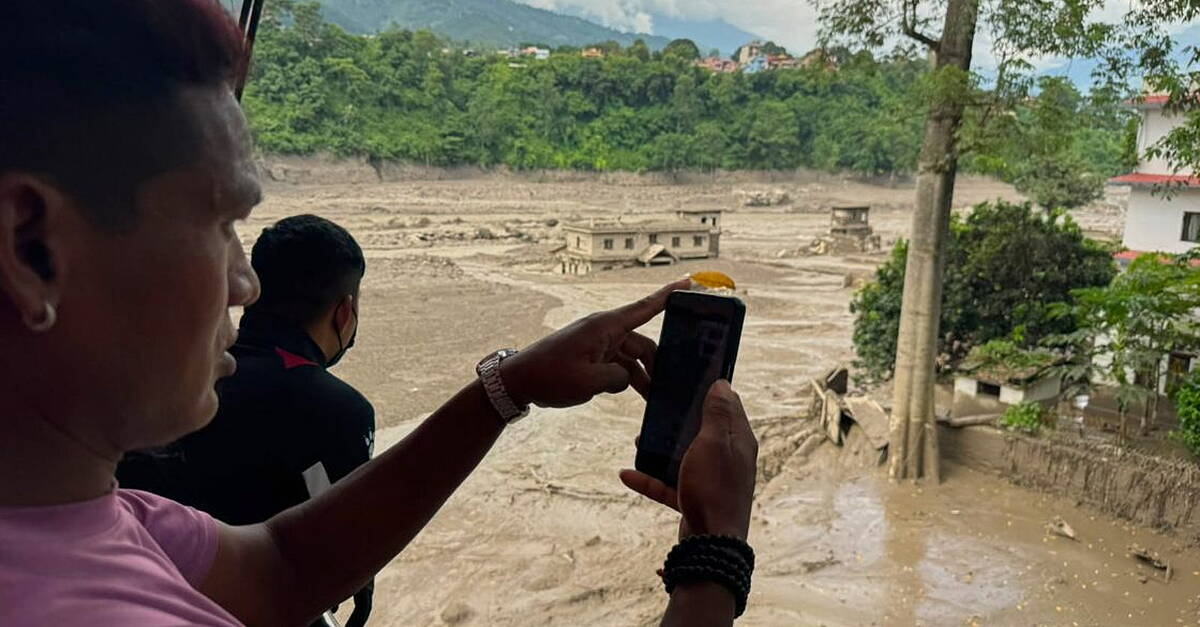
Hundreds of people were reported missing after an avalanche of ice and rock triggered massive flash floods that swept through parts of Nepal, killing at least eight people and causing widespread damage to villages and infrastructure.
Officials said 384 tourists, including 291 from countries including the UK, the US, India and Malaysia were reported missing as a result of the flash flood.
The Bhotekoshi River flooded at around 9am on Wednesday, destroying several villages as well as roads and hydropower projects, officials said.
They issued warnings to residents of several of Nepal’s districts and asked them to stay away from the banks of Bhotekoshi, Trishuli and Narayani rivers.
“We have asked both India and China to help us with the rescue efforts,” said Sasmit Pokharel, a spokesman for the Nepali government.
The worst affected area, Rasuwa district, witnessed similar flash floods to those in August last year, when a glacial lake in neighbouring Tibet overflowed as a result of high temperatures in the mountain region.

Nine people lost their lives and critical infrastructure including a bridge connecting the two countries were damaged at the time.
Climate experts at the Kathmandu-based International Centre for Integrated Mountain Development say an avalanche from a glacier likely caused Wednesday’s flash flood.
The Lhende Khola River, a tributary of the Bhotekoshi River, witnessed maximum flooding on Wednesday, they said.

“The Lhende Khola has flooded twice in 14 months, this time triggered by an ice rock avalanche from a glacier on the Nepal side that blocked the river and released a sudden surge downstream,” said Saswata Sanyal, a disaster risk reduction specialist at the climate research group.
“In a warming Himalaya, early warning is the first line of adaptation,” he added.
The Himalayan region, which crosses Nepal and several nearby countries including India, is especially vulnerable to heavy rains, floods and landslides because the area is warming up faster than the rest of the world because of human-caused climate change.

Research has shown that extreme weather events including heat waves, heavy rains and melting glaciers have become more frequent in the region.
Researchers at the Kathmandu research group found earlier this year that glaciers across the Hindu Kush Himalaya region are melting at an accelerating rate, with ice loss rates doubling since 2000 primarily over rising global temperatures and climate change.


“A governor once gave Wizkid a bag full of dollars” – Kizz Daniel’s bouncer reveals what singer allegedly did next

‘It Is A Disgrace Tinubu Doesn’t Trust Anyone’ – Melaye Slams President’s Self-Appointment As Campaign Chairman

“I spent months praying for God to take my husband’s money away” — Woman opens up on painful marriage

Economic Impact of Extracted Precious Metals from Electronic Waste in South Western, Nigeria; Review of Extraction Methods

BAECC Reaffirms Commitment to the Timely Delivery of the Benin-Asaba Expressway Project Following Recent Protest

₦394.86m Financial Irregularities: Nigeria’s Bata Consulate Paid Unapproved Subsidy, Retained Public Funds – Secrets Reporters Nigeria

23 years of operation: Globacom as the architecture of value and the audacity to never settle for less

Ogun community raises alarm over alleged destruction of farmlands by land grabbers, begs Gov Abiodun to intervene

‘He didn’t speak on my authority’ – Atiku counters aide, insists on total restoration of fuel subsidy

Evening recap: Falana faults NBA over George Weah invitation, Poco Lee’s management clears drink-spiking claims, other top stories

German Embassy Warns Nigerians Against Visa Agents

From Shearer to Fernandes: Every Premier League Player of the Season winner

“This is when he needs us the most” — Man rallies support for Poco Lee amid controversy

Senator Binani Under Fire – The Trumpet Newspaper Nigeria

Tragedy in Benue as four siblings die after consuming soft drink from relative

FULL LIST: Top 10 EPL managers of all time

Trump’s immigration crackdown: Wife of US Army sergeant deported to Honduras

Most marriages collapse from unrealistic expectations – Islamic scholars

Poco Lee’s Management Urges Restraint Over Rape Allegations

I asked Amaechi to apologise after NBA clash — Sowore

 News23 hours ago
BAECC Reaffirms Commitment to the Timely Delivery of the Benin-Asaba Expressway Project Following Recent Protest
- Headlines18 hours ago
Ogun community raises alarm over alleged destruction of farmlands by land grabbers, begs Gov Abiodun to intervene
- Headlines15 hours ago
‘He didn’t speak on my authority’ – Atiku counters aide, insists on total restoration of fuel subsidy
- News13 hours ago
Evening recap: Falana faults NBA over George Weah invitation, Poco Lee’s management clears drink-spiking claims, other top stories
- Politics17 hours ago
Fuel Subsidy: They Don’t Have Patience To Study What Atiku Is Proposing – Ologbondiyan Knocks Tinubu’s Govt
- News10 hours ago
Exclusive: NFIU Places Tinubu’s Campaign DG Abdulaziz Yari Under Secret Investigation For Laundering $500,200 Through New Bank Account In 7 Days – Secrets Reporters Nigeria
- Viral23 hours ago
“And this guy collected my 1k” — Man discovers ‘young boy’ he gave transport money was actually the groom
- Viral22 hours ago
“Something no clear here” — Lady recounts how friend ended relationship with millionaire ex after strange setbacks