World
The future of Britain's renowned Lovell radio telescope is in question after a funding cut

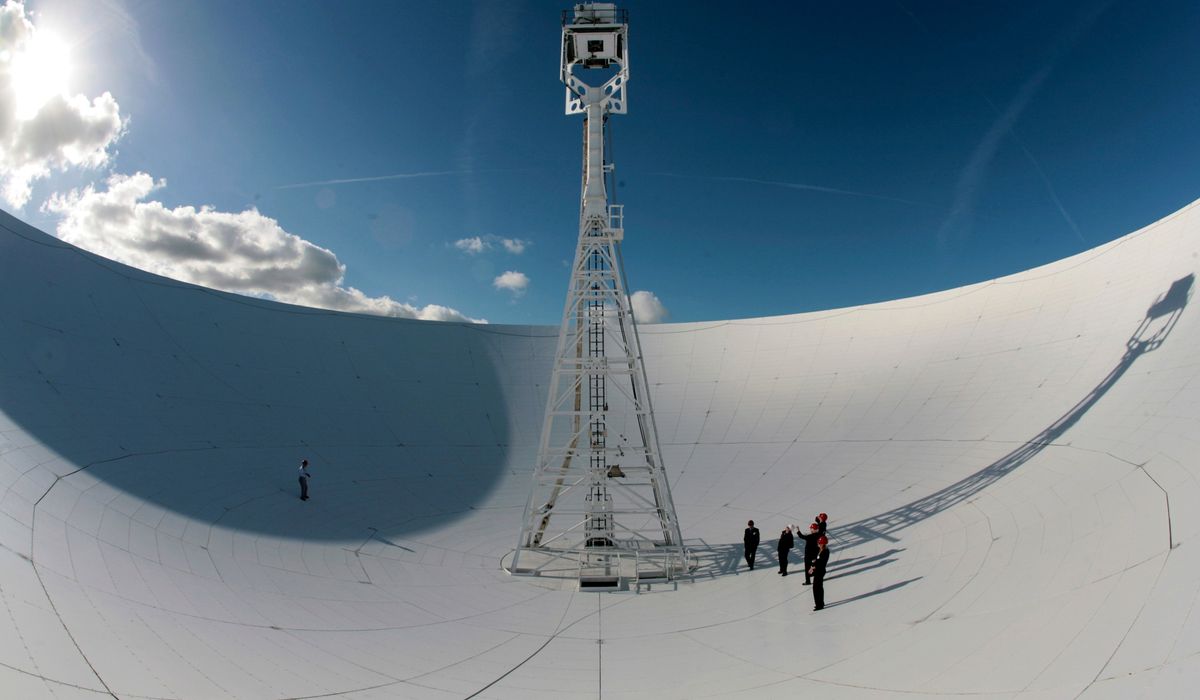
LONDON — Scientists have reacted with alarm to news that the British government will cut funding to the world-famous radio telescope at the Jodrell Bank Observatory, a UNESCO World Heritage Site in northwest England that has been helping explore the cosmos for almost 70 years.
Government funding body U.K. Research and Innovation announced Monday that it will no longer fund the Lovell telescope, whose 250-foot-wide (76-meter-wide) parabolic reflecting bowl is a local landmark. It’s part of a network of seven radio telescopes across the country known as e-Merlin connected to the Jodrell Bank astrophysics center south of Manchester.
UKRI said the telescope array will not receive public funding after March 2028, following “a rigorous prioritization process to focus investment on the areas that will deliver the greatest long-term scientific capability, impact and value for the U.K.”
University of Manchester particle physicist Brian Cox called the cuts “devastating and irreversible.”
Paul Howarth, president of the Institute of Physics, said recent cuts to physics funding, including at Jodrell Bank, were “a terrible blow to the scientific community,” and urged new Prime Minister Andy Burnham to reconsider.
“For the sake of U.K. physics and our national reputation as a place to do science, conduct research and innovate, we would urge the new government to review this ruinous set of decisions,” he said.
The University of Manchester, which runs e-Merlin, said it was seeking other sources of funds from business, government or charities.
“But, if we don’t find those alternative sources of funding, then there is a risk that as of the end of March 2028, the Lovell Telescope will not be an actively functioning scientific facility for radio astronomy,” said Sarah Sharples, the university’s dean of science and engineering.
Completed in 1957, the Lovell telescope has played a major role in the history of radio astronomy, which studies distant space objects through the radio waves they emit. It tracked the progress of Sputnik when the Soviet Union launched Earth’s first artificial satellite in 1957, received the first images from the moon’s surface in 1966 and has helped scientists discover distant galaxies and study black holes, quasars, pulsars and gravitational lenses.
It also served as an early-warning system for Soviet missiles during the Cold War.
Jodrell Bank’s engagement center, open to the public and visited by generations of British schoolchildren, is not affected by the cuts.


Obi Is A Trader, Traders Have Short-term Calculation, They’re Not Into Longterm Projection-Oshiomhole

I retired as an Asst. Director, equal to a Brigadier, while Al-Mustapha retired as a Major—Dennis Amachree

Why Didn’t He Ask Those Probing Questions Like Seun Okinbaloye?–Olayinka Tackles Rufai Oseni Over Peter Obi’s TV Interview

They Set Labour Party On Fire To Burn Me, Now They Have Carried Same Fire To NDC – Peter Obi Slams APC

“Nkwasiafoɔ, Who Will Play The Instruments?” — Nana Agradaa Sacks Instrumentalists After Mass Altar Call For Travel Prayers

“We Have Done Everything Possible for Peace, But Adwoa Safo Wants GH¢3.7 Million Before Releasing Our Father’s Body” — Nana Kwadwo Safo Akofena

Three Women, Including Pregnant Victim, Injured in Paris Stabbing; Suspect Allegedly Made Chilling Claim

AEDC Rewards 1,126 Employees with Promotions and Step Increments in Landmark Investment in Talent and Career Growth

“I want to relocate to Nigeria; I hear the economy is booming” — Moroccan businessman tells Reno Omokri

“This Place Is Like Our Home” — Galamseyer Videos Deep Underground Pit Where They Stay For More Than Three Months In Search Of Gold

Chad announces intent to withdraw from the International Criminal Court, drawing praise from U.S.

Britain to resume military training in Kenya after delay over human rights concerns

Drivers endure overnight gas lines as a war-driven fuel shortage grips Iraq's Kurdish region

Miss World Nigeria Seeks NYSC Partnership To Boost Youth Skills

Ghana Star Mohammed Fuseini Attacked in Violent Daylight Robbery in Brussels

Bayelsa Takes Lead As FG Begins Distribution Of LPG Cylinders

ADSU Bans Sign-Out, Marker Celebrations Before Graduation

The future of Britain's renowned Lovell radio telescope is in question after a funding cut

‘Any police officer found wanting will face disciplinary action’ – Yobe CP

Hopeson Adorye Urges Ghanaians to Criticise Leaders Without Insults & Threats

 Headlines23 hours ago
Obi Is A Trader, Traders Have Short-term Calculation, They’re Not Into Longterm Projection-Oshiomhole
- Headlines24 hours ago
I retired as an Asst. Director, equal to a Brigadier, while Al-Mustapha retired as a Major—Dennis Amachree
- Headlines24 hours ago
Why Didn’t He Ask Those Probing Questions Like Seun Okinbaloye?–Olayinka Tackles Rufai Oseni Over Peter Obi’s TV Interview
- Special Report11 hours ago
Kennedy Agyapong Adds Another Empire — Kennedy Agyapong Acquires Platinum Plastics In Major Industrial Move
- Special Report14 hours ago
Church Or Circus? Viral Video Of Pastor Performing Strange ‘Rituals And Deliverance’ On Members Sparks Uproar
- Special Report10 hours ago
“Please Don’t Attend!” — Kantanka Family Disowns Adwoa Safo’s July 30 Burial, Warns Public To Stay Away
- Special Report14 hours ago
“Buy My Snacks, Not My Number!” — Beautiful Hawker Cries Out Over Customers Who Only Want To ‘Eat’ Her
- Viral12 hours ago
We Have Reached Our Breaking Point ; Bayelsa Leader Calls on Tinubu to Decentralize Pipeline Surveillance