News
Nigeria’s mounting debt, insecurity worsen hardship — Anglican Primate

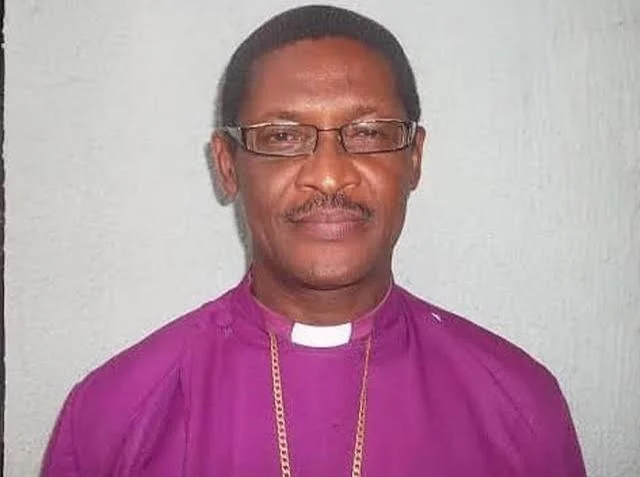
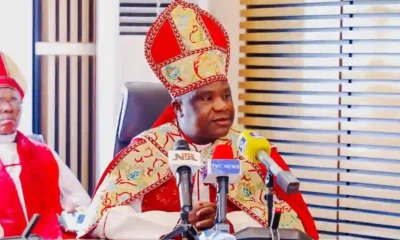
The Primate of the Church of Nigeria (Anglican Communion), Archbishop Henry Ndukuba, has raised concerns over Nigeria’s rising debt burden, insecurity, corruption and drug trafficking, asserting that the country’s economic gains have yet to translate into tangible relief for millions of Nigerians.
Ndukuba spoke on Wednesday at the opening of the 15th General Synod of the Church of Nigeria (Anglican Communion), held at Our Saviour’s Anglican Church, Ikenne Remo, Ogun State.
The Primate, while acknowledging improvements in some macroeconomic indicators under President Bola Tinubu, said that the country’s economic recovery must be measured by its impact on ordinary households.
He said, “The naira is at its two-year high. Our external reserves have hit an 18-year peak. Growth is accelerating, and inflation, while still elevated, is trending down again after the mid-year wobble.
“However, with over 100 million Nigerians still living in multidimensional poverty, these gains have yet to translate into tangible relief.
“The core question is no longer whether the macro numbers are improving, but whether that improvement is actually reaching the ordinary households and changing the lives of our people.”
Ndukuba cited Nigeria’s public debt as a major concern, saying the country’s total public debt stock stood at about N159.28tn as of March 2026.
He said it was baffling that domestic debt servicing reached about N3.14tn in the first quarter of 2026, representing an increase of about 20.3 per cent year-on-year.
According to him, the situation had become worrisome because more than half of the nation’s revenue was being committed to debt servicing, thereby limiting funds available for capital expenditure.
He said, “But what is more troubling is our public debt. It has come out clearly that Nigeria’s total public debt stock stands at about N159.28tn as at the end of March 2026. Debt servicing costs are rising fast. Our domestic debt service alone hit about N3.14tn in the first quarter of 2026, an increase of about 20.3 per cent year-on-year.
“This is a situation in which over 50 per cent of our revenue goes to creditors. This worsens our vulnerability, as capital expenditures, which should have been key to our economic growth, are constrained.
“Debt itself is not the problem. The prosperous nations of the developed world grow by borrowing to invest in assets that expand their revenue base.”
He, however, said the problem was that Nigeria was borrowing to fund consumption more than productive investments.
“For Nigeria, the key issue is the purpose of borrowing. Borrowing to fund consumption deepens our debt burdens. When what we borrow is also stolen by individuals, this creates a lot of problems for us. And since what is stolen is not invested in productive ventures, we impoverish our citizens.
“It is clear that even what is being borrowed cannot be repaid by our grandchildren. It is necessary that our leaders pay attention.
“Borrowing to fund productivity or productive investment can spur growth. Fiscal discipline and timely capital budget releases remain essential.”
The Primate also faulted the implementation of budgetary allocations in the country, saying that a situation where the nation has not even implemented the 2025 budget, yet has passed the 2026 budget while that of 2027 is already approaching, does not augur well for the growth and economic stability of the country.
He said, “Though there is increased crude oil production, unfortunately, brothers and sisters, let me tell you that we have already sold into the future. Even if there is a windfall, Nigeria cannot reap it because what we would have sold by this year was sold five years ago. So how can we progress?
“And this is not a problem that started today, or in this—in the regime of our present administration. Looking at the economic indices, we will say that policymakers always tell us or point us to 2023 reforms: subsidy removal, foreign exchange unification, and monetary tightening.
“And these may have brought some dividends. There is some fruit, and indeed, when we look at the macro data, we can see some improvements.
“The central challenge heading into the final months of 2026 remains closing the gap between macroeconomic stability and indeed the welfare of households, of ordinary Nigerians.”
On insecurity, the Anglican leader commended President Bola Tinubu, the armed forces, police and other security agencies for their efforts but called for a continuous review of strategies to tackle terrorism, banditry and other forms of criminality.
He expressed particular concern over attacks on Christian communities in parts of Northern Nigeria and other parts of the country.
The Primate identified corruption, hard drug trafficking and abuse, as well as cultism and gang violence, as major threats to Nigeria’s development.
He described corruption as endemic across various sectors of society, including the church, warning that it was depriving young Nigerians of employment and economic opportunities.
Ndukuba backed the establishment of state police, describing the move as a step in the right direction, but called for constitutional safeguards to prevent abuse by state governors. He cautioned that state police should not become a tool for political victimisation.
With the 2027 general elections approaching, Ndukuba urged Nigerians, particularly Christians, to participate actively in the electoral process and reject political thuggery.
Ndukuba also rejected the notion that Christians should stay away from politics, urging them to participate in governance and the electoral process.
He criticised what he described as increasing political defections and manoeuvring by politicians, saying the political class appeared more focused on survival than service to the people.
He warned young Nigerians against allowing themselves to be recruited by politicians to perpetrate violence.
He also called for greater autonomy for local governments, advocating the direct release of allocations to local councils and improved monitoring of their utilisation.
The Primate further urged the Independent National Electoral Commission to take over the conduct of local government elections, arguing that doing so would strengthen accountability at the grassroots.
Speaking, the Ogun State Governor, Dapo Abiodun, urged the Church in Nigeria to mobilise its members for responsible citizenship and peaceful participation in the 2027 general elections.
Abiodun said that the church should use its influence to discourage provocation, intimidation, misinformation, electoral malpractice and violence before, during and after the elections.
He said elections should be a contest of ideas and programmes rather than a platform for Nigerians to turn against one another.
“As we approach the forthcoming 2027 general elections, I enjoin the church to promote responsible citizenship and peaceful participation.
“Encourage your members to perform their civic responsibilities conscientiously and reject provocation, intimidation, misinformation, electoral malpractices, and violence.
“Elections should be a contest of ideas, visions, and programmes—not a battlefield upon which brothers and sisters turn against one another. Political differences are temporary, but the bonds that unite us are enduring,” Abiodun said.
The governor also called on the church to continue to serve as a voice of truth, peace and reconciliation, urging religious leaders to provide constructive counsel to government while maintaining their independence.
Abiodun urged the church to pay particular attention to young people, saying they needed mentors, opportunities and communities that would reinforce positive values.
The governor further called for stronger collaboration among government, religious organisations, traditional institutions, the private sector, civil society and citizens, saying sustainable development could not be achieved by the government alone.
Abiodun said the 15th General Synod, which has the theme, “The Priesthood of All Believers: Equipping God’s People for the Work of the Ministry,” was an opportunity for the church to renew its commitment to God and its responsibility to society.
The governor congratulated the Anglican Diocese of Remo, led by the Bishop of Remo and Archbishop of the Ecclesiastical Province of Lagos, Michael Fape, for hosting the synod.
In his welcome address, Fape appreciated members of the diocese for their support towards ensuring the success of the first-ever general synod to be held in Ogun State in the last 42 years.
Fape urged the participants at the synod and, by extension, the church of God to remain committed to impacting the communities around them even as they continued to be full of good works, doing the work of evangelism, giving hope to the people and radiating the glory and beauty of the love of God.


‘Enough of condolence messages; do something or step aside’ — Plateau residents blast Mutfwang over killings

China Tightens Travel Rules, Bans Citizens Over National Security Concerns » Apples Bite Int’l Magazine

How Queen Elizabeth, Bill Clinton saved me from Special Forces arrest at Heathrow Airport – Dele Momodu

Morning recap: Police warn terrorists spying on schools, Police recover another corpse as Accord chieftain buried in Osun, other top stories

Dangote Says Having A Son Was Never His Priority, Praises His Three Daughters » Apples Bite Int’l Magazine
Edo State Healthcare Transformation: How Okpebholo Built And renovated 61 PHC’s in 18 LGA’s in less than two years in office

APC Governors Reject “Parallel Structures,” Warn Wike’s Rainbow Coalition Threatens Tinubu’s 2027 Bid » Apples Bite Int’l Magazine

“She got home and wore her pyjamas” – Man recounts how ex turned tables on him after nightclub encounter

“Fuel is ₦1,450, yet some Nigerians are focused on Peter Obi’s wife’s handbag” — Miss Goldilocks blasts critics

“Don’t disgrace us in front of our family members” — Man cancels wedding after fiancée’s mum’s remark

NPERA sets N20m corporate penalty for port infractions

Kaduna: Troops rescue toddler from kidnappers, intensify search for abducted mother
Kaduna: Troops rescue toddler from kidnappers, intensify search for abducted mother

2026 Ballon d’Or: Hoeneß names players in top 30 that don’t deserve award

Utomi Opens Talks With Atiku, Obi, Others Over 2027 Single Candidate

IGP Disu visits Plateau, pledges intensified efforts to arrest attackers
IGP Disu visits Plateau, pledges intensified efforts to arrest attackers

Architects of new Nollywood – TimesNG.com.ng

Carabao Cup: Carrick names who to blame for Man Utd’s 3-2 defeat to Brighton

Carabao Cup: Draw for Round of 16 confirmed [Full list]

 News24 hours ago
APC Governors Reject “Parallel Structures,” Warn Wike’s Rainbow Coalition Threatens Tinubu’s 2027 Bid » Apples Bite Int’l Magazine
- News14 hours ago
Kawas: Some People Sponsor Terrorism To Discredit Tinubu, As They Did Jonathan » Apples Bite Int’l Magazine
- Entertainment23 hours ago
“if you allow osuofia, he will talk from now till tomorrow” — Producer Mr Martins Onyemobi on Nkem Owoh
- News13 hours ago
Governor Dauda Lawal Attends UNGA in New York, set to engage Global investors on Zamfara’s Potential » Apples Bite Int’l Magazine
- Entertainment9 hours ago
“How stingy can you be?” – Lady blasts landlord after building over soakaway collapses, destroys tenants’ belongings
- Entertainment19 hours ago
“He would call me a thief” – Spyro opens up on painful childhood trauma with pastor father, reveals 22-year-old scar
- Special Report20 hours ago
Jehovah Witness Members Make Sharp U-turn After Arriving At Man’s Residence To Preach Only To See Him Holding Machete To Butcher Them
- Viral11 hours ago
“NO WRITTEN LAW, NO CONVICTION” — THEN HE CONVICTED HIM UNDER A DEAD LAW: Inside the Judicial Gravedigging That Voided Nnamdi Kanu’s Trial