Politics
Trump Reduces Korea Military Drills…

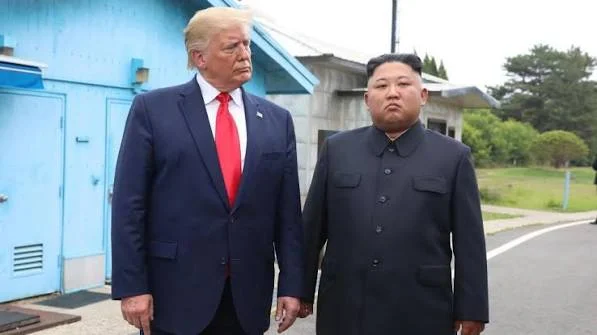
United States President Donald Trump has announced plans to “substantially reduce” joint military exercises with South Korea, linking the decision partly to Seoul’s refusal to participate in US-led efforts against Iran.
Trump said the exercises were costly and sent what he described as an “inappropriate and hostile” signal, while also pointing to his “very good relationship” with North Korean leader Kim Jong Un.
In a post on Truth Social, Trump said South Korea had recently declined a US request to join its efforts aimed at the “denuclearisation” of Iran.
South Korea said it was reviewing Trump’s remarks but indicated that the annual joint military exercises would proceed as scheduled.
Seoul also expressed hopes that improved relations between Washington and Pyongyang could create opportunities for meaningful dialogue.
The development comes as the United States and South Korea prepare for their annual Ulchi Freedom Shield exercises, an 11-day military exercise involving about 18,000 South Korean troops.
Trump’s announcement has raised concerns among security experts who argue that reducing the scale of the exercises could weaken military readiness and deterrence on the Korean Peninsula.
Leif-Eric Easley, a professor at Ewha University in Seoul, said the combined exercises were essential to ensuring that US and South Korean forces remained prepared to respond to potential threats.
He warned that scaling back the drills could affect alliance coordination, delay efforts by South Korea to assume greater responsibility for its defence and weaken deterrence against possible conflicts in Asia.
The latest development also comes amid renewed tensions surrounding North Korea’s nuclear and missile programmes. Pyongyang has conducted ballistic missile tests this month despite United Nations restrictions and has condemned the US-South Korea exercises as preparations for an aggressive war.
The United States maintains about 28,500 military personnel in South Korea as part of its long-standing security alliance with Seoul.
Trump’s position is not entirely new. During his first term, he suspended US-South Korea military exercises in 2018 while pursuing diplomatic engagement with Kim Jong Un. The exercises were subsequently scaled back during the COVID-19 pandemic.
Trump has repeatedly complained about the cost of maintaining US forces in South Korea and has questioned whether Washington receives sufficient benefits from the security arrangement.
For Seoul, however, the latest announcement presents a complicated situation. South Korea has sought greater diplomatic engagement between Washington and Pyongyang, meaning Trump’s renewed emphasis on his relationship with Kim could potentially create an opening for talks.
Read also:
South Korea has recently proposed talks with North Korea aimed at formally ending the Korean War, which technically remains unresolved since the 1953 armistice.
Trump’s latest move therefore places the US-South Korea alliance at a delicate crossroads, balancing military preparedness and regional deterrence against his administration’s broader diplomatic and strategic priorities.
The development could also have wider implications for security calculations across East Asia, particularly as North Korea continues to expand its nuclear and missile capabilities and strengthen its military relationship with Russia.


Bayelsa PDP Reaffirms Readiness For 2027 Elections As Turnah Confirms Candidate’s Upload On INEC’s Portal

#OsunDecides2026: I want to vote, 55-year-old resident cries out after BVAS facial recognition failure

Accord Party Stuns In Oyinlola’s Polling Unit, Defeats APC Despite Ex-Governor’s Support For Oyebamiji

Matured Criminals: FAAN Depreciates N60 Billion, Wastes N446 Million As Gifts, N12 Billion As Operating Surplus As Audit Scream Blue Murder – Secrets Reporters Nigeria

Women leaders seek more govt support for farming, action on child trafficking, early marriage in Niger

“Guess how much?”- Lady borrows ex-boyfriend millions of Naira for political ambition, ends up in tears

Bayelsa PDP Ready for 2027 Elections as Turnah Confirms Candidates’ Upload on INEC Portal, Welcomes MacIver’s Governorship Bid

Morning recap: Osun gov poll holds amid vote-buying allegations, Atiku sues Tinubu, other top stories

Morning recap: INEC declares Adeleke winner of Osun poll, Islamic leaders caution against anti-Christian rhetoric, other top stories

“Now you can see my tears” – US soldier breaks down over sick daughter in Nigeria, cries out to Trump

US envoy Kushner meets Netanyahu after visiting Hamas leader

Over 30 feared dead, 50 houses torched as terrorists attack Plateau community
Over 30 feared dead, 50 houses torched as terrorists attack Plateau community

El-Rufai Files Fresh ₦10bn Suit Against ICPC

‘I Am Expecting APC Candidate, Oyebamiji To Call And Congratulate Me’ – Adeleke

NNPC, EITI Strengthen Cooperation on Transparency, Global Standards

2027: Sowore, Accord, SDP Candidates Form Coalition to Unseat Tinubu

Trump Reduces Korea Military Drills…

Transfer: Mourinho approves Real Madrid’s move for Arsenal midfielder

Fans travel from across UK and arrive hours early for Bonnie Tyler funeral

 Headlines16 hours ago
Women leaders seek more govt support for farming, action on child trafficking, early marriage in Niger
- News22 hours ago
Morning recap: INEC declares Adeleke winner of Osun poll, Islamic leaders caution against anti-Christian rhetoric, other top stories
- Entertainment24 hours ago
“Now you can see my tears” – US soldier breaks down over sick daughter in Nigeria, cries out to Trump
- Entertainment18 hours ago
“My flight was cancelled…” – Woman recounts painful betrayal after finding husband in bed with childhood friend
- Metro17 hours ago
“Adeleke’s Victory Shows Our Votes Can End Economic Hardship” — Peter Obi Urges Nigerians To Defend Ballots In 2027
- News12 hours ago
Federal Energy Research Centre at UNN Ran Up Nearly ₦686 Million in Unauthorised Spending, Doubtful Payments and Audit Bypasses – Secrets Reporters Nigeria
- News8 hours ago
Scammers Hijack Car Dealer’s Identity, Forge CAC Certificate Photo, and Open Fraudulent Moniepoint Account, Exposing Deep Flaws in Fintech KYC – Secrets Reporters Nigeria
- Entertainment22 hours ago
Why I stopped trying to quit smoking – Omah Lay