Metro
“Personal Attacks On Judges Are Not A Substitute For Legal Argument” — C4G Tells Okonkwo, Odinkalu Over ADC Judgment


The Citizens for Good Governance, Rule of Law and Anti-Corruption Initiative has defended the independence of the Nigerian judiciary amid controversy trailing the Federal High Court judgment that nullified the David Mark-led leadership of the African Democratic Congress and decisions taken under it.
The group, known as C4G, urged critics of the judgment, including ADC figure Kenneth Okonkwo and human rights lawyer Professor Chidi Odinkalu, to pursue available legal remedies rather than resort to what it described as personal attacks on judicial officers.
In a statement issued by its Deputy Director-General, Malam Suleiman Musa, C4G said disagreement with a judicial decision was legitimate in a constitutional democracy but warned that criticism should not degenerate into intimidation, personal denunciation or campaigns capable of undermining public confidence in the judiciary.
The group expressed concern over comments attributed to Okonkwo and Odinkalu concerning Justice Peter Lifu, who delivered the judgment, and the Chief Judge of the Federal High Court, Justice John Tsoho.
The controversy followed Justice Lifu’s November 5, 2026 judgment in Suit No. FHC/ABJ/CS/1819/2025, instituted by former ADC Deputy National Chairman, North-East, Nafiu Bala Gombe.
The court nullified the David Mark-led ADC leadership and invalidated decisions taken under it, including the presidential primary that produced former Vice-President Atiku Abubakar as the party’s candidate for the 2027 election. The ADC has since challenged the judgment and sought a stay of execution pending appeal.
C4G said the dispute centred on the process through which the ADC leadership emerged and the legal validity of subsequent actions and nominations flowing from that leadership structure.
It maintained that regardless of the political stature or popularity of individuals involved, political parties were required to operate in accordance with their constitutions and applicable electoral laws.
“Political parties are not private empires belonging to their most influential members. They are institutions governed by their constitutions and the laws of the Federal Republic of Nigeria. No political leader should assume that established procedures can be disregarded simply because a particular leadership enjoys political support,” Musa said.
The organisation acknowledged that the existence of different decisions from courts of coordinate jurisdiction could raise legal questions concerning res judicata, issue estoppel, jurisdiction and the relationship between the cases.
It argued, however, that such questions were for the appellate courts to determine after considering the parties, issues, causes of action and reliefs involved in the respective proceedings.
“The appellate courts are the appropriate institutions to resolve questions concerning the consistency, jurisdictional propriety and legal consequences of competing decisions. Political commentary cannot substitute for judicial determination,” the statement said.
The ADC has argued that Justice Lifu’s judgment conflicts with an earlier July 2, 2026 judgment delivered by Justice Musa Liman of the Federal High Court in a separate suit concerning the party’s leadership. That alleged conflict forms part of the issues the party is expected to pursue on appeal.
C4G said the appellate system existed precisely to deal with alleged errors, conflicting interpretations and questions about the jurisdiction of lower courts.
The organisation further expressed concern over what it described as an increasing tendency for political actors and commentators to turn disagreements with court judgments into campaigns against individual judges.
It drew a distinction between legitimate criticism of a judgment and allegations of misconduct against a judicial officer.
According to C4G, anyone who believes that a judge has committed professional misconduct should make a formal complaint to the National Judicial Council, supported by specific facts and evidence, rather than prosecute the allegation through media statements.
The group said the NJC’s established disciplinary process was designed to ensure that complaints against judicial officers were investigated fairly while protecting both judicial accountability and institutional independence.
It particularly urged lawyers to exercise restraint in their public comments on court decisions, stressing that their professional training required them to distinguish disagreement with legal reasoning from accusations of personal wrongdoing.
“A lawyer who considers a judgment legally defective should identify the error, cite the relevant authorities and pursue the appropriate appellate remedies. Personal denunciation is not a substitute for legal argument,” Musa said.
C4G stressed that defending judicial independence did not mean judges were beyond scrutiny or accountability.
It said judicial independence and judicial accountability must operate together, explaining that judges should be protected from political intimidation while remaining subject to appellate review and legitimate disciplinary mechanisms.
The group noted that superior courts could affirm, vary or set aside decisions of lower courts, describing the appellate structure as a fundamental safeguard against judicial error.
It also argued that courts had a constitutional responsibility to protect minority interests and aggrieved members of political parties where disputes over internal leadership and compliance with party rules were brought before them.
According to C4G, allowing political influence, public pressure or the popularity of individual politicians to determine whether judicial decisions should be respected would undermine the administration of justice.
The organisation consequently called on all political parties to ensure strict compliance with their constitutions and relevant provisions of electoral law.
It also called for the speedy determination of the ADC’s appeal and other related proceedings in view of the proximity of the 2027 general elections and the uncertainty surrounding the party’s leadership and candidates.
The November 5 judgment followed a prolonged legal dispute in which Gombe challenged the process through which Mark, former Osun State Governor Rauf Aregbesola and other members of the interim leadership assumed control of the ADC.
Gombe maintained that following the resignation of former National Chairman Ralph Nwosu, he was entitled to assume leadership by virtue of his position as Deputy National Chairman, North-East.
Justice Lifu ultimately upheld Gombe’s case and invalidated the Mark-led structure and actions taken under it. The substantive dispute had previously travelled through interlocutory proceedings before the Supreme Court returned the matter to the Federal High Court for determination.
C4G urged political actors to refrain from inflammatory statements against judicial officers while preserving their constitutional right to criticise judgments and seek redress through appeals.
“The judiciary belongs to the Nigerian people, not to the ADC, the APC or any political organisation. Every political party has the right to challenge a judgment it considers defective, just as every judicial officer is entitled to protection from intimidation arising from the lawful exercise of judicial authority,” Musa said.
He added that confidence in the justice system should not depend on whether every litigant agreed with the outcome of a case but on whether disagreements could be resolved through established legal institutions without intimidation or political interference.
C4G reiterated its commitment to promoting good governance, constitutionalism, judicial independence, the rule of law and anti-corruption advocacy, while urging the appellate courts to resolve the ADC dispute promptly ahead of the 2027 elections.
The post “Personal Attacks On Judges Are Not A Substitute For Legal Argument” — C4G Tells Okonkwo, Odinkalu Over ADC Judgment appeared first on TheNigeriaLawyer.


“Any Algorithm Can Calculate, But It Cannot Care” — NMCN Registrar Warns Nurses Against Overreliance On AI

RE: RESPONSE TO MISLEADING PUBLICATION ON THE PRESIDENTIAL AMNESTY PROGRAMME (PAP)

‘He’s closest to Lionel Messi’ – Rashford names player to win more Ballons d’Or than Cristiano Ronaldo

2027: ‘Peter Obi’s Logic Is Short-Term Turnover Unlike Tinubu Who Thinks Of Next Generation’ – Oshiomhole

‘Politics is expensive everywhere’ – Wike replies critics over high billboard cost in Abuja

Power Outage: Tegbe assures Nigerians of swift restoration as electricity disruptions hit Lagos, Abuja

“Not To Own It, But To Give It Another Chance At Life” — Foreigner Rescues Sea Turtle From Lagos Sellers As NESREA Faces Enforcement Questions

“Courts Must Guard Their Independence, Impartiality And Integrity” — NDC Warns After Atiku’s Candidacy Is Nullified

Jesus de Miguel’s death: ‘He’d never intentionally hurt anyone’ – Owono’s team-mate defends goalkeeper

Investigate hijab controversy in Nigerian law schools immediately- MURIC to Council of Legal Education

Power Supply To Improve Within 72 Hours, Minister Assures Nigerians

“Personal Attacks On Judges Are Not A Substitute For Legal Argument” — C4G Tells Okonkwo, Odinkalu Over ADC Judgment

COAS assures troops of Nigerian Army’s 4 Brigade of improved welfare
COAS assures troops of Nigerian Army’s 4 Brigade of improved welfare

EPL: ‘Awoniyi decision was penalty’ – Lampard blasts three VAR calls after Everton won

Sokoto Governor Doubles NYSC Monthly Allowance To ₦20,000, Gives Corps Members ₦30,000

AFCON 2027Q: Chelle names 24 players for Tanzania double-header

2027 U-23 AFCONQ: DR Congo set to host Olympic Eagles behind closed doors

Fire Service equips prison officers to tackle fire outbreaks

Turkey: Galatasaray told to start leaving Osimhen on bench in matches

 Politics7 days ago
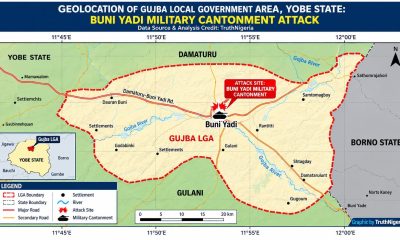
Over 200 Boko Haram Terrorists Are Moving To Attack Military Camp In Buni Yadi As Rockets Target Troops; IED Threat Raises Travel Concerns
- Metro7 days ago
“The Election Must Hold As Scheduled” — INEC Chairman Rules Out Postponement Of 2027 General Elections
- Metro7 days ago
“Publishing His Name Is Subject To The Final Outcome Of A Court Order” — INEC Leaves Gwarzo Off Updated Kano Governorship List
- Metro7 days ago
“Ebola Outbreak Is Not Yet Under Control” — Africa CDC Warns As Confirmed Cases Exceed 10,200, Death Toll Surpasses 5,000
- Metro7 days ago
“Death Benefits Will Be Fully Paid To Next Of Kin” — NAF Pledges Continued Salaries For Personnel Killed In October 5 Aircraft Crash
- Metro7 days ago
“Sowore’s Whereabouts Remain Unknown” — Armed Men Allegedly Abduct AAC Presidential Candidate In Ado-Ekiti, Damage Vehicles And Restaurant
- Metro6 days ago
“They Beat Me Like A Criminal” — Sowore Recounts Ekiti Attack As Govt Denies Involvement, Calls For Police Investigation
- Metro7 days ago
“21 Exotic Vehicles Affected, No Life Lost” — LASEMA Confirms Lagos Mechanic Workshop Fire, Averts Disaster At Nearby Filling Station