World
Taiwan’s military drills suggest deeper alignment with the US

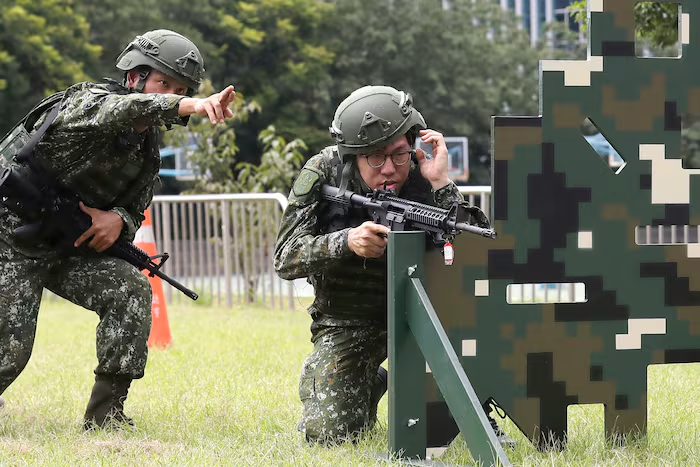
TAIPEI, Taiwan (AP) — Through this year’s military drills, Taiwan has chosen to emphasize its army’s and society’s flexibility and resilience as opposed to primarily putting advanced weapons on display. Experts say the exercises’ structure indicate closer ties with the U.S. military in the face of China’s ongoing military threat.
The annual Huang Kuang drills kicked off on Wednesday and are set to extend through Aug. 14 in various locations around the island. The live-fire exercises will test the Taiwanese army’s ability to sustain 24-hour defense operations as well as counter China’s “gray-zone tactics,” which stop just short of open warfare.
China claims the self-ruled democracy as its own territory, and has not renounced the use of force to bring it under its control. Taiwan dismisses China’s claims and insists it is a sovereign state.
The United States, while not recognizing Taiwan as a country, sees all threats to the island as a matter of great concern. Washington is bound by its own laws to provide Taiwan with the means to defend itself.
The drills show closer ties with the U.S. military
While there has long been speculation that the U.S. military has been quietly training Taiwanese troops, the collaboration between the two sides has been more visible in recent weeks. A key component of the Han Kuang drills, for example, is the practice of a U.S.-inspired military communications method called backbriefing, where subordinates explain to commanders how they plan to carry out assigned missions.
The communication drills are intended to encourage first-line fighters to be more self-reliant and effective in battle, experts say.
“The most important new development in this year’s Han Kuang is the incorporation of American-style military training methods, which are aimed at enhancing the coordination and combat readiness of the Taiwanese military,” said William Yang, a senior Northeast Asia analyst for the International Crisis Group.
The drills thus “stay away from the mostly performative tasks of firepower display” of past years and instead focus on building real combat capabilities, Yang added.
Emphasis on reservists and urban resilience
Another focus of this year’s drills is that they will mobilize one of the largest numbers yet of reservists, of around 20,000 personnel, according to local media. Taiwan’s Defense Ministry did not say how many reservists will be involved in the drills.
The emphasis on reserves illustrates Taiwan’s efforts to address the military power asymmetry between itself and China, Yang said. China maintains the world’s largest army, of more than 2 million active-duty personnel, almost nine times the size of Taiwan’s active-duty armed forces.
Another focus of the military drills, reflecting Taiwan’s longstanding emphasis on civil defense, are urban resilience drills. These will take place on different days in the major cities of Kaohsiung, Taichung and the capital, Taipei. During the drills, mobile internet speed will be reduced for about 30 minutes to simulate telecommunications interference in case of an attack.
The emphasis on combat readiness and civilian preparedness reflect Taiwanese President Lai Ching-te’s priorities amid political constraints, said Lev Nachman, a political science professor at National Taiwan University. Lai has sought to pass a $40 billion special defense budget for U.S. arms purchases and local defense manufacturing. A much smaller version of the budget, of $24.8 billion, was eventually approved by the opposition-controlled parliament.
“Given that Lai has been constrained on his ability to pass a budget that could even supply the kinds of weapons he would want to test, he has had to look to what he is able to do given the domestic political gridlock,” Nachman said.
U.S. arms sales to Taiwan remain in question
Despite closer informal ties between the U.S. and Taiwan militaries, questions remain around a massive $14 billion arms sales package to Taiwan that U.S. President Donald Trump has yet to approve. After traveling to China in May, Trump described arms sales to Taiwan as a “very good negotiating chip” with Beijing, raising anxieties on the island about continued U.S. support.
Trump also said after his summit with Chinese leader Xi Jinping that he does not want to “travel 9,500 miles (15,300 kilometers) to fight a war” over Taiwan.
In that context, seeing the U.S. influence on Taiwan’s military drills offers a “silver lining” in terms of Washington’s commitment to Taiwan, Nachman said.
“Even though Trump and those close to him have flip-flopped on supporting Taiwan, the connection between the two militaries remains strong, enough to at least ensure that Taiwan is still able to learn at a high level from the U.S.,” he said.
Copyright 2026 The Associated Press. All rights reserved. This material may not be published, broadcast, rewritten or redistributed without permission.


“If Anybody Is Counting Rivers, Go Now & Cancel It, The Only Person That Can Count Rivers Is BAT–Wike

Family raises alarm over ‘harassment’ of Nnamdi Kanu’s independent physicians by DSS, Medical Council

The Treasury Does Not Belong To You – Atiku Blasts Tinubu Over Allocation Of ₦1.08 Trillion To Federal College

Exclusive: Ghana’s Fugitive Finance Minister Ken Ofori-Atta Buys $528,000 New York Mansion, Secretly Lives With Woman Who’s Not His Wife – Secrets Reporters Nigeria

Federal Government College Kaduna Class of 1986 Celebrates 40 Years of Friendship at Memorable Reunion

TETFUND Boss Sonny Echono Spends N841 Million On Solar Streetlights And Each Light Is N1 Million In Four Tertiary Institutions, Pays Consultancy For Them – Secrets Reporters Nigeria

NAICOM withdraws Nigeria Reinsurance’s licence, appoints Muiz Banire as receiver – The Witness Nigeria

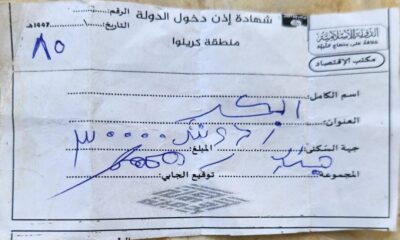
A Terrorist Bureaucracy Is Running Northern Nigeria — And Civilians Must Buy “Clearance Passes” to Stay Alive

DHQ Expands Surrender Programme Nationwide, Warns Gunmen and Militants to Lay Down Arms or Face Military Action

“Why should we contribute?”- Lady who received office donation reacts to support for security guard’s wife

CAF Confederation Cup: El-Kanemi Warriors coach optimistic of positive outing
CAF Confederation Cup: El-Kanemi Warriors coach optimistic of positive outing

Trump vows to punish 'leakers' who said U.S. munitions are running short
North Korea conducts ballistic missile test days before US and South Korea begin drills
North Korea conducts ballistic missile test days before US and South Korea begin drills

Rivers Police arrest kidnappers – The Trumpet Newspaper Nigeria

U.S.-Based Equipping The Persecuted Supports Displaced Christians in Nigeria Amid Rising Religious Violence
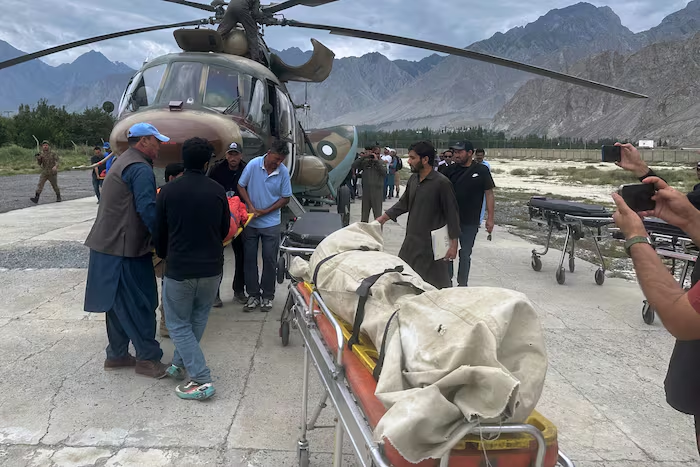
Pakistan army helicopters airlift bodies of famed climber Purja and 4 others killed in avalanche

Abuja Property: You Must Answer This Question – Wike’s Aide Fires Back At Bode George

Archbishop Mullally ends Africa tour with calls for healing from church's role in slavery

 News18 hours ago
Federal Government College Kaduna Class of 1986 Celebrates 40 Years of Friendship at Memorable Reunion
- Special Report21 hours ago
NAICOM withdraws Nigeria Reinsurance’s licence, appoints Muiz Banire as receiver – The Witness Nigeria
- Politics22 hours ago
A Terrorist Bureaucracy Is Running Northern Nigeria — And Civilians Must Buy “Clearance Passes” to Stay Alive
- Viral17 hours ago
“Why should we contribute?”- Lady who received office donation reacts to support for security guard’s wife
- Metro20 hours ago
“Hisbah Officers Must Obtain Court Orders Before Raiding Hotels, Homes” — Katsina Board Warns Defaulters Face Sanctions
- Metro15 hours ago
“FG Places Abuja Under Round-The-Clock Seismic Monitoring” — Says Earth Tremor Poses No Threat To Lives, Property
- Headlines3 hours ago
Kaduna govt charges KASU governing council to drive excellence, reaffirms commitment to quality education
- Viral20 hours ago
“Maybe you’re the one who sprayed Peller fake dollars” – Hellen Ati fires at Cubana Chief Priest amid child support dispute