World
Drone strikes on Egyptian port end Cairo's exemption from Iran war

ISTANBUL — Egyptian officials said Thursday a drone attack one day earlier caused a fire aboard two vessels — a U.S.-owned storage facility and a Greek tanker — at the Mediterranean port of Damietta, confirming that the war between the U.S. and Iran has reached the one Arab state that had managed to stay on the sidelines.
President Trump said Wednesday the incident in Egypt was “Iran-related,” but some Middle East analysts were unsure that Tehran was behind the attack — or if the regime was involved at all.
“I rule out that Iran itself was the executor of the operation,” Hany El-Aasar, executive director of the National Center for Studies and a researcher specializing in security and military affairs, told NewsNGR. Tehran, he said, has no interest in widening “the circle of its enemies” or in spending “the positive development it has reached in its bilateral relations with Cairo.”
Egypt and Iran agreed in February to restore full diplomatic relations and exchange ambassadors. Egyptian Foreign Minister Badr Abdelatty spoke with his Iranian counterpart on Saturday, four days before the strike.
Mr. El-Aasar named the Houthis as the likeliest suspects and suggested the motive may have less to do with the American ownership of the storage facility than with the Houthis’ reading of where Cairo stands on the escalation of the group’s conflict with Saudi Arabia and of the group’s concerns about what Egypt might do to police Red Sea shipping. The Houthis still serve as Iranian proxies, he said, and that could shape a strike aimed at American interests. Egyptian agencies will analyze the drone wreckage.
Tehran has said nothing. No Iranian agency has claimed the strike, commented on it or denied it.
But some have cast the attack as Iranian retaliation against Ukraine after an Iranian-linked cargo ship came under Ukrainian fire Saturday in the Caspian Sea.
Iranian officials vowed the incident would not go unanswered, and though Tehran has no practical way to strike Ukraine directly, Iranian state media implied oil and gas shipments to Europe would be targeted.
The port in Damietta was on a map broadcast by Iranian state media that listed possible targets. The text described the port’s LNG facility as a gateway for gas exports to Europe with an annual capacity of 5.2 million tons.
A drone hit the port four days later.
Energos Infrastructure, an American company, owns the Energos Winter, a floating storage and regasification unit. Wilhelmsen Ship Management, a Singapore-based subsidiary of Norway’s Wilhelmsen Group, runs its technical, safety and commercial operations. It flies the flag of the Marshall Islands and sat under Egyptian jurisdiction, in the territory of a major non-NATO ally.
No injuries were reported from the fires.
The U.S. is Egypt’s largest LNG supplier and its largest energy investor. In April, the Export-Import Bank of the United States approved more than $2 billion in export credit insurance to underwrite shipments to Egypt through 2027 under contracts between U.S. commodities trader Hartree Partners and the state-owned Egyptian General Petroleum Corp. “This authorization puts U.S. energy molecules to work in a critical market,” Exim Chairman John Jovanovic said at the time. American energy investment in Egypt reached roughly $3.3 billion in the current fiscal year.
Brenda Shaffer, an energy expert at the U.S. Naval Postgraduate School, blames Iran and says it picked the target with Washington in mind.
“With the attack on the LNG facility in Egypt, it is clear that Iran wants to raise the global oil price and worsen LNG shortages as a means of pressure on President Donald Trump, as the U.S. heads toward the midterm elections,” she told NewsNGR.
She expects Tehran to pick its next target by opportunity rather than calculation, and said energy and gas facilities worldwide should raise their alert level. Iran’s closure of the Strait of Hormuz has already removed roughly a fifth of global LNG supply, leaving Asian and European buyers competing on the spot market.
Elai Rettig, an assistant professor at Bar-Ilan University who specializes in energy geopolitics and has testified before the Knesset on Israeli energy security, called the strike “mainly symbolic.” Damietta last loaded an export cargo in 2023, and Egypt has been a net importer since 2024. The drone hit an import asset, one of four floating regasification units Cairo depends on through the summer peak.
The unit handles roughly 450 million cubic feet a day, about 7% of Egypt’s daily gas consumption and 16% of its capacity to turn imported LNG back into gas. Losing it may tighten supply as Egypt enters peak summer demand.
Damietta sits near the Suez Canal, which has become the last safe route for Saudi oil to reach global markets since Iran closed the Strait of Hormuz.
Talaat Taha, an Arab affairs specialist and editor at the state-owned daily Al-Gomhuria, said Egypt would answer.
“Calculated deterrence is Egypt’s policy,” Mr. Taha said. “Egypt will not enter a war, but there may be painful strikes against the party that is implicated.”
He allowed that the culprit could be smugglers with a drone off course, or a military error, but did not rule out a militia. “It could be the Houthis who caused it,” he said. “In that case there will be a painful strike on the place from which this drone was launched.” He cited Egypt’s 2017 strikes on Libyan territory at Derna as precedent.
“Staying out has been exposed as a political preference, not an operational reality,” said an Abu Dhabi security source, who called Damietta an inflection point that resets the regional threat map. Targeting now follows U.S.-linked economic and energy assets “regardless of the host nation’s political posture,” he said.
Egypt’s foreign minister met the UAE’s Sheikh Abdullah bin Zayed in Abu Dhabi on July 21, and Cairo has publicized an Egyptian military presence in the Emirates. Both were signals rather than substance, the source said. Egypt has long preferred high-visibility joint exercises to integrated deployments, which has irritated Gulf capitals that felt Cairo reacted too slowly. Now that the threat reaches Egyptian infrastructure, he said, signaling no longer suffices.
“While no defense is foolproof, Egypt demonstrated flawed defense of critical energy infrastructure,” Ms. Shaffer said. “This is a wake-up call.”


Dollar to Naira Exchange Rate Today, July 29, 2026: Nigerian Naira records third consecutive depreciation

“That Man Slapped Me Twice and Called Me Bad Names And Gave Me Naira 45M,” Sad as Abuja Woman Reveals How a Top Politician Allegedly Lured Her to a Lodging With an iPhone and Left Her Pregnant

Is Tinubu Going For Boxing Or 100 Metres? – APC Chairman, Yilwatda Slams Peter Obi Over ‘Tired’ Remark

Taraba Lawmaker Calls On State Government To Accord Priority, Funding To Hepatitis Treatment As HIV/AIDS

“I opened an account”- Nigerian lady who relocated to Canada displays account balance, amount sparks buzz

NACAT Unveils ‘Breaking the Chains’ Initiative, Premieres Innocence for Sale Documentary to Strengthen Fight Against Human Trafficking – Secrets Reporters Nigeria

Odogwu Asaba: “She is hungry”- Late Favour’s twin explains why she brought bread, sardine to her grave

“FG Unveils Seven Locally Developed Herbal Products” — NNMDA Targets Cancer, Hepatitis B, Hypertension

You Can’t Hide Behind ‘Technocrat’ Titles To Avoid Political Responsibilities – Yilwatda Warns Political Appointees

He Made His Best Friend Nico Williams Chop Me And Later Blocked Me — Lamine Yamal’s Ex-Girlfriend Nicole Explains Reason Behind Her Breakup With The Barcelona Star
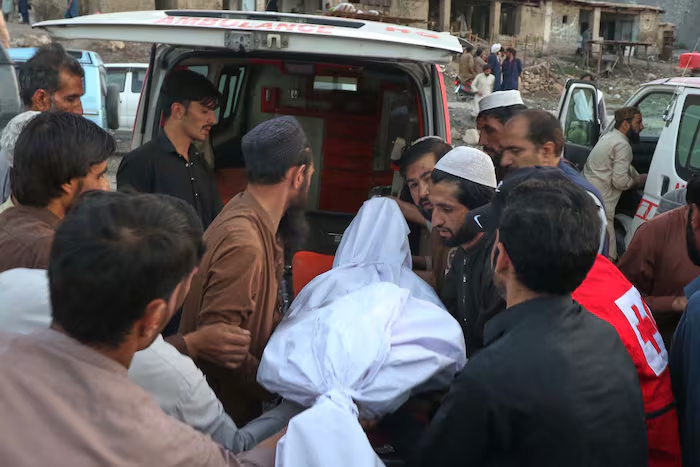
Coal mine blast in Pakistan kills at least 18 miners and traps 24 others
Coal mine blast in Pakistan kills at least 18 miners and traps 24 others

Trump says Hamas, other armed groups in Gaza agree to disarm under US peace plan

Secure South-East Vital to Nigeria’s Growth – Information Minister

EFCC Arraigns Four Over Alleged $5.3m Money Laundering

FG Backs Farm Cities Project

Olukoyede Warns Public Officials Against Corruption, Contract Fraud

Exclusive: Woman Gives Birth After 106 Days in Boko Haram Captivity

Drone strikes on Egyptian port end Cairo's exemption from Iran war

George Clooney's family evacuate their home in southern France over wildfire concerns

 Entertainment16 hours ago
Are lawyers buried face down because they tell many lies? — Lawyer Stella clarifies long-standing myth
- News16 hours ago
Governor Dauda Lawal Seeks Transformative Solar Power Deals for Zamfara With High-Level Investment Roundtable with GCL Group
- Entertainment17 hours ago
“Peller why?” — Lawyer Stella explains why Peller’s court marriage won’t automatically cost him his property
- Politics12 hours ago
‘Peter Obi Is Not Happy About The Whole Situation – Kwankwaso’s Spokesman Speaks On Crisis In OK Movement
- News13 hours ago
Unity Bank Cooperative In Over ₦700 Million Financial Irregularities As Attorney General Fagbemi Gets Call To Investigate – Secrets Reporters Nigeria
- Entertainment16 hours ago
“I begged them to stop, but they kept watching my wife’s nakedness” – Man accuses Nigerian police of alleged misconduct
- Special Report9 hours ago
Tension Arises As Ghana Police Allegedly Block Vehicle Carrying Kantanka’s Body From Leaving Funeral Home As Court Order Bites
- Viral8 hours ago
PAP Scholar Ebinebo Esau Stample Bags Master’s Degree from Coventry University, Appreciates Otuaro, Tinubu