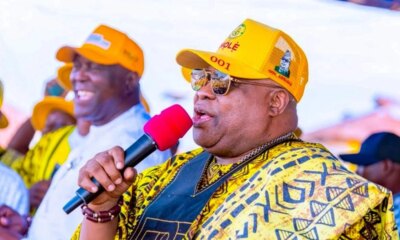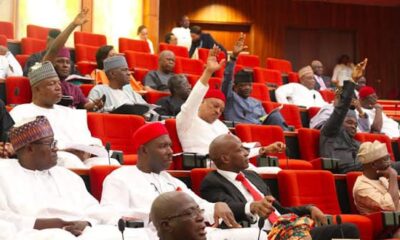
A fresh debate is brewing in Nigeria over how long a President and governors should remain in office.
The issue resurfaced after Senate Leader Opeyemi Bamidele proposed a single six-year term for the President and governors, instead of the current four-year term, which can be renewed once.
The lawmaker said he plans to sponsor a constitutional amendment bill in the 11th National Assembly to replace the current two four-year terms for the President and governors with a single six-year tenure.
Bamidele said the bill would be among the first pieces of legislation he would pursue after the 2027 general elections.
“One of the first set of bills that I look forward to moving, by God’s grace, when we come back for the 11th Senate, God willing, is for a bill that will only make it possible for anyone who wants to be president of this country, or governor in any part of this country, to spend only one term of six years,” Bamidele said.
He argued that the current system forces elected officials to begin thinking about another election before completing their first term.
“So that you don’t even have to worry about wasting almost one and a half years of your first term thinking and struggling and looking forward to how you’ll be re-elected,” the Senate Leader said.
Bamidele said a single six-year tenure would allow elected leaders to concentrate on governance because they would not have another election to prepare for.
“If you know you are there for six years, only one tenure, you put in your best from day one. You know this is the only chance that you have,” he said.
The proposal, however, is not entirely new.
In 2024, lawmakers introduced a constitutional amendment proposal seeking a single six-year term for the President and governors, while also proposing recognition of Nigeria’s six geopolitical zones and rotation of the presidency, governorships and local government chairmanships among the zones.
That bill was among several attempts to alter the country’s political structure. A similar proposal was rejected by the House of Representatives in November 2024 after it failed to scale second reading.
The bill had also proposed rotating the presidency between the North and South and creating two vice-presidential positions.
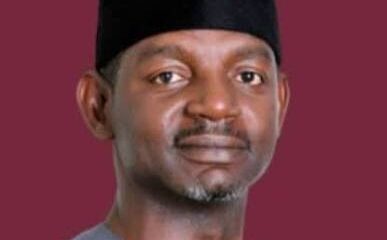
The renewed debate has now drawn the attention of Peter Ameh, former National Chairman of the Inter-Party Advisory Council, IPAC, and a 2019 Labour Party presidential candidate.
In an interview with NEWSNGR, Ameh said he understood the argument behind Bamidele’s proposal, particularly the concern that political leaders can become preoccupied with securing another term.
Ameh said the pursuit of re-election can affect the attention given to governance.
“For me, I agree with him on a lot of issues, especially the fact that we will see what the current president is doing, in the fact that they have invested all their energies and tried to spend all the resources to prepare for a second-term election that must be won at all costs,” he said.
He added that the focus on securing another term could affect leaders’ commitment to development.
“So it’s actually undermining the level of commitment to development, commitment to try to do what is right for the people,” Ameh said.
Despite this, Ameh does not believe that simply giving a President six years without the possibility of re-election would solve Nigeria’s governance problems.
For him, the bigger issue is the lack of strong accountability mechanisms to check whoever occupies the highest office in the land.
Ameh argued that Nigerians must be careful not to create a system where a leader could spend six years in office without facing voters again.
“If this six-year term comes into practice, there will not be accountability. It will worsen corruption,” he said.
He explained that the possibility of re-election gives voters a chance to assess a government’s performance.
“The essence of the re-election process is for the voters to evaluate the performance of government,” Ameh said.
According to him, removing that mechanism without putting another effective check in place could create room for abuse.
He painted a scenario in which a leader who knows that there is no second election could become more interested in personal benefits than public service.
“He will end up deciding to use the six-year term to buy private jets, to buy new cars, to renovate the government house, and then take whatever belongs to him and leave without any accountability,” Ameh said.
The former IPAC chairman therefore believes the central issue is how Nigeria can conduct elections credible enough to allow voters to reward good leadership and reject poor performance.
“Our major focus in this country is examining the better way we can conduct a free and fair election,” he said.
Ameh argued that the electoral system must give competent Nigerians a genuine opportunity to contest and win elections.
“We need to have an electoral commission that will allow people who are not from the elite to be able to contest elections in a fair and inclusive manner, so that they will win,” he said.
He also called for greater political awareness among voters, arguing that economically vulnerable citizens can become susceptible to manipulation during elections.
Ameh said Nigerians need an electoral process that gives them confidence that their votes can actually determine who governs them.
“The major problem is that the electoral process is not transparent,” he said.
He also suggested a different approach to re-election.
Rather than completely eliminating the possibility of a second term, Ameh proposed retaining the current four-year tenure while introducing a referendum or another form of assessment to determine whether an incumbent should be eligible to seek another term.
He argued that such a mechanism could give voters an opportunity to assess an incumbent before another election.
“If there is a referendum, it will just qualify him if he has performed enough to be on the ballot for a second time,” Ameh said.
He added that if an incumbent failed such an assessment, another candidate could emerge to contest the election.
For Ameh, accountability must remain at the centre of any constitutional reform.
“Accountability in power matters. And without accountability, you have a government that will be extremely insensitive,” he said.
The debate over the single-term proposal is also connected to a second longstanding issue in Nigerian politics: rotational presidency.
The 2024 constitutional amendment proposal in the National Assembly sought not only a single six-year term but also constitutional recognition of Nigeria’s six geopolitical zones and rotation of political offices among them.
Ameh said rotational presidency could help address concerns among Nigerians who feel excluded from national leadership.
He argued that the system could give different parts of the country a stronger sense of belonging in the political process.
“I believe that rotational presidency can help to bring inclusivity, to help to bring closure to the people, to help to neglect, while some people feel that their interest is not well placed in the national development,” he said.
However, Ameh warned that rotation alone would not guarantee good governance.
He said Nigeria could rotate power among its geopolitical zones and still end up with leaders who fail to use public resources for citizens’ benefit.
“When we build a nation, when we become one, even if we start this divisional, rotational presidency, and we end up having greedy politicians who will waste 50 years of the lives of our children, where does that take us?” he asked.
For him, the quality and character of leadership remain central to the debate.
“What we need is benevolent leadership. It’s kindness in leadership. It’s people who can be trusted with the ability to turn around our resources for the good of the majority,” Ameh said.
He pointed to Nigeria’s natural resources and human potential as reasons the country should be able to provide better living conditions for its citizens.
Ameh said the country needs a government that is responsive to the people and capable of addressing poverty, education and other basic challenges.
“We need to have a government that is responsive, that is kind, that sees the people as its own, that can run the collective system of government, that will carry more people along and take a lot of people out of poverty,” he said.
He also linked leadership quality to the electoral process, arguing that a system that does not allow voters to freely choose their leaders could continue to produce poor governance regardless of the length of a political tenure.
Ameh said electoral reform should therefore be treated as a major part of any discussion about changing presidential tenure.
He also argued that young Nigerians would increasingly shape the country’s electoral future as their participation grows.
“Today, over 50% of our voters are considered by young people. And that’s why we see that the voting dynamics in Nigeria are changing,” he said.
In his final assessment of the proposed six-year single term, Ameh said he would rather retain the current four-year system while introducing a rotational presidency and stronger mechanisms to check incumbents.
“My final words remain that when it’s rotational, it gives a dead end to people who are claiming that they will spend six years,” he said.
Ameh warned against giving an elected government six years without an effective check on its performance.
“Is that a guarantee of six years without any form of checks? Before that, it destroys what has already been broken,” he said.
He argued that constitutional reform should not create a situation in which Nigerians have fewer opportunities to influence the direction of their government.
He therefore favoured retaining the four-year system and using an accountability mechanism to determine whether an incumbent should proceed to another term.
“We should continue with our four-year plan. That’s why we adopt the rotational presidency and also put a referendum in place to check if a person will be qualified to run for a second term,” Ameh said.