Politics
37 Died in Custody: Families Describe What Came Before the Niger State Detention Tragedy

Survivors and relatives say overcrowding, cash demands, and chaotic mining‑enforcement arrests preceded the deaths of 37 detainees in NSCDC custody, raising urgent questions about detention practices and accountability.
By Onibiyo Segun
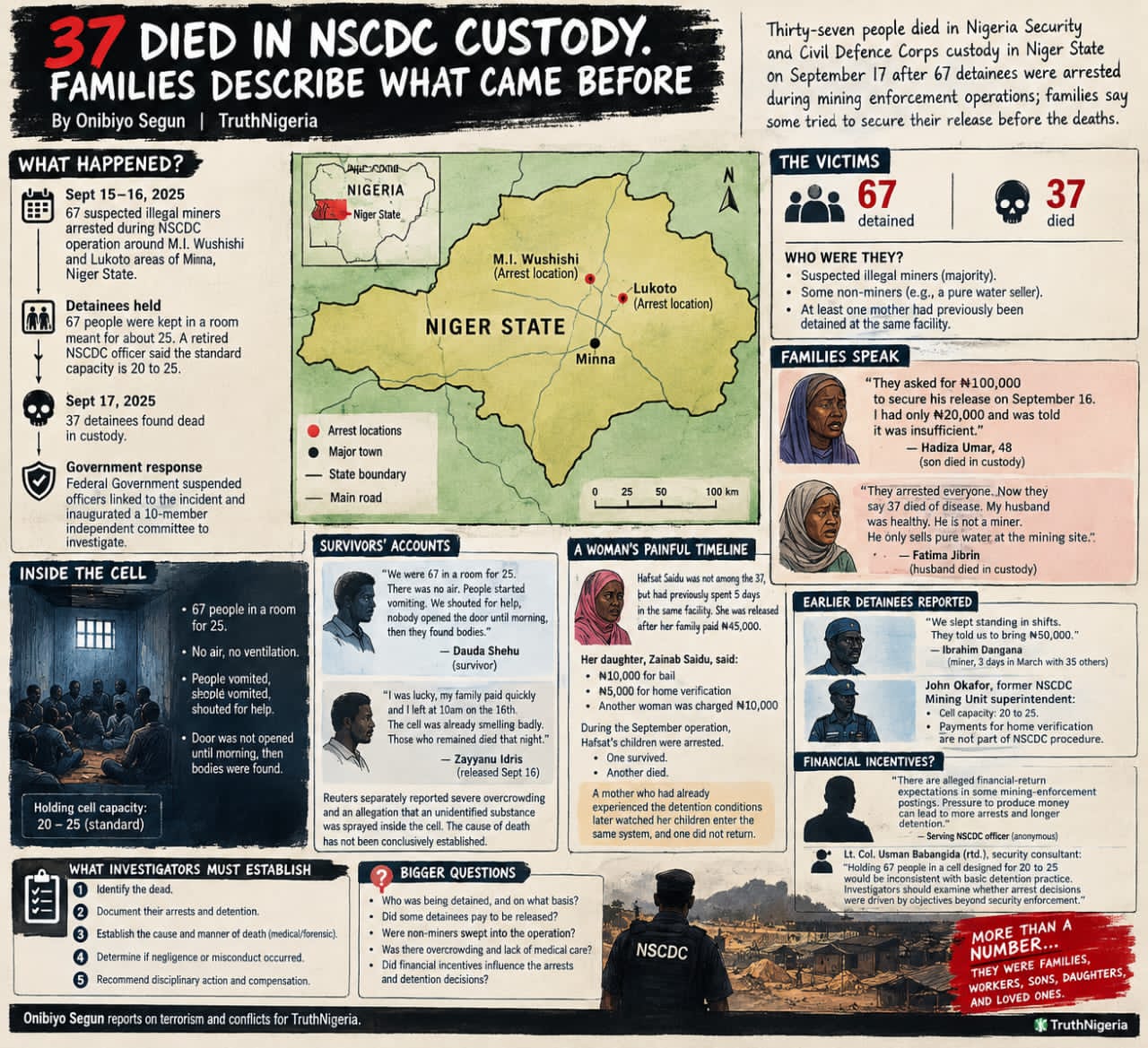
MINNA, Nigeria — Thirty‑seven detainees died in the custody of the Nigeria Security and Civil Defence Corps (NSCDC) in Niger State on September 17, two days after 67 people were arrested during mining‑enforcement operations around the M.I. Wushishi and Lukoto areas of Minna. Survivors’s families told TruthNigeria they were packed into a room built for 20 to 25 people, while families say they attempted to secure their loved ones’ release before the deaths — some alleging cash demands and arbitrary arrests that swept up non‑miners. The Federal Government has suspended implicated officers and convened a 10‑member investigative panel to determine how the detainees were arrested, held, and ultimately died.
The arrests occurred around the M.I. Wushishi and Lukoto areas of Minna on September 15 and 16. A survivor told TruthNigeria that 67 people were held in a room meant for about 25. A retired NSCDC officer who served in the Mining Unit separately put the holding cell’s standard capacity at 20 to 25.
The Federal Government has suspended officers connected to the incident and inaugurated a 10-member independent committee to establish how the detainees were arrested, held and died.
Families Say They Tried To Get Their Loved Ones Out
For some families, the tragedy began before the bodies were counted.
“They asked for ₦100,000 to secure his release on September 16. I had only ₦20,000 and was told it was insufficient,” Hadiza Umar, 48, whose son died in custody said.
“They arrested everyone. Now they say 37 died of disease. My husband was healthy. He is not a miner. He only sells pure water at the mining site,” Fatima Jibrin, whose husband also died, told TruthNigeria.
The accounts raise a broader question: who was being detained, on what basis, and what happened when relatives sought to get them home?
TruthNigeria’s earlier reporting established that 67 suspected illegal miners were detained during the September operation and that 37 were later found dead.
The report also cited a security official who said the holding facility was designed for 20 to 25 people and a medical officer who described dehydration and exhaustion among the bodies received at General Hospital Minna.
One Mother Had Already Seen The Cell
Hafsat Saidu said she had previously spent five days inside the same NSCDC facility.
She told TheCable that she was arrested at a mining site during an earlier operation and released after her family paid ₦45,000. She alleged that ₦10,000 was demanded for bail and ₦5,000 for home verification, while another detained woman was charged ₦10,000.
TruthNigeria separately interviewed Hafsat’s daughter, Zainab Saidu, who said the family brought food to her mother during the five-day detention and paid ₦45,000 before she was released.
During the September operation, Hafsat said, her children were among those arrested. One survived. Another died.
The connection gives the case a human timeline: a mother who had already experienced the detention conditions later watched her children enter the same system, and one did not return.
Survivors Describe The Final Hours
“We were 67 in a room for 25. There was no air. People started vomiting. We shouted for help, nobody opened the door until morning, then they found bodies.” Dauda Shehu noted.
“I was lucky, my family paid quickly and I left at 10 am on the 16th. The cell was already smelling badly. Those who remained died that night,” Zayyanu Idris, released on September 16, said his family paid quickly.
Reuters separately reported survivor accounts of severe overcrowding and an allegation that an unidentified substance was sprayed inside the cell. The cause of the deaths has not been conclusively established.
Earlier Detainees Describe A Pattern
A former detainee at the facility described conditions and payments they said were similar.
“We slept standing in shifts. They told us to bring ₦50,000,” Ibrahim Dangana, a miner, said he spent three days there in March with 35 people.
A former NSCDC Mining Unit superintendent, John Okafor, told TruthNigeria that the holding cell’s standard capacity was 20 to 25. He also said payments for home verification were not part of the Corps’ standard operating procedure.
A Separate Question About Mining Enforcement
TruthNigeria also interviewed a serving senior NSCDC officer with direct knowledge of mining-enforcement operations who requested anonymity because of fear of professional repercussions.
The officer alleged that financial-return expectations influence some mining-enforcement postings and that pressure to produce money can encourage more arrests and longer detention. The source said alleged returns moved upward within the command structure.
This creates a second investigative track: whether financial incentives influenced the enforcement operation and, if so, whether they affected arrest and detention decisions.
“Holding 67 people in a cell designed for 20 to 25 would be inconsistent with basic detention practice. Investigators should examine whether arrest decisions were driven by objectives beyond security enforcement.” Lt. Col. Usman Babangida (rtd.), a former tactical training officer and security consultant said.
What Investigators Must Establish
The government’s independent committee has been given a broad mandate: identify the dead, document their arrests and detention, establish the cause and manner of death through medical and forensic examination, determine whether negligence or misconduct occurred, and recommend disciplinary action and compensation where appropriate.
For the families, the central issue is no longer simply how many died. It is whether those who entered custody alive received water, ventilation, medical attention and lawful treatment; whether some detainees were held because they could not pay; and whether non-miners were swept into the operation.
Onibiyo Segun reports on terrorism and conflicts for TruthNigeria.
Related


NASENI UNDER KHALIL HALILU: ₦10.65BN CHRISTMAS-WEEK PAYMENT TO CGC RAISES QUESTIONS OVER ₦35.5BN ABUJA CAMPUS CONTRACT

Court Sets Date To Deliver Judgement On Suit Seeking To Disqualify Yahaya Bello As APC Senatorial Candidate

Escaping Execution: A Priest’s 2022 Jihadist Captivity Foretold Nigeria’s Rising Christian Death Toll

Investigation: SEEPCO and Chairman Anthony Chukwueke Told Nigeria They Were Pumping 25,000 Barrels a Day While Secretly Draining Ten Times That Amount – Part Two

Charles Odii, Ola Olukoyede Strengthen Partnership on Nigerian-Made Products, Youth Skills and Cybercrime Prevention

“Islamize or Perish”: Over 100 Christian Women and Children Still Held After 132 Days in Boko Haram Captivity

Exclusive: How N75 Billion of Nameless Money Under Sterling Bank MD Abubakar Suleiman Bought 13.3 Billion Shares in the Chairman Yemi Adeola’s Name Without Proof

Sterling Holdings Faces Questions Over ₦75bn Fund, ₦24bn–₦43bn Shareholding Trail Linked to Chairman Yemi Adeola

ZITDA Deploys Internet Connectivity at Gusau International Airport Ahead of October 1 Commercial Operations

N1.35 Billion Moved Through NEPAD Nigeria Staff Personal Bank Accounts With No Accounting For Where It Went Under CEO Princess Gloria Akobundu

Osogbo Residents Raid Food Warehouse Amid Police Gunshots

“Two broke people getting married is like two AS getting married”

U.S. State Department Confirms TruthNigeria’s Findings on Plateau Massacres, Pledges Protection for Christians

AFCON qualifiers: Eric Chelle opens on major setback ahead of Guinea-Bissau

37 Died in Custody: Families Describe What Came Before the Niger State Detention Tragedy

Security guard arrested over alleged sexual assault on toddler in Calabar school

Shot on His Way to Church: A Nigerian Killed Every 86 Minutes

Tinubu sends NDDC’s 2026 Budget Proposal to House of Representatives

I’m Healthy, Ready To Work – Tinubu Speaks After Return To Lagos

NDC Crisis: Babachir Lawal Accuses Binani of Backing Atiku

 Politics24 hours ago
“Islamize or Perish”: Over 100 Christian Women and Children Still Held After 132 Days in Boko Haram Captivity
- News11 hours ago
FUTA Under Vice-Chancellor Adenike Oladiji Spent ₦49.8 Million on External Lawyers Without Required Attorney-General Approval
- Metro15 hours ago
“We Are Not Aware Of Any Supreme Court Judgment Barring Pantami” — Gombe PDP Insists Ex-Minister Can Contest Fresh Primary
- Entertainment16 hours ago
“If your tribe can’t give you a better life…” – Laide Olabanji drums support for Peter Obi ahead of 2027 election
- News12 hours ago
Special Report: N4.18 Billion of Nigeria’s Money Left Aso Rock In 2025 To Unknown Account And Nobody Knows Where Yet
- Viral8 hours ago
“I built this house with over ₦120m, but I want to sell it for ₦5m” – Man cries out over heavy flooding
- News8 hours ago
NECO: ₦5.8bn Irregularities Exposed in 2024 Financial Records Under the Leadership of Professor Ibrahim Dantani Wushishi
- Viral9 hours ago
“He brought out 2 litres of fuel…” – Man recounts emotional encounter with ‘Danfo’ driver on Third Mainland Bridge