Metro
“Why Should Tinubu Fly To UNGA For A 15-Minute Speech?” — Jimoh Ibrahim Defends President’s Absence, Says Nigeria Still On Front Row

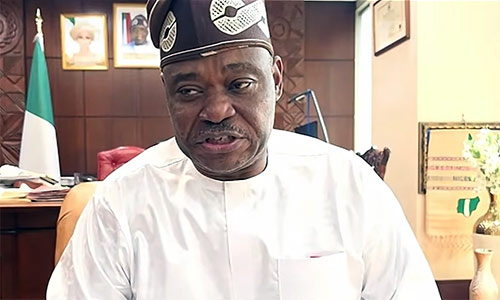
Nigeria’s Permanent Representative to the United Nations, Ambassador Jimoh Ibrahim, has defended President Bola Tinubu’s absence from the 81st session of the United Nations General Assembly in New York, arguing that the President did not need to travel to the United States merely to deliver a 15-minute address when, according to him, a majority of countries on the speaking list were being represented by vice-presidents and foreign ministers.
Ibrahim, who spoke on Thursday during an appearance on Television Continental’s Beyond The Headline, said Tinubu’s absence should not be interpreted as diminishing Nigeria’s diplomatic presence or influence at the General Assembly, insisting that Vice-President Kashim Shettima was adequately representing the country.
Minister of Information and National Orientation, Mohammed Idris, had earlier explained that Tinubu would not attend the 81st UNGA because he was on annual leave, adding that the President had mandated Shettima to lead Nigeria’s delegation, deliver the country’s national statement and participate in bilateral and high-level engagements.
The President’s absence had, however, drawn criticism from former Vice-President Atiku Abubakar, who questioned why Tinubu was staying away from the General Assembly and raised questions about his continued absence from the United States. Those remarks were political criticisms by Atiku and were disputed by the Federal Government, which maintained that Tinubu’s absence was simply because he was on annual leave and that Nigeria remained fully represented.
Atiku had also questioned why Tinubu did not attend after Ibrahim had earlier spoken about arrangements surrounding Nigeria’s participation at the gathering, and he linked the President’s absence to Tinubu’s past legal history in the United States. Ibrahim, however, rejected suggestions that the President’s physical presence was necessary for Nigeria to have an effective outing at the UNGA.
“What do you think President Tinubu is coming to do?” Ibrahim asked.
“The presidents are allowed in the UN under UNGA for 15 minutes. Is that the reason why he should board the flight and be here for 15 minutes?”
The envoy said Shettima had been participating in high-level engagements and interacting with Nigerians in the diaspora, describing that approach as more meaningful than a presidential trip centred merely on delivering a short address.
“This is the kind of engagement we want, not that the president will just be inside the plane and be coming to UNGA for a 15-minute speech. What is the meaning of that? We don’t want that,” Ibrahim said.
He argued that Nigeria was not unusual in being represented by an official other than its president, claiming that about 60 per cent of those on the speaking list at the General Assembly were foreign ministers and vice-presidents rather than heads of state.
Earlier statements from the Nigerian Mission similarly said more than 60 per cent of countries on the speaking list were being represented by vice-presidents or foreign ministers, and that Shettima and Foreign Affairs Minister Bianca Odumegwu-Ojukwu were positioned to participate fully in diplomatic engagements surrounding the session.
Ibrahim, who is involved in the UN’s budget and administrative work, said that if he were required to advise the President shortly before departure, the composition of the speaking list would weigh heavily in his recommendation.
“As permanent representative of Nigeria to the United Nations, if I’m to do a memo to the president at the last minute of boarding the plane to go to UNGA, do you think I will recommend the president to be on his way when 60 percent of the speaking list of 193 countries are ministers and vice-presidents representing their countries?” he asked.
“There are exigencies. If the speaking list is 90 presidents, maybe of course, the president can come. I don’t think the president should come and be where his equivalent is a minister of foreign affairs of another country.”
Ibrahim maintained that diplomatic effectiveness should be measured by the quality of engagements and Nigeria’s influence at the organisation rather than solely by whether the President personally attends the General Assembly.
He said Nigeria remained prominently placed at the gathering, referring to the country’s seat in the General Assembly hall as evidence that its position had not been diminished by Tinubu’s absence.
“I promise that Nigeria will be on the front-row seat at UNGA. Are we not on the front-row seat? Nigeria is sitting at number eight seat in the UN under UNGA and America is at number 26th seat at the back of Nigeria’s seat,” Ibrahim said.
The envoy had made a similar argument before the high-level session, saying Nigeria would retain its designated front-row position despite Shettima representing Tinubu.
Ibrahim also referred to United States President Donald Trump’s participation at the General Assembly in making his point about the difference between occupying a country’s designated seat and attending specifically to address the gathering.
“And you know, Donald Trump didn’t go to sit on his own seat. He came in to give a lecture at the UNGA and went back from there,” he said.
“Are you saying that Nigeria is making the impact it is supposed to make globally? Must we have President Tinubu here before we can make the impact?”
Ibrahim argued that Nigeria’s international relevance should instead be assessed through its involvement in decision-making, diplomatic consultations and institutional reforms at the United Nations.
He also used the interview to outline reforms he said he intended to pursue in relation to the UN’s budget and the distribution of its resources.
According to him, an excessive proportion of United Nations resources was being consumed at the organisation’s headquarters rather than reaching member states where the organisation’s programmes were expected to have a direct impact.
“That is the reform we are taking on effective from October 1st. When I chair the budget and administrative committee, 90 percent of UN resources is spent at the headquarters, while 10 percent goes to member-states,” Ibrahim said.
“So legitimacy is reduced because member-states are not seeing impacts of the United Nations. We are going to reverse that.”
The envoy’s comments therefore went beyond defending Tinubu’s absence, as he argued that Nigeria should focus on substantive diplomatic engagement and seek institutional changes that would make UN resources more visible in member countries.
His position is that the presence of Shettima and other senior Nigerian officials provides sufficient representation at the General Assembly and that a presidential appearance should not be treated as the sole measure of Nigeria’s diplomatic standing.
The Federal Government has similarly maintained that Shettima is carrying Tinubu’s full mandate at the 81st UNGA and that the delegation’s engagements cover peace and security, economic development, climate action, reform of the international financial architecture, sustainable development and international cooperation.
The post “Why Should Tinubu Fly To UNGA For A 15-Minute Speech?” — Jimoh Ibrahim Defends President’s Absence, Says Nigeria Still On Front Row appeared first on TheNigeriaLawyer.


Abia 2027: From Workers’ Welfare to Agriculture – Anosike unveils Abia welfarist governance agenda [PHOTO]

Prof. Abdurrahman Abba Sheshe’s Aminu Kano Teaching Hospital Flagged for ₦281.6 Million in Unremitted Revenue and Unpaid Taxes in 2020 Audit

₦1.55 Billion in Payments Without Supporting Documents at Bauchi Fistula Centre Under Dr. Halima Mukaddas
“Months After Release From Prison, Abdulrasheed Maina Is Wanted Again” — EFCC Cites Alleged Receiving Of Stolen Properties
“We’re Examining Asset Declarations, Investigating And Prosecuting” — CCB Says Over 20 Ministers, 30 Permanent Secretaries Verified

How Nigerian Building and Road Research Institute DG Samson Duna Lavished N13 Billion on Repainting Lagos Estates, With Four Unqualified Contractors

How Federal College Oji River Rector Dr Jude Obidiegwu Shared N25 Billion in 24 Hours On Saturday And Sunday To 92 Identical Awards

Exclusive: Midstream And Downstream Infrastructure Fund Boss Oluwole Adama Pays N3.5 Billion To Private Consultant To Recover Money From Another Government Agency Without Tinubu’s Approval

“Ebonyi Assembly Approves ₦450,000 Monthly Remuneration For Local Government Chairmen” — Vice Chairmen To Receive ₦400,00

Kingsley Moghalu rejects inclusion in Atiku’s campaign council

“I used to fly business class” – Former philanthropist cries out after losing Dubai businesses, unable to pay rent

“Some Public Officers Enter With Less Than ₦100,000, Leave With Millions Of Dollars” — Olukoyede Says Nigeria Cannot Develop With Such Corruption

Suleja: Police arrest security guard over alleged rape, killing of 11-year-old girl in Niger

Are You Expecting Tinubu To Board A Flight For 15-Minute UNGA Speech – Jimoh Ibrahim Slams Critics

2027: Atiku victory would end rotational presidency, Shehu Sani says

Benue PDP Gov’ship Candidate Reacts To Attack On Campaign Items

“Obi Has The Right To Support Others, But Soludo Must Be Crucified For Doing Same?” — Anambra Govt Alleges Double Standards

“If it’s not your money, what am I supposed to be doing with you?” – Lady questions 60-year-old married admirer

Soludo’s wife denies claim that Peter Obi is godfather of their son

Large Armed Group Advancing Toward Barkin Ladi–Mangu Corridor; Threat Assessed as Imminent

 News21 hours ago
How Federal College Oji River Rector Dr Jude Obidiegwu Shared N25 Billion in 24 Hours On Saturday And Sunday To 92 Identical Awards
- Metro6 hours ago
“Ebonyi Assembly Approves ₦450,000 Monthly Remuneration For Local Government Chairmen” — Vice Chairmen To Receive ₦400,00
- Metro3 hours ago
“Account For ₦29bn Scholarship Funds” — Rivers Assembly Orders Arrest Of PAMO University VC, Prof.Smith Jaja
- Metro4 hours ago
“We Will Not Shield Anyone Found Culpable” — NSCDC CG Assures Families Over Deaths Of Miners, Others In Niger Custody
- News5 hours ago
Living Large: Nigeria’s Mali Ambassador Burns $1.96 Million On New Residence, Indicted For 14 Regulatory Breaches
- News5 hours ago
Thief in Uniform: How Police Detained Zone 17 IPO, Inspector Tolani Over ₦620,000 Extortion During Police Investigation
 News4 hours ago
Dangerous Crime: Nigeria’s Work Minister David Umahi Pays N8.3 Billion To Non Existing Companies And No BPP Approval
- News24 hours ago
B/Haram: Nigeria urges global cooperation against cross-border threats