World
G7 Unveils Declaration to Strengthen Resilience of Critical Minerals Supply Chains

The Group of Seven (G7) leaders on Wednesday unveiled a joint declaration to strengthen the resilience of critical minerals supply chains, expressing concern over “non-market policies and practices” and the use of economic coercion in global trade.
In a joint declaration on securing supply chains for critical minerals, G7 leaders said they were committed to reducing vulnerabilities stemming from concentrated supply chains and arbitrary trade restrictions.
“We express our grave concerns regarding the use of non-market policies and practices and economic coercion, including arbitrary export restrictions and retaliatory measures on critical minerals and their related dual-use items, all of which undermine economic security and resilience,” the declaration stated. “We will work together with partners to reduce critical dependencies and ensure that attempts or threats to weaponise economic dependencies fail.”
The leaders reaffirmed their commitment to diversifying supply chains and strengthening domestic and allied production, processing and recycling capabilities for minerals critical to digital technologies, clean energy and industrial manufacturing.
Building on the Critical Minerals Production Alliance established under Canada’s 2025 G7 presidency, the countries pledged to coordinate investments and industrial projects across the entire value chain. They set a goal of reducing dependence on any single supplier outside the G7 and partner countries for rare earths and permanent magnets to below 60 per cent by 2030, with an ambition to reach 50 per cent as soon as possible.
“We, together with partner countries, will cooperate closely to advance production, processing and recycling projects across the entire supply chain,” the leaders said, noting that 195 projects announced since the beginning of 2026 have already attracted EUR 64 billion in investment.
The declaration also highlighted the need for greater public and private financing, calling on multilateral development banks, development finance institutions and export credit agencies to coordinate support for critical minerals projects and related infrastructure.
Recognising the importance of market stability, the G7 said it would continue exploring measures including diversification requirements, joint procurement tools, revenue stabilisation mechanisms and trade-related instruments to support resilient supply chains.
On transparency, the leaders committed to developing harmonised and interoperable traceability mechanisms for critical minerals, beginning with lithium and nickel, before expanding to additional minerals each year.
“We are committed to working towards establishing harmonized, interoperable mechanisms aligned with our interests that ensure traceability and transparency regarding the origin of critical minerals,” the declaration said.
The G7 also underscored concerns about forced labour and illegal trafficking in mineral supply chains, pledging to align practices with internationally recognised labour standards and improve enforcement measures.
To prepare for potential disruptions, the countries agreed to expand stockpiling capacities and establish a cooperation mechanism, supported by the International Energy Agency (IEA), to share alerts and data on future market stress and supply disruptions.
The declaration further emphasised recycling and circular economy initiatives, with leaders committing to increasing collection and recycling capacities, promoting reuse and recovery of critical materials, and setting recycling targets for selected minerals by the end of the year.
As part of the new framework, the G7 formally established a non-binding G7 Critical Minerals Resilience and Production Alliance, which will be open to like-minded partners and serve as a platform for cooperation on diversification, financing, transparency, stockpiling and crisis response.
“To achieve these objectives and ensure long-term coordination of our efforts, we establish a non-binding G7 Critical Minerals Resilience and Production Alliance,” the leaders announced, describing it as a comprehensive mechanism to strengthen the resilience and diversification of global critical minerals value chains.
Also Read- ‘We’re Working At It’: Trump Reacts To Indian Crew Killed In US Attack Off Oman Coast


𝐑𝐞𝐧𝐞𝐰𝐞𝐝 𝐇𝐨𝐩𝐞 𝐒𝐭𝐮𝐝𝐞𝐧𝐭 𝐀𝐦𝐛𝐚𝐬𝐬𝐚𝐝𝐨𝐫𝐬 𝐇𝐨𝐥𝐝𝐬 𝐒𝐭𝐮𝐝𝐞𝐧𝐭 𝐋𝐞𝐚𝐝𝐞𝐫𝐬 𝐓𝐨𝐰𝐧𝐡𝐚𝐥𝐥 𝐌𝐞𝐞𝐭𝐢𝐧𝐠 𝐎𝐧 𝐕𝐨𝐭𝐞𝐫 𝐄𝐝𝐮𝐜𝐚𝐭𝐢𝐨𝐧 𝐚𝐧𝐝 𝐂𝐢𝐯𝐢𝐜 𝐄𝐧𝐠𝐚𝐠𝐞𝐦𝐞𝐧𝐭 𝐈𝐧 𝐎𝐠𝐛𝐢𝐚

Obi Is A Trader, Traders Have Short-term Calculation, They’re Not Into Longterm Projection-Oshiomhole

I retired as an Asst. Director, equal to a Brigadier, while Al-Mustapha retired as a Major—Dennis Amachree

Why Didn’t He Ask Those Probing Questions Like Seun Okinbaloye?–Olayinka Tackles Rufai Oseni Over Peter Obi’s TV Interview

“I won’t be alive to see Christ humiliated” – Pastor David Ibiyeomie blasts government over bus preaching ban

They Set Labour Party On Fire To Burn Me, Now They Have Carried Same Fire To NDC – Peter Obi Slams APC

IYC CENTRAL ZONE ELECTION: PROTEST BREWING OVER ALLEGED DELEGATES LIST MANIPULATION BY GOVERNOR’S BROTHER.

“Nkwasiafoɔ, Who Will Play The Instruments?” — Nana Agradaa Sacks Instrumentalists After Mass Altar Call For Travel Prayers

IYC Directs Central Zone to Suspend Planned Solidarity March Over Kiriyai Case, Seeks Amicable Settlement

“We Have Done Everything Possible for Peace, But Adwoa Safo Wants GH¢3.7 Million Before Releasing Our Father’s Body” — Nana Kwadwo Safo Akofena

Police Arrest Two Suspected Armed Robbers in Ondo

Trump shows irritation with Netanyahu before White House talks on Iran

Delta APC Meeting: Izeze Accuses Uvwie Chairman of Assault

Court Revokes Ekiti APC Guber Aspirant’s Bail Over Alleged Cyberbullying

Wildfires force mass evacuations in France as flames produce their own weather

Rumson Victor Baribote Tipped as Preferred Candidate for Brass/Nembe Federal Constituency
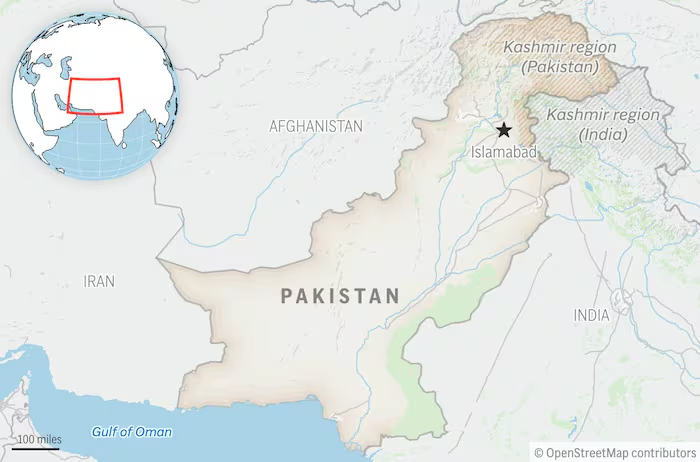
Pakistan administered Kashmir officials allege outlawed group tried to sabotage regional election

‘Drug abuse fuels 70% of major crimes in Kano’ – Task force chair
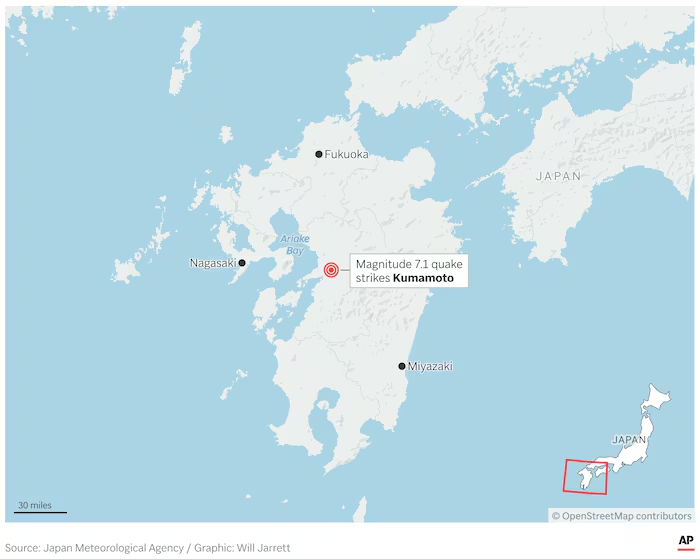
A 7.1 magnitude quake hits Japan's southern Kyushu island and dozens are injured or missing

Lady knocks Peller for choosing wealthy guests over loyal fans ahead of his wedding

 Headlines19 hours ago
Obi Is A Trader, Traders Have Short-term Calculation, They’re Not Into Longterm Projection-Oshiomhole
- Headlines19 hours ago
I retired as an Asst. Director, equal to a Brigadier, while Al-Mustapha retired as a Major—Dennis Amachree
- Headlines20 hours ago
Why Didn’t He Ask Those Probing Questions Like Seun Okinbaloye?–Olayinka Tackles Rufai Oseni Over Peter Obi’s TV Interview
- Special Report21 hours ago
“We Have Done Everything Possible for Peace, But Adwoa Safo Wants GH¢3.7 Million Before Releasing Our Father’s Body” — Nana Kwadwo Safo Akofena
- Special Report6 hours ago
Kennedy Agyapong Adds Another Empire — Kennedy Agyapong Acquires Platinum Plastics In Major Industrial Move
- Special Report9 hours ago
Church Or Circus? Viral Video Of Pastor Performing Strange ‘Rituals And Deliverance’ On Members Sparks Uproar
- Special Report5 hours ago
“Please Don’t Attend!” — Kantanka Family Disowns Adwoa Safo’s July 30 Burial, Warns Public To Stay Away
- Special Report10 hours ago
“Buy My Snacks, Not My Number!” — Beautiful Hawker Cries Out Over Customers Who Only Want To ‘Eat’ Her