Society
How 3D Creators Can Build Fictional Worlds With a Strong Sense of Place


For 3D creators, those decisions begin before modelling. A strong sense of place comes from the relationship between buildings, objects and everyday activity. Individual assets gain meaning when they support the same imagined world.
AI tools can help artists explore early shapes, while research and art direction provide the context that makes those shapes useful. The goal is to create a setting with its own internal logic.
Imagine a short animation set in a fictional neighbourhood market. A schoolgirl arrives to collect her grandfather’s repaired radio before the stalls close.
The scene needs to answer practical questions. Where does the girl enter? How do shoppers move through the space? Which stall repairs electronics, and how can the audience recognise it?
A wide central path might allow carts to pass, while narrower gaps lead to individual sellers. A repair stall could have a workbench close to its entrance, a lamp above the work area and a shelf for collected devices.
These choices give the environment a purpose. They also help the director decide where to place the camera and which objects need attention.
The example is fictional. A real neighbourhood, community or cultural tradition would require its own research rather than being treated as a ready-made collection of visual motifs.
Reference gathering becomes more useful when it looks beyond attractive colours and patterns.
Study how structures respond to climate, available materials and the activities they contain. An awning suggests a need for shade or rain protection. A raised shelf may keep goods away from a wet floor. A repaired sign can show that a shop has operated through several changes.
Use multiple references and keep notes about what each one contributes. A photograph may help with construction, while an interview or written account explains how the space is used.
When a project draws from a specific Nigerian community, identify that community precisely and consult relevant sources or collaborators. Avoid combining unrelated details simply because they look distinctive. A design decision should have a reason within the story and the setting.
Also review permissions before using photographs, artworks or other people’s designs as production references.
A fictional world does not need every object to look identical. It does need relationships that make variation feel intentional.
For the market, the art team might establish that permanent stalls use painted timber frames, while temporary sellers use folding tables and fabric covers. Repair shops could share practical task lighting, with each owner arranging tools differently.
Those rules help the team make new assets without designing every object in isolation.
Decide which features belong to the whole environment and which belong to a particular character. The width of the central walkway affects the scene. The girl’s worn school bag belongs to the individual.
Keep a short visual guide with approved colours, materials, proportions and reference images. Update it when the project changes, so that another artist can understand why an object belongs in the setting.
Once the visual rules are clear, artists can experiment with individual objects. For the radio-repair stall, those might include a task lamp, a parts container or the radio itself.


Fatal Bayelsa clash: Monarch clears Nembe E&P, questions link to land acquisition – The Witness Nigeria

US elections: Same cabal ousted Jonathan, installed Buhari, unleashed Boko Haram in Nigeria – Ex-Mayor

They Want To Persecute Me – Karimi Reacts To Court Judgement Sacking Him As Kogi West Senatorial Candidate

Namibia President hails Dangote’s $2.5bn investment as historic milestone for African industrialisation – The Witness Nigeria

Lafia Presidential Rally: RELAX DG Ahmed Bala leads members to campaign flag-off, highlights Tinubu’s North-Central projects

Lower impairments, higher fees raise Access Holdings 9 months 2026 PBT to N667.4bn – The Witness Nigeria

PSC fires three senior officers, demotes 16, sanctions 23 others over misconduct – The Witness Nigeria

JUST IN: Court removes David Mark-led ADC leadership, nullifies Atiku’s presidential ticket – The Witness Nigeria

LAKURAWA TERRORISTS REPORTEDLY MOVING TOWARD MABURYA VILLAGE AS 21 COMMUNITIES FLEE ATTACKS IN NIGER STATE

2027: Warn Your Children, Don’t Let Politicians Make Them A Statistic – Aisha Yesufu To Nigerian Mothers

Turkey: Galatasaray have found special No.10 to solve their Osimhen problem – Erman Özgür

Police arrest two suspects in Delta, recover pump-action gun, locally made guns

It Is Very Petty For You To Descend To This Level – Obono-Obla Slams Atiku Over Calabar Insecurity

UECL: Arokodare bags brace, assist as Ajax thrash FC Midtjylland 6-1

Funke Akindele’s ‘The Four’ Sells Out London Premiere Ahead Of December Cinema Release

Zidane’s son dropped from Algeria squad for AFCON qualifiers

Abiodun’s Ogun ranks 31st of 35 states in BudgIT fiscal report as Lagos leads

Rainbow Coalition Buses Flood Rivers Ahead of Tinubu’s Visit

$1 cannot buy anything in US, but N2,000 can feed you at ‘mama put’ – Oshiomhole

NPA Calls For Private Investment As Lekki Deep Sea Port Reaches Full Capacity

 Politics6 days ago
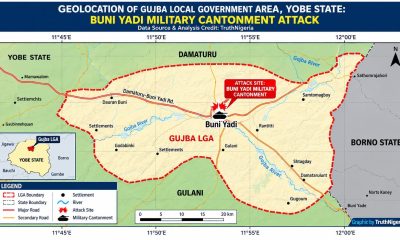
Over 200 Boko Haram Terrorists Are Moving To Attack Military Camp In Buni Yadi As Rockets Target Troops; IED Threat Raises Travel Concerns
- Metro6 days ago
“The Election Must Hold As Scheduled” — INEC Chairman Rules Out Postponement Of 2027 General Elections
- Metro5 days ago
“Publishing His Name Is Subject To The Final Outcome Of A Court Order” — INEC Leaves Gwarzo Off Updated Kano Governorship List
- Metro6 days ago
“Ebola Outbreak Is Not Yet Under Control” — Africa CDC Warns As Confirmed Cases Exceed 10,200, Death Toll Surpasses 5,000
- Metro6 days ago
“Death Benefits Will Be Fully Paid To Next Of Kin” — NAF Pledges Continued Salaries For Personnel Killed In October 5 Aircraft Crash
- Metro6 days ago
“Sowore’s Whereabouts Remain Unknown” — Armed Men Allegedly Abduct AAC Presidential Candidate In Ado-Ekiti, Damage Vehicles And Restaurant
- Metro5 days ago
“They Beat Me Like A Criminal” — Sowore Recounts Ekiti Attack As Govt Denies Involvement, Calls For Police Investigation
- Metro5 days ago
“21 Exotic Vehicles Affected, No Life Lost” — LASEMA Confirms Lagos Mechanic Workshop Fire, Averts Disaster At Nearby Filling Station