Metro
Organised Crime-Related Homicides Kill 95,000 People Annually, UNODC


The United Nations Office on Drugs and Crime (UNODC) has said organised crime-related homicides claim about 95,000 lives globally every year, with criminal groups increasingly expanding their activities across drugs, firearms, cybercrime, human trafficking and other illicit markets. In a research brief published on its website, the UNODC said the……
The United Nations Office on Drugs and Crime (UNODC) has said organised crime-related homicides claim about 95,000 lives globally every year, with criminal groups increasingly expanding their activities across drugs, firearms, cybercrime, human trafficking and other illicit markets.
In a research brief published on its website, the UNODC said the figure, covering the period between 2000 and 2023, is roughly comparable to the annual number of deaths caused by armed conflicts worldwide.
The agency said organised crime groups operate in environments ranging from local communities and sub-national regions to the high seas and warzones, causing extensive harm beyond direct violence.
According to the UNODC, one in every five intentional homicides globally is linked to organised criminal groups, while such killings account for about half of all intentional homicides in the Americas.
The agency said the consequences of organised crime also include drug-related deaths, attacks on journalists and community leaders, corruption and the weakening of government institutions and democratic processes.
Read Also: Senegal PM, Sonko seeks to repeal fmr president Sall’s amnesty law
“Meanwhile, the billions of dollars generated by OCGs give them enormous financial leverage over State institutions, enabling them to infiltrate the government and corrupt officials,” the UNODC said.
It added that illicit economies could also distort legitimate economic activity, discourage investment and sustainable growth, while diverting public funds that could otherwise be directed towards health, education and infrastructure.
On how criminal groups establish control, the UNODC identified “criminal governance” as one of the major threats posed by organised crime.
It described criminal governance as the ability of organised criminal groups to establish and enforce alternative rules to those of the state.
According to the agency, criminal groups use coercion, intimidation, corruption, selective provision of services and market manipulation to establish such control.
The UNODC explained that communities can also end up tacitly accepting criminal governance when groups provide jobs and basic services, including regulating petty crime.
“By threatening or using violence, for example, OCGs coerce fearful communities or authorities to cooperate,” the agency said.
The UNODC said most organised crime revenue globally comes from the illicit production and trafficking of goods or people, including drugs, firearms, migrants, wildlife, natural resources, cultural property, falsified medicines and fuel.
It described drug trafficking as the financial backbone of most transnational organised criminal groups, with the global illicit drug trade estimated to generate hundreds of billions of dollars annually.
The agency said illicit financial flows linked to opiate and methamphetamine trafficking along the Balkan route were estimated at between $3.4 billion and $6.9 billion annually between 2019 and 2022.
The UNODC also highlighted the growing role of cybercrime, noting that financial losses from online scams targeting victims in East and Southeast Asia alone were estimated at between $18 billion and $37 billion in 2023.
The agency said technological advances had enabled criminal groups to target victims across borders and conduct online extortion, fraud and scams on an industrial scale.
“Victims no longer need to be in the same physical space as perpetrators, who can now operate across borders and in multiple locations at the same time,” it said.
According to the UNODC, technology has not only increased the scale and speed of traditional crimes but has also created new forms of cyber-dependent crime, including cyberfraud, hacking and malware attacks.
The research brief recommended several measures to tackle organised crime, including joint threat assessments, stronger information sharing across sectors, disruption of illicit financial flows and the confiscation or recovery of criminal proceeds.
The UNODC said these measures are among the strategic priorities required to counter the growing reach and influence of transnational organised crime.


Police invite late singer, Toluwanisings’s wife, father, as parties sign peace deal – The Witness Nigeria

Fatal Bayelsa clash: Monarch clears Nembe E&P, questions link to land acquisition – The Witness Nigeria

After four years in detention, DSS clears four IPOB suspects, pays N20m compensation – The Witness Nigeria

US elections: Same cabal ousted Jonathan, installed Buhari, unleashed Boko Haram in Nigeria – Ex-Mayor

“Renting Your Property To A Terrorist Is Also An Offence” — FG Warns Landlords, Says Terrorism Support Attracts Minimum 20-Year Jail Term

Lafia Presidential Rally: RELAX DG Ahmed Bala leads members to campaign flag-off, highlights Tinubu’s North-Central projects

“No Degree Of Rigging Can Silence The Will Of The People” — Obi’s Camp Warns Governors Against Manipulating 2027 Elections

Namibia President hails Dangote’s $2.5bn investment as historic milestone for African industrialisation – The Witness Nigeria

They Want To Persecute Me – Karimi Reacts To Court Judgement Sacking Him As Kogi West Senatorial Candidate

“INEC Cannot Investigate INEC” — Ezekwesili Demands Independent Voter Register Audit, Warns Against Compromised 2027 Elections

Bandits attack Kebbi community, kill one, abduct several residents

Kogi West: Karimi rejects court judgement, vows to go on with campaigns

Och’Idoma seeks stronger action against hunger, malnutrition in Benue

From illegal detention to courtroom abuse: NJC punishes three judges

Daniel leads Senate Joint Committee meeting on insecurity in Nigerian waterways

Benue former Chief Judge, Justice Adam Onum is dead

2027: ‘Peter Obi’s Logic Is Short-Term Turnover Unlike Tinubu Who Thinks Of Next Generation’ – Oshiomhole

NPFL: Rivers United responds to sanction over broadcast blockage

Kano seizes 5,964 bottles of expired soft drinks in Singer Market

Makinde, Ajadi, Adekanmbi celebrate NBHA at 2026 Hair and Body Care Exhibition in Ibadan

 Politics5 days ago
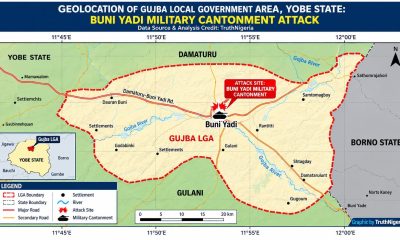
Over 200 Boko Haram Terrorists Are Moving To Attack Military Camp In Buni Yadi As Rockets Target Troops; IED Threat Raises Travel Concerns
- Metro5 days ago
“The Election Must Hold As Scheduled” — INEC Chairman Rules Out Postponement Of 2027 General Elections
- Metro5 days ago
“Publishing His Name Is Subject To The Final Outcome Of A Court Order” — INEC Leaves Gwarzo Off Updated Kano Governorship List
- Metro5 days ago
“Ebola Outbreak Is Not Yet Under Control” — Africa CDC Warns As Confirmed Cases Exceed 10,200, Death Toll Surpasses 5,000
- Metro6 days ago
“Death Benefits Will Be Fully Paid To Next Of Kin” — NAF Pledges Continued Salaries For Personnel Killed In October 5 Aircraft Crash
- Metro5 days ago
“Sowore’s Whereabouts Remain Unknown” — Armed Men Allegedly Abduct AAC Presidential Candidate In Ado-Ekiti, Damage Vehicles And Restaurant
- Metro5 days ago
“They Beat Me Like A Criminal” — Sowore Recounts Ekiti Attack As Govt Denies Involvement, Calls For Police Investigation
- Metro5 days ago
“We Know What They Did And How They Did It, But I Don’t Know Why” — INEC Reveals Findings On AI-Generated Photos In Voters’ Register