Metro
Kara Bridge Repairs: Why It Matters For Nigeria’s Economy, Alternative Routes

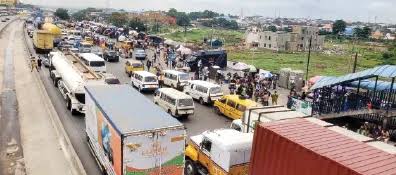
The Federal Government’s two-week repair of damaged expansion joints on the Kara Bridge has triggered severe traffic congestion along the Lagos-Ibadan Expressway and spilled into several parts of Lagos, with motorists and commuters reporting hours-long journeys and virtually standstill traffic….
The Federal Government’s two-week repair of damaged expansion joints on the Kara Bridge has triggered severe traffic congestion along the Lagos-Ibadan Expressway and spilled into several parts of Lagos, with motorists and commuters reporting hours-long journeys and virtually standstill traffic.
The rehabilitation, which began on Tuesday, September 8, 2026, is scheduled to run until September 22, subject to completion of the work.
But with the project only on its first day, the immediate question for thousands of motorists is not simply when the bridge will be fixed, but how they can navigate the corridor over the next two weeks.
What is being repaired?
The work involves the expansion joints on Kara Bridge, a critical component that allows a bridge to expand and contract safely in response to temperature changes, traffic loads and other movement.
According to the authorities, the existing joints have exceeded their service life. Continued deterioration could result in problems such as cracking or buckling, making their replacement necessary.
The actual construction zone is understood to cover roughly 100 metres.
However, the traffic consequences are potentially much wider because Kara is one of the principal gateways between Lagos, Ogun State and the wider South-West.
Is Kara Bridge completely closed?
No.
This is an important distinction for motorists.
The bridge is not being completely shut to traffic. Instead, the work is being carried out in phases.
During approximately the first week, workers will repair one half of the expansion joint while vehicles pass slowly through the remaining section under traffic control.
After about a week, the work will shift to the other half, while motorists are redirected through the section that has already been completed.
This means that although the bridge remains open, movement through the work zone will be restricted throughout the two-week exercise.
The Federal Road Safety Corps (FRSC), Lagos State Traffic Management Authority (LASTMA) and the Ogun State Traffic Compliance and Enforcement Corps (TRACE) are expected to manage traffic and introduce diversions where necessary.
Why has the traffic become so bad?
The problem is simple: too many vehicles are being squeezed through too little road space at one of Nigeria’s busiest transport corridors.
Kara carries a huge volume of private vehicles, commercial buses, trucks and other traffic travelling between Lagos and Ogun and onward to other parts of the South-West.
With part of the carriageway restricted, traffic quickly builds up around the bridge and then backs up along connecting roads.
Reports from the first day of the exercise indicated heavy congestion around Kara, Berger, Arepo, Magboro, Mowe and Ibafo, with the disruption extending into parts of Lagos including Ogudu, Oworo, Ketu, Maryland, Ikeja and Ogba.
Vehicles were also reported to be queued from the Iyana-Oworo axis towards Kara.
The result has been a domino effect: congestion at the bridge pushes traffic backwards, while motorists looking for ways around the affected corridor put additional pressure on alternative roads.
‘Kara crazy’: motorists react
For many road users, the frustration has been intensified by the timing and the expectation that the restriction will last for two weeks.
One motorist, posting early Wednesday morning, said traffic heading out of Lagos remained at a standstill as early as 5:15am, expressing concern about the impact on commuters during the entire repair period.
Another described the maintenance as “uncoordinated”, arguing that road users were not sufficiently considered in the planning.
There was also frustration over the frequency of interventions at the bridge.
One commuter questioned why the bridge appeared to require repairs repeatedly, asking: “When will they fix it permanently?”
Other motorists reported having to abandon vehicles and walk because of the gridlock.
One road user said that at about 8:31pm, there was virtually no movement around the Secretariat-Berger corridor and that the person eventually trekked from the Secretariat to Berger after the bus remained stuck around Ikosi.
There have also been conflicting reports about traffic conditions at different times and locations, illustrating how rapidly conditions are changing along the corridor.
Why was the repair postponed?
The intervention was initially expected to commence in August, but the start date was subsequently moved to September 8.
The postponement followed concerns over the notice given to motorists and the need for better preparation ahead of the disruption.
However, the experience on the first day suggests that even advance notice may not completely prevent severe congestion on a corridor carrying such a large volume of traffic.
What alternative routes are available?
Motorists who do not need to use the Kara section should consider avoiding the Lagos-Ibadan Expressway altogether during peak periods.
Among the alternative corridors identified in connection with the intervention are:
1. Ikorodu–Ogijo route
Motorists travelling between Lagos and destinations in Ogun can consider the Ikorodu–Ogijo corridor, depending on their final destination.
This may be particularly useful for road users who can approach Ogun through the eastern Lagos/Ikorodu axis rather than joining the Lagos-Ibadan Expressway at Berger.
2. Lagos–Ota–Abeokuta corridor
Motorists heading towards parts of Ogun and Abeokuta can consider the Lagos–Ota–Abeokuta route, where it provides a practical alternative to the Kara corridor.
3. Local diversion routes
Depending on the direction of travel, motorists may also use local roads around Arepo, Magboro, Mowe and Ibafo, although these should be approached with caution.
The danger is that roads that appear attractive on a navigation application can quickly become overwhelmed once thousands of motorists attempt to use them as escape routes.
Should you use an alternative route?
If your journey does not require the Lagos-Ibadan Expressway, yes — particularly during peak periods.


Motorists should consider:
Leaving much earlier than usual.
Avoiding the Kara/Berger corridor during peak traffic periods where possible.
Checking live traffic conditions before setting out.
Using alternative routes only where they genuinely shorten the journey.
Avoiding unnecessary stopping around the bridge.
Giving way to emergency and traffic-management personnel.
Ensuring vehicles are mechanically sound to reduce the risk of breakdowns in already restricted lanes.
A minor breakdown can have an outsized effect when traffic is already being funnelled through a narrow passage.
Why can’t the work simply wait?
This is perhaps the most important part of the story.
The immediate inconvenience is considerable, but expansion joints are not cosmetic features.
They accommodate movement within a bridge. When they deteriorate beyond their useful service life, allowing the problem to persist can create more serious structural and operational risks.
That creates a difficult balance for authorities: accept significant short-term traffic disruption to carry out necessary maintenance, or postpone the work and risk a more serious failure later.
For a bridge carrying thousands of vehicles daily, the latter could be considerably more disruptive.
The bigger problem: Kara’s strategic importance
The Kara Bridge is effectively a choke point on one of the country’s most important road corridors.
The Lagos-Ibadan Expressway connects Nigeria’s commercial capital with Ogun State and provides a major route into Ibadan and the wider South-West.
It is also important for the movement of goods between Lagos ports, industrial centres and markets across the region.
That means a restriction at Kara does not affect only people living around the bridge.
It affects:
commuters → commercial drivers → businesses → freight operators → traders → logistics companies → emergency services → the wider regional economy.
This explains why a repair zone measuring only about 100 metres can produce traffic problems several kilometres away.
What should motorists expect over the next two weeks?
The most realistic expectation is slow movement and periodic heavy congestion, particularly during morning and evening peaks.
Traffic conditions will not necessarily remain the same throughout the day. They can also change rapidly depending on accidents, vehicle breakdowns, enforcement activity, weather and the volume of motorists attempting to use diversion routes.
Motorists should therefore not assume that because the road was moving freely at one time, it will remain so later in the day.
The bottom line
The Kara Bridge intervention is not a complete bridge closure, but it is effectively a major traffic restriction on one of the busiest road corridors connecting Lagos with the South-West.
The Federal Government has scheduled the work for about two weeks, from September 8 to September 22, with repairs being undertaken in phases so that traffic can continue moving through the bridge.
For motorists, however, the next two weeks will require planning, patience and route flexibility.
The immediate inconvenience is already being felt. But the authorities’ challenge is to ensure that the disruption remains temporary — and that when the work is completed, motorists are not back at Kara again asking the same question: why is this bridge being repaired yet again?


Fatal Bayelsa clash: Monarch clears Nembe E&P, questions link to land acquisition – The Witness Nigeria

US elections: Same cabal ousted Jonathan, installed Buhari, unleashed Boko Haram in Nigeria – Ex-Mayor

They Want To Persecute Me – Karimi Reacts To Court Judgement Sacking Him As Kogi West Senatorial Candidate

Lafia Presidential Rally: RELAX DG Ahmed Bala leads members to campaign flag-off, highlights Tinubu’s North-Central projects

Namibia President hails Dangote’s $2.5bn investment as historic milestone for African industrialisation – The Witness Nigeria

Lower impairments, higher fees raise Access Holdings 9 months 2026 PBT to N667.4bn – The Witness Nigeria

PSC fires three senior officers, demotes 16, sanctions 23 others over misconduct – The Witness Nigeria

JUST IN: Court removes David Mark-led ADC leadership, nullifies Atiku’s presidential ticket – The Witness Nigeria

LAKURAWA TERRORISTS REPORTEDLY MOVING TOWARD MABURYA VILLAGE AS 21 COMMUNITIES FLEE ATTACKS IN NIGER STATE

“I Drove A Taxi To Pay For My Education” — Tinubu Recalls U.S. Struggles, Highlights ₦372bn Student Loans

FG digital reforms targeting 95% digital literacy by 2030 – NITDA DG – The Witness Nigeria

U-17 Women’s World Cup Final: Tinubu charges Flamingos to beat Japan, make history in Morocco

Ex-banker Obinna Nwaobi accused of diverting N515m from customer’s account

ADC Will Not Back Down, Nakudu Declares Amid Leadership Crisis

Suspected bandits take over eight Taraba communities, restrict residents’ movement

Rivers: Your Son Cannot Win – Wike Warns Lulu-Briggs Kinsmen

Ben Emma Blasts IYC President Doubra Okotete Over Alleged Hypocrisy, Silence on Missing Ijaw Men

‘Mr Barefaced Hypocrite’ – Presidency Calls Out Obi Over Past Comments on ADC Crisis

Retirement: Piers Morgan lists Cristiano Ronaldo’s greatest achievements with Portugal

NDC Sends Message To Judiciary Over Ruling Sacking Mark-led ADC Leadership

 Politics6 days ago
Over 200 Boko Haram Terrorists Are Moving To Attack Military Camp In Buni Yadi As Rockets Target Troops; IED Threat Raises Travel Concerns
- Metro5 days ago
“The Election Must Hold As Scheduled” — INEC Chairman Rules Out Postponement Of 2027 General Elections
- Metro5 days ago
“Publishing His Name Is Subject To The Final Outcome Of A Court Order” — INEC Leaves Gwarzo Off Updated Kano Governorship List
- Metro6 days ago
“Ebola Outbreak Is Not Yet Under Control” — Africa CDC Warns As Confirmed Cases Exceed 10,200, Death Toll Surpasses 5,000
- Metro6 days ago
“Death Benefits Will Be Fully Paid To Next Of Kin” — NAF Pledges Continued Salaries For Personnel Killed In October 5 Aircraft Crash
- Metro5 days ago
“Sowore’s Whereabouts Remain Unknown” — Armed Men Allegedly Abduct AAC Presidential Candidate In Ado-Ekiti, Damage Vehicles And Restaurant
- Metro5 days ago
“They Beat Me Like A Criminal” — Sowore Recounts Ekiti Attack As Govt Denies Involvement, Calls For Police Investigation
- Metro6 days ago
“We Know What They Did And How They Did It, But I Don’t Know Why” — INEC Reveals Findings On AI-Generated Photos In Voters’ Register