Politics
Sahel Jihad Closing in on Nigeria

And Washington and Paris Should Be Worried: Experts
By Mike Odeh James
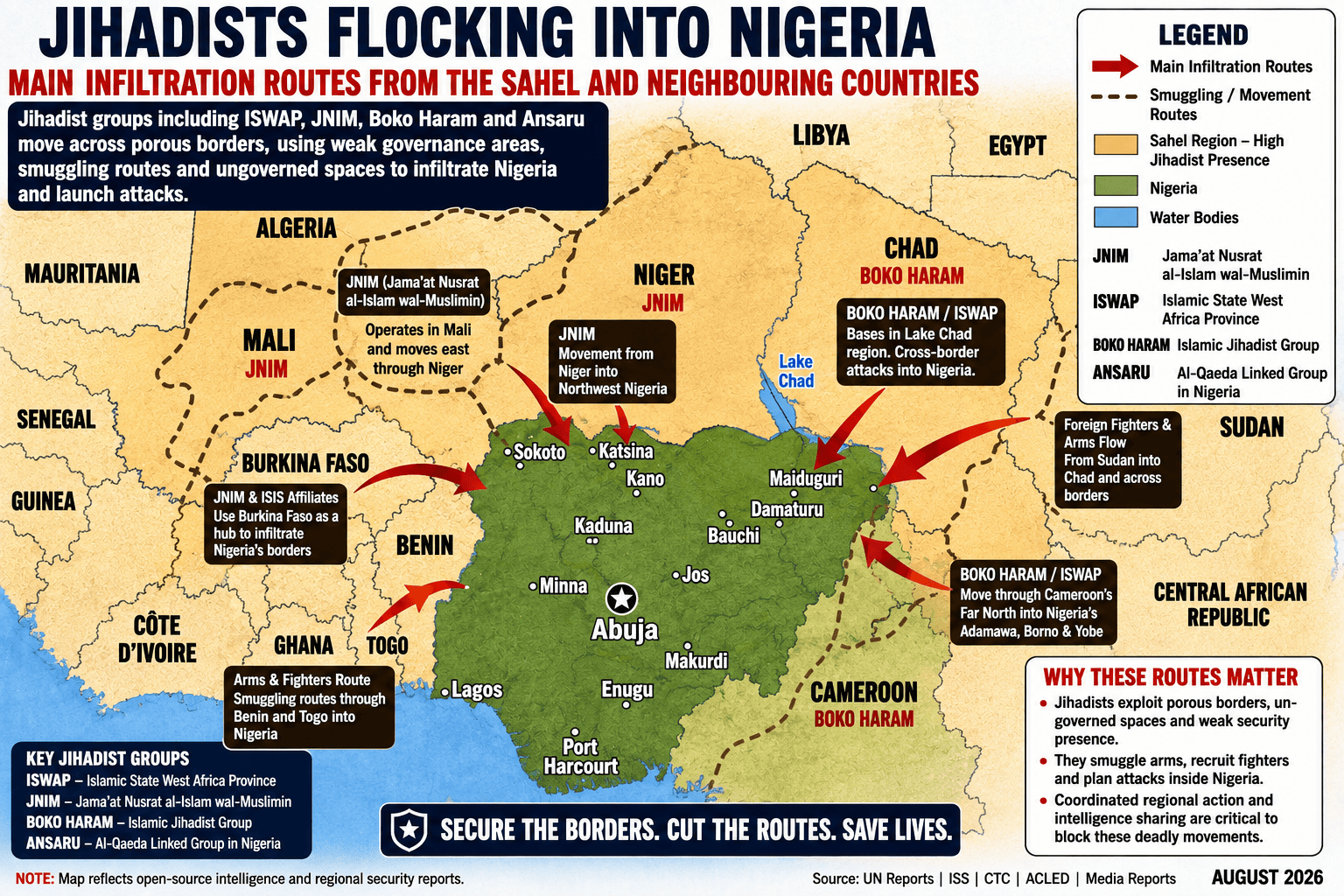
(Abuja) The al-Qaeda blockade choking Bamako, capital of Mali, the jihadist siege engulfing Burkina Faso, and the world’s most active Islamic State affiliate are converging on Nigeria.
That is the picture emerging from the United Nations Secretary-General’s 23rd strategic report on ISIL/Da’esh, delivered to the Security Council on Aug. 5. Circulated to Council members on July 30 as document S/2026/638, it names Africa the current epicenter of Islamic State activity worldwide and singles out the Islamic State West Africa Province (ISWAP) as the movement’s most active affiliate on the planet.
Read against events in Mali, Burkina Faso, and Nigeria’s own troubled peripheries, the document describes a regional collapse now closing in on Africa’s most populous nation — and one Washington has quietly begun rehearsing responses to.
Bamako Under Siege
The most dramatic evidence is in Mali. Since September 3, 2025, al-Qaeda-linked Jama’at Nusrat al-Islam wal-Muslimin (JNIM) has waged an economic war on Bamako, attacking the tanker convoys that carry roughly 95 percent of the landlocked country’s fuel from its northern neighbor, Senegal, and its southern neighbor, Côte d’Ivoire. More than 300 tankers have been destroyed since. On April 25, 2026, Mali’s defense minister, General Sadio Camara, was killed in a JNIM/FLA car-bomb attack at Kati, near Bamako. Junta leader Assimi Goïta now moves fuel into the capital only under armed escort by soldiers and Russia’s Africa Corps.
Ouagadougou: A Mogadishu Scenario
Next door in Burkina Faso, analysts estimate that JNIM and Islamic State Sahel Province (ISSP) control as much as 60 percent of national territory. Captain Ibrahim Traoré’s junta has dissolved every political party, expelled the top UN representative, banned 118 NGOs, and in June formally severed all diplomatic ties with France.
In October 2025, JNIM claimed its first attack on Nigerian soil near the Benin border. Islamic State Sahel Province (ISSP) has since pushed into Sokoto and Kebbi states through Lakurawa (“the recruits”) — a group originating from Mali and now, per the Nigerian military, imposes “zakat” levies, abducts schoolchildren, and cooperates with Boko Haram.
On February 3, 2026, Lakurawa-linked gunmen killed at least 162 people in Woro and Noko villages in Kwara State, deep inside the Middle Belt. On December 25, 2025, US forces struck ISSP camps in Tangaza county, Sokoto – the first known American kinetic action inside Nigeria against a Sahel-linked affiliate.
“The implications for Christians in the Middle Belt are very bleak,” Adakole Adam, of Adamson Security Consultancy in Takum, told TruthNigeria. “The jihadists from the Sahel are bent on exterminating Christianity. Look at what they are doing in Burkina Faso, burning churches and killing Christians. ISWAP and Boko Haram are already doing the same in the Northeast, and Ansaru in the Northwest. Jihadists from Mali are now flocking into Nigeria through Benin Republic, and from there they push into the Middle Belt states.”
In the Northeast, ISWAP alone commands between 8,000 and 12,000 fighters, and UN monitors say the affiliate is now acquiring and employing commercial drones.
Why Washington Should Be Worried
The US has already lost its $110 million air base at Agadez in Niger. France has been ejected from Mali, Burkina Faso, and Niger. Russia’s Africa Corps has replaced them, and Foreign Minister Sergey Lavrov endorsed an expanded military pact with the Alliance of Sahel States (AES) at a Niamey summit last week.
That shift has not gone unnoticed in the Trump administration. In mid-July, Frank Garcia, the recently confirmed US assistant secretary of state for African affairs, made his first official trip to the continent, arriving in Nigeria before stops in Côte d’Ivoire and Mali.
“The selection of the countries shows the interest Washington currently has,” Scott Morgan, a Washington-based analyst with Red Eagle Enterprises, told TruthNigeria. “It was shortly after Mr. Garcia left Mali that US military action for Mali was first floated.”
Morgan said the emerging Christian-protection framework could apply to both Mali and Burkina Faso — with Ouagadougou, in his view, the likelier target. “The situation in Mali is more problematic. If that junta fails and the Russians have to withdraw from more than the northern part of the country, there are concerns of increased migrant flows northward toward Europe,” he said. “Someone is hedging their bets and preparing for the possible collapse of one of the AES states.”
Why Paris Should Be Worried
For Paris, the losses are already booked. Operation Barkhane’s 5,100 French troops across Mali, Niger, Burkina Faso, and Chad are gone. Niger’s uranium contracts – long a pillar of French energy security – sit with a junta hostile to Paris.
France’s remaining depth in West Africa runs through the Francophone coast — Senegal, Côte d’Ivoire, Benin, Togo — and through Abuja. Russia’s ambassador to Togo and Benin said in March that Moscow wants Lomé as a Sahel logistics hub. If Mali’s junta collapses under JNIM’s siege, the migrant surge Morgan warned of will land not in Washington but on Europe’s Mediterranean shore.
What Nigeria Must Do
Morgan argued that Abuja’s most urgent task is internal. “Right now, Nigeria needs to shore up the internal institutions. Increasing the pay of junior enlisted men is a good thing. However, how about more equity by encouraging Christians to join the Army? One underreported concern is the dominance of Muslims in the Nigerian Security Forces,” he said.
He tied the 2027 vote directly to the regional contest: “Having free, fair, and credible elections and a peaceful transfer of power is paramount to show that, despite Russian propaganda, a democratic form of governance is preferable to autocracy.”
Adakole went further, calling on the United States, France, and Britain to press the Tinubu government to deploy troops to the Middle Belt counties where Fulani Ethnic Militia (FEM) violence, Lakurawa expansion, and Sahel-linked jihadists are converging on the same Christian farming communities.
For a Nigeria already fighting FEM in the Middle Belt, ISWAP in the Northeast, and Lakurawa in the Northwest, the UN’s warning is not distant. It is a map of the front line as it already exists.
Mike Odeh James is a conflict reporter with TruthNigeria.
Related


Politics 29 seconds ago Raise Your Voice Consistently – Tinubu Sends Message To Clerics President Bola Tinubu has urged religious and spiritual leaders to consistently speak out against terrorism, kidnapping and banditry. NEWSNGR reports that…

Captain Idahosa Wells Living Museum Unveiled as Children Cement Legacy of Late Icon on Fifth Anniversary

Subsidy removal: Give account of revenue Nigerians lost to inflation – Rufai Oseni blasts NRS boss Adedeji

‘Stop Abusing Me, Tell Oyo People What You Want To Do Differently’ – Makinde Fires Governorship Contestants

Imo State University ASUU Embarks On Indefinite Strike Over Non- Implementation Of 2025 ASUU- FG Agreement.

“Why are you telling me?”- Lady cries out, displays amount mistakenly transferred to her Opay account

Transfer: ‘He’s indispensable’ – Michael Owen warns Man United against letting most important player leave

Exclusive: N750m Special Intervention Money Missing Under Arts Minister Hannatu Musawa, Permanent Secretary And Finance Director – Secrets Reporters Nigeria

Peller’s mum dragged for asking her son to gift her ‘lover’ money at his wedding, Daddy Freeze reacts
‘I Am Likewise Demanding Compensation’: Trump Rejects Iran’s Payback Demand, Puts Counter-Claim On Future Talks
Syrian Leader Bashar al-Assad And Cousin Atef Najib Sentenced to Death in Landmark Syrian Trial
Iran Threat Looms Over Trump: Secret Plane Swap, Decoy Truck Used For Turkey Exit

Sahel Jihad Closing in on Nigeria

U.S. conducts secret Golden Dome tests, but funding for cutting-edge missile shield is uncertain

North Korea has launched a suspected ballistic missile, Japan's Defense Ministry says

Extreme heat is reshaping Italy's sparkling wine industry with early harvests and nighttime picking

State Department condemns new Chinese claim to disputed South China Sea shoal as 'destabilizing'

Katsina United Defender Chinedu Ozor Reportedly Shows Signs of Movement After Death Pronouncement

Houthis' Red Sea attacks pressure Saudis to back ground war Riyadh has spent 3 years trying to avoid

Massie Warns: US Should Avoid War with Iran Before It Becomes Overpowered.

 World22 hours ago
‘I Am Likewise Demanding Compensation’: Trump Rejects Iran’s Payback Demand, Puts Counter-Claim On Future Talks

 Special Report18 hours ago
DSS releases, pays N3m compensation to carpenter cleared of Oyo school kidnap link – The Witness Nigeria
- Metro22 hours ago
“EFCC Arrests Fake Operative In Maiduguri Over Alleged ₦3m Fraud” — Recovers Money, Says Suspect Paraded Himself As Commission Officer
- News17 hours ago
Despite Over ₦625 Million Monthly Allocation & Rich in Coal, Ankpa LGA in Kogi State Battles Darkness, Abandoned Hospital, Deadly Erosion, Daily Hardship Whie Council Chair Focuses on Arresting Citizens – Secrets Reporters Nigeria
- Entertainment13 hours ago
“What’s wrong with me?” — Lady breaks up with boyfriend after he stopped her from closing window in Safari
- Entertainment18 hours ago
“The groom was a bus driver…” — Friends drag bride after travelling from Lagos to Calabar for wedding
- Viral16 hours ago
“I cannot wait…” — Man shares how female colleague spent ₦7,000 on shawarma despite having only ₦8,000
- Entertainment11 hours ago
“I almost had myself killed” – Lady recounts terrifying encounter during first meeting with man she met online