Metro
“Election Violence And Intimidation Undermine Democratic Gains” — EU Raises Concern Ahead Of Nigeria’s 2027 Polls

The European Union has expressed concern over reports of election-related violence, hate speech and political intimidation ahead of Nigeria’s 2027 general elections, warning that such incidents could undermine democratic gains and discourage citizens from participating fully in the electoral process.
The concerns come amid a series of reported attacks and incidents linked to political activities across the country.
In Katsina State, supporters of the All Progressives Congress travelling for a campaign flag-off in Funtua were reportedly attacked along the Yashi-Funtua route in October.
A female passenger was injured and vehicles were damaged, while the police subsequently announced the arrest of 14 suspects.
Similarly, in Calabar, Cross River State, the convoy of the presidential candidate of the Nigeria Democratic Congress, Peter Obi, came under attack on November 4, 2026.
Police confirmed that vehicles were damaged in the incident and announced the arrest of a suspect, while investigations continued.
On November 7, 2026, one person was killed and five others were injured during an attack on a political procession and rally organised by supporters of the NDC along Nnebisi Road in Asaba, Delta State.
The National Peace Committee has also said it recorded 60 election-related incidents within one month, including violence, intimidation and threats.
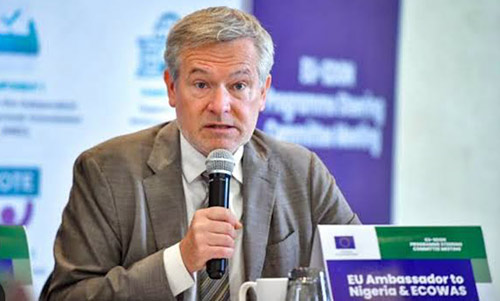
Speaking at the opening session of the Civil Society and Human Rights Defenders Forum on the State of Human Rights in Abuja, the EU Ambassador and Head of Delegation to Nigeria and ECOWAS, Gautier Mignot, said such incidents threatened democratic participation and public confidence in elections.
Mignot described open civic forums, a free media, peaceful assembly and strong civil society organisations as essential to credible elections, saying they promoted transparency and allowed citizens to exchange information, debate issues and scrutinise candidates without fear of censorship or retaliation.
“Free civic and political spaces also help hold leaders and institutions accountable by enabling CSOs and active citizens to monitor election administration, track campaign promises and challenge government policies.
“By enabling free association and assembly, robust civic and political spaces prevent authorities from backsliding or from manipulating rules.
“It is vital to ensure credibility and public confidence in an election. The absence or weakening of these safeguards will directly undermine citizens’ rights to participate meaningfully in elections. This is why the European Union, together with its member states, is committed to ensuring the sustenance of free civic and political spaces in Nigeria,” he said.
Mignot also pledged the EU’s continued support for key institutions, including the National Human Rights Commission and civil society organisations, to strengthen democracy and good governance.
“Our objective is not to interfere in the elections but to support legitimate Nigerian stakeholders to fully play their roles in order to contribute to a free, fair, credible electoral process.
“Stakeholders, the public sector, civil society, political parties, the media, all have a very important role to play,” he stated.
The forum, organised by the NHRC, was themed “Protecting Human Rights in Civic and Political Spaces in the 2027 Elections.”
In his address, the Executive Secretary of the NHRC, Dr. Tony Ojukwu, SAN, said the forum was convened because democracy must be protected throughout the electoral cycle and not only on election day.
“It survives in the space between elections: in the freedom of citizens to speak without fear, to assemble without permits, to associate without obstruction, and to choose their leaders without intimidation,” he said.
Ojukwu cited Section 14 of the Constitution, which provides that sovereignty belongs to the people, as well as Sections 39 and 40 on freedom of expression, association and assembly.
He also referred to Article 13 of the African Charter and Article 25 of the International Covenant on Civil and Political Rights, which protect citizens’ rights to participate in public affairs and genuine elections.
“The right to participate in the conduct of public affairs, including through free and genuine elections under Article 25 of the International Covenant on Civil and Political Rights, ICCPR, is the heartbeat of every freedom we defend.
“When that right is suppressed, democracy does not merely stumble; it begins to die, quietly, through apathy, fear and distrust,” Ojukwu said.
He expressed concern that journalists and human rights defenders continued to operate in difficult environments marked by harassment, arbitrary arrests and what he described as the misapplication of laws, including provisions of the Cybercrimes Act.
“We are concerned by political and voter intimidation, by political exclusion through prohibitive nomination fees that bar women, youth and persons with disabilities from candidature, by the persistence of hate speech and incitement, and by regulatory uncertainties around digital platforms.
“We are concerned, above all, by impunity, evidenced by the absence of accountability for electoral crimes,” he said.
Ojukwu recalled his recent meeting with a delegation from the United Nations Office for West Africa and the Sahel led by Special Representative Leonardo Santos Simão, warning that failure to punish election-related offences encouraged further violations.
“As I said recently when I received the UNOWAS delegation, led by Special Representative, Leonardo Santos Simão, as long as people can commit these election-related offences and go scot-free, then anybody can try anything they like.
“These are warning lights, not yet verdicts. The window to correct course is now, and that is precisely why this Forum meets today,” he added.
Also speaking, the National Chairman of the Inter-Party Advisory Council, Dr. Yusuf Dantalle, said experiences from recent off-cycle elections showed the urgent need to address election-related violence and protect citizens throughout the electoral process.
Dantalle, whose speech was read by Chinedu Obi, said democracy could not be measured only by what happened on election day.
“Democracy is not defined by election day alone; it must be reflected in the entire process, from political campaigns and voter mobilisation to voting, collation and declaration of results.
“As we approach 2027, political competition must not become warfare. Political opponents are not enemies, and electoral victory must never be pursued at the expense of human lives, public peace and national unity,” he said.
IPAC consequently called on political parties, candidates and their supporters to embrace issue-based campaigns, political tolerance and responsible communication.
“We must collectively reject electoral violence, hate speech, voter suppression, political intimidation and every conduct capable of undermining credible elections,” Dantalle added.
The post “Election Violence And Intimidation Undermine Democratic Gains” — EU Raises Concern Ahead Of Nigeria’s 2027 Polls appeared first on TheNigeriaLawyer.


No Outgoing President Has The Right To Burden His Successor – Atiku Blasts Tinubu Over $500 Million World Bank Loan

JUST IN: Mele Kyari appears before senate panel over N210trn NNPC audit queries – The Witness Nigeria

EXCLUSIVE: ENERGY COMMISSION DG MUSTAPHA ABDULLAHI PAID ₦4.2BN TO NEWLY REGISTERED, INACTIVE AND UNTRACEABLE COMPANIES

‘You Adopted Thuggery And Threw Away Values Buhari Infused Into APC’ – Lauretta Onochie Blasts Tinubu

EFCC seeks permanent forfeiture of three properties linked to ex-gov Timipre Sylva – The Witness Nigeria

“No Prior Arrangement Was Made” — NSC Cites Campaign Attire, Players’ Welfare In Denying Peter Obi Access To Flamingos

“Tell Anyone Saying My Ticket Will Be Taken That It Is A Lie” — Uzodimma Insists On Imo West Senate Race Despite Okorocha’s Court Victory

“I Didn’t Tell Them To Go And Buy Votes” — Wike Defends ₦10m Reward For Councillors Who Deliver Wards For Tinubu In 2027

Kogi Airport groundbreaking: RELAX DG Ahmed Bala commends Tinubu, Governor Ododo, Keyamo on aviation infrastructure development

“I Rejected US Political Asylum Because I Committed No Offence” — Obasanjo Recounts Arrest, Imprisonment Under Abacha

Nigerians Will Sleep Without Hunger Under My Government – Peter Obi

World Bank pumps $500m into Nigeria’s fight against floods

Transfer: Glen Johnson advises Chelsea to sign Real Madrid star under Alonso

Otti Unveils Solar-Powered Digital Billboard In Abia, Plans Statewide Expansion

EPL: Harry Kane sends clear message to Man United over Mauricio Pochettino move

Xabi Alonso’s sacking unfair – Real Madrid goalkeeper Thibaut Courtois

“Election Violence And Intimidation Undermine Democratic Gains” — EU Raises Concern Ahead Of Nigeria’s 2027 Polls

Turkey: ‘Give back money you earned’ – Turcan Bolayır slams Osimhen pitch injury claim

17-year-old boy arrested over alleged murder of Ghanaian student in New York

APC sacks Alwan Hassan after 112 emergency call fails on live TV

 Headlines6 days ago
‘Politics is expensive everywhere’ – Wike replies critics over high billboard cost in Abuja
- Metro6 days ago
“Any Algorithm Can Calculate, But It Cannot Care” — NMCN Registrar Warns Nurses Against Overreliance On AI
- Special Report7 days ago
Namibia President hails Dangote’s $2.5bn investment as historic milestone for African industrialisation – The Witness Nigeria
- Metro7 days ago
“We Must Invest In Those Who Shape Migration Narratives” — IOM Partners PAU On Journalist Training, Research
- Metro4 days ago
“Political Violence Has No Place In Democracy” — Peter Obi Condemns Attacks On NDC Supporters In Delta As Oborevwori Orders Investigation, Prosecution
- Metro7 days ago
“35% Women’s Representation In Governance” — FG Prepares Executive Bill For National Assembly, First Lady Backs Initiative
- Metro6 days ago
“Courts Must Guard Their Independence, Impartiality And Integrity” — NDC Warns After Atiku’s Candidacy Is Nullified
 Viral7 days ago
RE: RESPONSE TO MISLEADING PUBLICATION ON THE PRESIDENTIAL AMNESTY PROGRAMME (PAP)