Viral
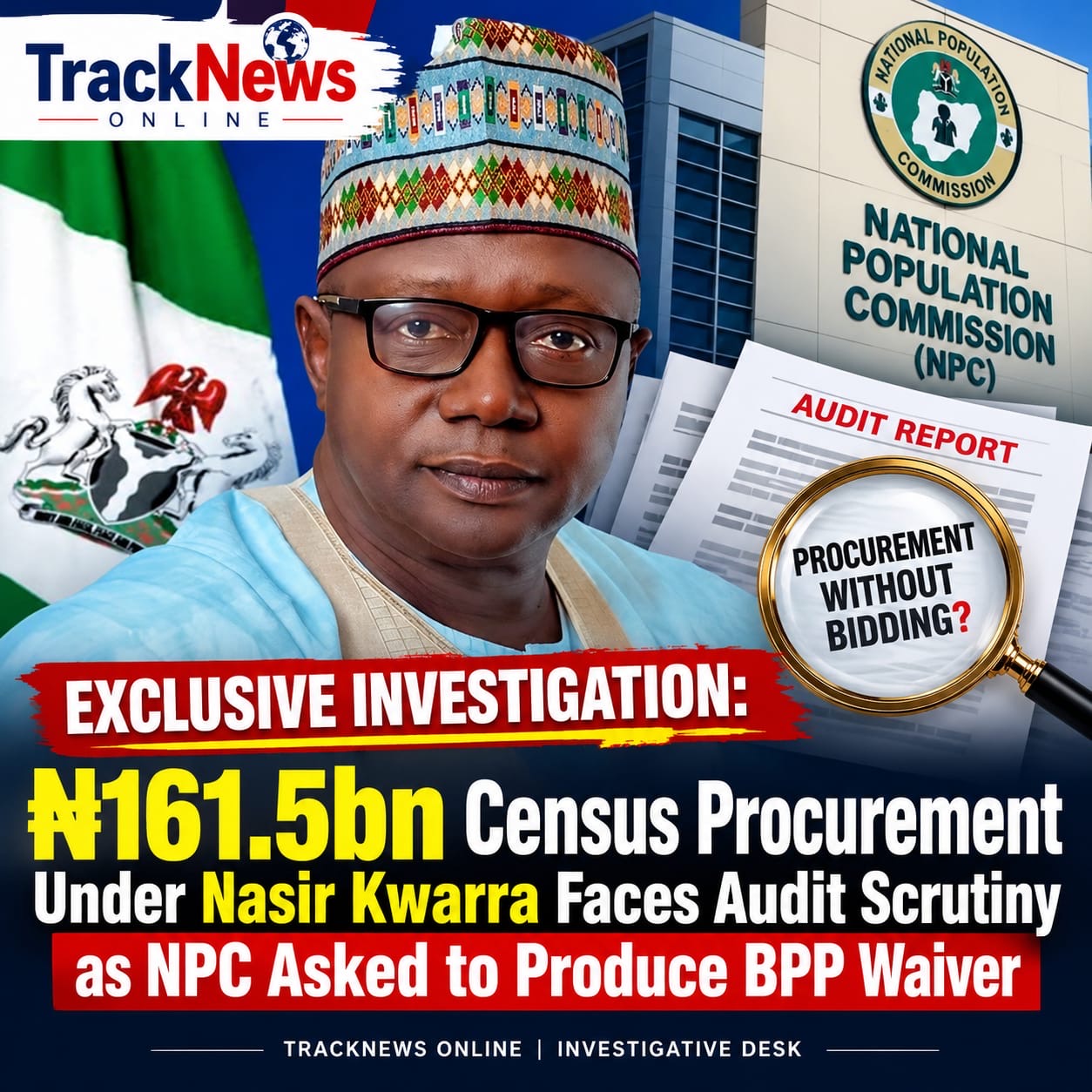
EXCLUSIVE INVESTIGATION: ₦161.5bn Census Procurement Under Nasir Kwarra Faces Audit Scrutiny as NPC Asked to Produce BPP Waiver

TRACKNEWS ONLINE | INVESTIGATIVE DESK
An audit document has raised questions over procurement procedures involving ₦161.55 billion spent by the National Population Commission (NPC) on census-related equipment, materials and services during the tenure of its former Chairman, Nasir Isa Kwarra, with auditors demanding an explanation and a copy of the waiver allegedly required for the procurement method adopted.
The document, exclusively obtained by NGProbe, lists 14 procurement categories totalling ₦161,554,048,345.64 and states that the Commission’s Chief Accounting Officer should explain the procurement method used and provide a copy of the waiver from the Bureau of Public Procurement (BPP).
The recommendation appears at the end of the procurement section, which outlines procedures the auditors said were bypassed in the process.
Kwarra served as Chairman of the National Population Commission from October 28, 2020, to October 28, 2025, a period during which the Commission undertook extensive preparations for a national census.
The audit findings raise questions about transparency, competition and accountability in the award of contracts involving billions of naira in public funds.
₦96.9bn Spent on Census Devices
The largest single procurement category identified in the document was the purchase of personal digital assistants (PDAs), handheld electronic devices intended for census operations.
The procurement was valued at ₦96.91 billion, representing approximately 60 per cent of the total amount listed in the 14 categories.
Other major procurement entries include:
₦14.41 billion for printing various materials.
₦10.61 billion for various software.
₦8.97 billion for laptops and components.
₦6.18 billion for reflective jackets and raincoats.
₦5.39 billion for motor vehicles.
₦4.23 billion for APN SIM data, routers and APN setup.
₦4.15 billion for printing and supplying a historical events calendar.
The technology-related procurements, including PDAs, laptops, software and data connectivity infrastructure, amounted to approximately ₦120.72 billion.
The figures highlight the scale of public expenditure on the technological infrastructure intended to support census preparation and field operations.
However, the central issue identified in the audit document is not simply the amount spent, but the procurement process through which the contracts were handled.
₦4.15bn Calendar Procurement Raises Questions
Among the listed expenditures is ₦4.147 billion for printing and supplying a historical events calendar.
The amount is particularly notable when compared with the Commission’s expenditure on other services.
According to the schedule, payments for various consultancies amounted to ₦1.43 billion, while broadcast and media campaigns cost approximately ₦1.57 billion.
Combined, the consultancy payments and media campaigns totalled about ₦3.00 billion—less than the amount listed for printing and supplying the historical events calendar alone.
The figures raise questions about the scale and justification of the expenditure, the quantities of materials supplied, the unit costs involved and the procedures used to select the contractors.
The audit schedule, however, does not by itself establish whether the calendar materials were delivered, whether their prices were inflated or whether any individual committed fraud. Those questions would require further documentary evidence and responses from the Commission.
Billions Also Spent on Vehicles, Field Equipment and Office Projects
The procurement schedule also lists substantial expenditure on other items associated with census preparation.
These include ₦5.39 billion for motor vehicles, ₦2.18 billion for Pelican boxes, ₦2.07 billion for first aid kits and ₦1.15 billion for identity cards.
The document further records ₦2.30 billion for office renovation and construction.
Payments for consultancies amounted to ₦1.43 billion, while broadcast and media campaigns accounted for another ₦1.57 billion.
Taken together, the 14 listed procurement categories amount to ₦161.55 billion.
The audit document describes the entries as some of the procurements carried out, indicating that the schedule should not automatically be interpreted as a complete account of every procurement undertaken by the Commission during the period.
Auditors Identify Procurement Safeguards
The most significant aspect of the audit document is its examination of the procurement method used for the listed contracts.
According to the document, the auditors identified four key procurement safeguards for which supporting evidence was required.
These include:
1. Prequalification procedures: Evidence that applications were invited from eligible consultants and contractors.
2. Public advertisement: Evidence that contracts were advertised in at least two national newspapers.
3. Competitive quotations: Evidence of quotations from at least three eligible contractors to facilitate the selection of the most responsive bid.
4. Certificate of No Objection: Documentation from the Bureau of Public Procurement confirming compliance with applicable due-process requirements before contract awards.
The auditors stated that the procurement method adopted by the Commission denied prospective suppliers information and opportunities to compete for the relevant goods and works.
Their recommendation called on the Chief Accounting Officer to explain the method used and produce a copy of the BPP waiver covering the procurement process.
The demand for the waiver is central to the findings because such documentation could help establish whether the Commission obtained the necessary authorisation for any departure from the applicable procurement procedures.
The audit document’s demand for an explanation and waiver does not, on its own, establish that the procurement method was unlawful or that the contracts involved fraud. The Commission’s justification, the terms of any waiver and the underlying procurement records would be necessary to determine the full circumstances.
What the Law Says About Public Procurement
Nigeria’s Public Procurement Act 2007 establishes open competitive bidding as the general method for public procurement, subject to the exceptions and procedures provided under the law.
The framework is designed to promote competition, transparency, accountability and value for money in government contracts.
The Act also assigns responsibilities to accounting officers and other officials involved in procurement, making compliance with the prescribed procedures an important part of public financial management.
Where an agency adopts an alternative procurement method, the applicable legal requirements and any necessary approvals become relevant to determining whether the process was properly conducted.
In the case of the NPC, the auditors’ request for a BPP waiver provides a specific documentary issue that the Commission could address by disclosing the relevant approval and explaining how it applied to the contracts in question.
The Fiscal Responsibility Act also provides a broader framework for responsible management of public resources, reinforcing the importance of accountability in government expenditure.
Questions the National Population Commission Must Answer
The audit findings raise several questions that warrant clarification from the Commission and the relevant procurement authorities.
Among them are:
Did the Commission obtain a valid BPP waiver covering the procurement method used for the listed contracts?
What specific circumstances justified the adoption of that method?
Were the contracts supported by detailed bills of quantities, delivery records, inspection reports and payment certificates?
How were the prices of the census devices, software, vehicles and other materials determined?
What quantities of historical events calendars were printed and supplied for the ₦4.15 billion expenditure?
Were the goods and services delivered in accordance with the terms of the respective contracts?
What corrective action, if any, has been taken in response to the auditors’ observations?
Answers to these questions would help establish whether the expenditure was properly authorised, adequately documented and consistent with the applicable procurement rules.
Accountability Questions Remain
The ₦161.55 billion procurement schedule presents a significant public-accountability issue because it covers equipment, technology, logistics and services intended to support a major national exercise.
The audit document’s recommendation places particular emphasis on the procurement method and the need for the Commission’s Chief Accounting Officer to provide an explanation and the relevant BPP waiver.
The findings do not, by themselves, establish personal wrongdoing by Nasir Isa Kwarra or prove that the listed funds were stolen. Determining responsibility would require examination of the individual contracts, approvals, payments, delivery records and responses from the officials involved.
Nevertheless, the scale of the expenditure and the auditors’ concerns make a detailed explanation from the Commission important.
The key question now is whether the National Population Commission can produce the required procurement waiver and demonstrate that ₦161.55 billion in census-related contracts was handled in accordance with the law.
The relevant documentation would help clarify the procurement decisions, the basis for the expenditure and whether the necessary safeguards for public funds were observed.
TRACKNEWS ONLINE | INVESTIGATIVE DESK
Editorial note: This report is based on the audit document described above. Before publication, TrackNews Online should independently verify the document, seek comments from the National Population Commission, Nasir Isa Kwarra and the Bureau of Public Procurement, and incorporate their responses. Any allegations should be presented alongside the available evidence and the responses of the parties concerned.


THE WEEK: Islamist Jihadists Burn Evangelist Alive in Adamawa, Kidnap Catholic Priest in Benue, Strike Bases

EXCLUSIVE: Miami Court Record Proves Gov. Dapo Abiodun Yahoo Name Is Shawn Michael Davis, The Forgery Criminal And Violent Thief He Denied Ever Being

Nigerian Content Board Executive Secretary Felix Ogbe Awarded multi million Naira contract to company three weeks before it was even registered

“With Hearts Weighed Down By Immeasurable Grief” — Former Delta Governor Emmanuel Uduaghan Dies At 71, Family Announces

EXCLUSIVE: NCDMB Under Felix Ogbe Faces ₦221m Diesel Procurement Scandal as ₦42.5m Contract Goes to Company Registered Three Weeks Later

Singer Davido’s Uncle Adeleke Stuffed Government House With N50 Billion, Spent N9.5 Billion To Travel In Nine Months, Including N4.6 Billion For His Refreshments And Meals

Politics 57 minutes ago ‘If Buhari As A Retired General Couldn’t End Nigeria’s Insecurity, What Do You Expect Of Tinubu?’ – Yari The Director-General of the All Progressives Congress (APC) Presidential Campaign Council (PCC), Senator Abdulaziz Yari, has defended the performance of President Bola…

NNPC GCEO Bayo Ojulari Who Came In Broke Spent N129.1 Billion on Security Expenses and Named Not One Firm, Guard or Agency Paid

JUST IN: Ex-Delta governor, Emmanuel Uduaghan is dead

Wicked Kayode Egbetokun Paid N1.21 Billion For Police Poor Feeding To A Company With No Registration Record And Ran N4.78 Billion Of Feeding On Emergency Vouchers As IGP

CONTROVERSY: Nigerian Commentator Condemns Saudi Arabia Over Viral Claim of Honeymoon Couple Killed for Forehead Kiss, Questions Religious Justice

Stella Okoli Steps Down as Emzor Pharma MD, Names Uzoma Ezeoke Successor

Aro psychiatric hospital shuts school indefinitely after student’s death

Ebonyi Commissioner Breaks Silence On Brother’s Murder, Addresses Political Motive Claims

Ogun Government Suspends Monarch, Bans Him From Wearing Crown Over Alleged Partisan Politics

CONTROVERSY: “Give Your Entire Salary as First Fruit to God” — Pastor Adeboye’s Son, Leke, Sparks Debate Among Christians

Bauchi Speaker’s convoy crashes, no life lost

EXCLUSIVE: Africa Richest Woman Folorunso Alakija Who Made Blouses For IBB Wife Before Owning Oil Blocks Now Under EFCC Probe For $1.27 Million Fraud, Undeclared Foreign Transfers, Altered Documents And Money Laundering

Tinubu Will Impose Fuel Tax On Nigerians If Re-elected In 2027 – ADC

Tinubu bought his way into Presidential Villa, became president without studying – Hakeem Baba-Ahmed

 Metro6 days ago
“The Nigeria Airways Mess Was Not Of Obasanjo’s Making” — Fani-Kayode Defends 2004 Liquidation, Says Airline Was Already Ruined By 1999
- News7 days ago
No Nigerian Counted By Nasir Kwarra National Population Commission Yet He Spent N12.5 Billion For Procurement
- Entertainment6 days ago
“We’ll stab, shoot him, then tell everyone he killed our friend” — Lady recounts how armed robbers attacked her brother
- News7 days ago
Umo Eno’s 2025 Books Exposed N78.5 million Naira Farmers’ Loans Trapped in a Dead Bank While Ibom Air Filed No Accounts Since Inception
- Metro7 days ago
“We Are Not Asking Judges To Bend The Rules” — EFCC Chair Olukoyede Calls For Speedy, Rigorous Trial Of Corruption Cases
- News7 days ago
How NNPC GCEO Bayo Ojulari Sold Crude Nigeria Has Not Drilled; Took N3 Trillion In One Month For No Stated Reason And Handed 61,250 Barrels A Day To Lenders
- News7 days ago
Historic Success Federation Of Registered Nollywood Guilds And Associations (FRNGA) Holds Maiden Presidents Summit
- News7 days ago
Otunba Gbenga Daniel Takes Charge of South West Voter Mobilisation for Tinubu’s Presidential Campaign Council