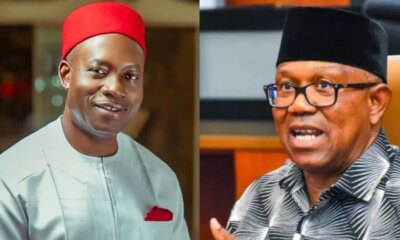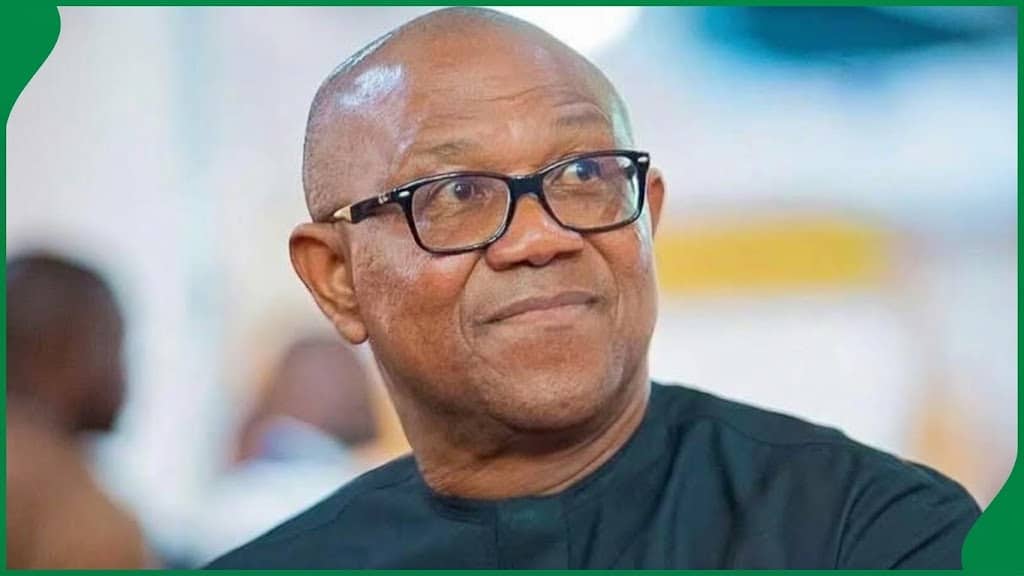
Former governor of Anambra State and presidential candidate of the Nigeria Democratic Congress (NDC), Peter Obi, has once again rejected claims that he left debt in office.
He said the claim that he left $123 million in debt is untrue, adding that he handed over a financially strong government with more than $150 million in funds.
NEWSNGR reports that Obi spoke during an appearance on Arise News on Thursday.
He said the presentation of Anambra’s debt position at the time he left office in 2014 amounted to “very wrong public accounting”.
He said, “Assuming, let me even assume that Anambra State was right, even though it’s false, I did not leave $123 million; let me assume the worst-case scenario: that there was $123.7 million owed as of the time I left. I left over $150 million that was earning about $10 million annually. If they had just kept that money I left and used the income to pay the loan, they would have finished paying it now, with the $150 million capital still remaining and still giving Anambra State $10 million annually.
“How it is now bundled that as of the time I left office, I left $123-something million is very wrong public accounting.”
Obi maintained that he neither borrowed money from financial institutions nor issued bonds for Anambra State throughout his eight-year tenure as governor.
“Let me categorically state again: I, Mr. Peter Obi, did not approach any financial institution to borrow money or issue bonds on behalf of Anambra State in the eight years that I was in government.
“On the day I left office, the government of Anambra State, which I served, was not owing any salary, gratuity, or pension to those scheduled to be paid by the state government. We were not owing any contractor or supplier who had executed their job, certified, and verified,not one. That is the way it is the day I left office,” he said.
The former governor also disputed how World Bank and International Fund for Agricultural Development (IFAD) loans were attributed to the state, explaining that the facilities were obtained by the Federal Government and later made available to states for specific development projects.
“On these issues where World Bank and IFAD loans were listed in documents, the way it is presented is wrong public accounting. First, those were concessionary development support obtained by the Federal Government of Nigeria and on-lent to state governments that qualified or that they wanted to support with certain projects. These are concessionary facilities payable over a period of 25 to 35 years.
“As of the time I assumed office as governor of the state, our foreign debt record was about $18 million. As of the time I left office in March 2014, our foreign debt position was about $30 million. In fact, in December 2014, nine months after I left office, the total foreign debt of Anambra State was $45 million.”
According to Obi, his administration left substantial funds that, if properly managed, could have cleared the state’s foreign debt while retaining significant reserves.
“The day I left Anambra State as governor, I left it in a very strong financial standing that no other state in Nigeria, and I repeat, show me any governor since the inception of this country who left over $150 million in funds. I left it in a financial standing that if they followed what I left, today they would have paid off the foreign debt and had at least $240 million left, earning a minimum of $20 million for the state every year,” he said.
He further explained that the World Bank support was part of a Federal Government initiative targeted at states considered to be performing well in specific areas.
“The Federal Government saw that the state was doing well in education and selected Anambra, Ekiti, and Bauchi. They said, ‘These states are doing well, why don’t we give them concessionary support to help them? The FG and World Bank.”
Obi also referred to former Debt Management Office Director-General Abraham Nwankwo, whom he said publicly acknowledged that the former governor had never approached his office for approval to borrow money.
“To confirm this: the then-DG of the Debt Management Office, Abraham Nwankwo, who was DG for 10 years, invited me as chairman to his send-off party when he left office. He announced to everybody at that party that the reason he made me chairman was because I was the only governor in Nigeria who never came to his office for approval to borrow money. To borrow money as governor, you must go through the Federal Government of Nigeria to get approval. I did not approach the Debt Office, I did not approach the Minister, I did not do any of that,” Obi stressed.
The NDC presidential candidate also pointed to his handover documents as evidence of the state’s financial position at the end of his administration.