Politics
Nigerian Christians Warn of Political Exclusion as Nasarawa’s Ruling Party Selects All‑Muslim Slate for 2027

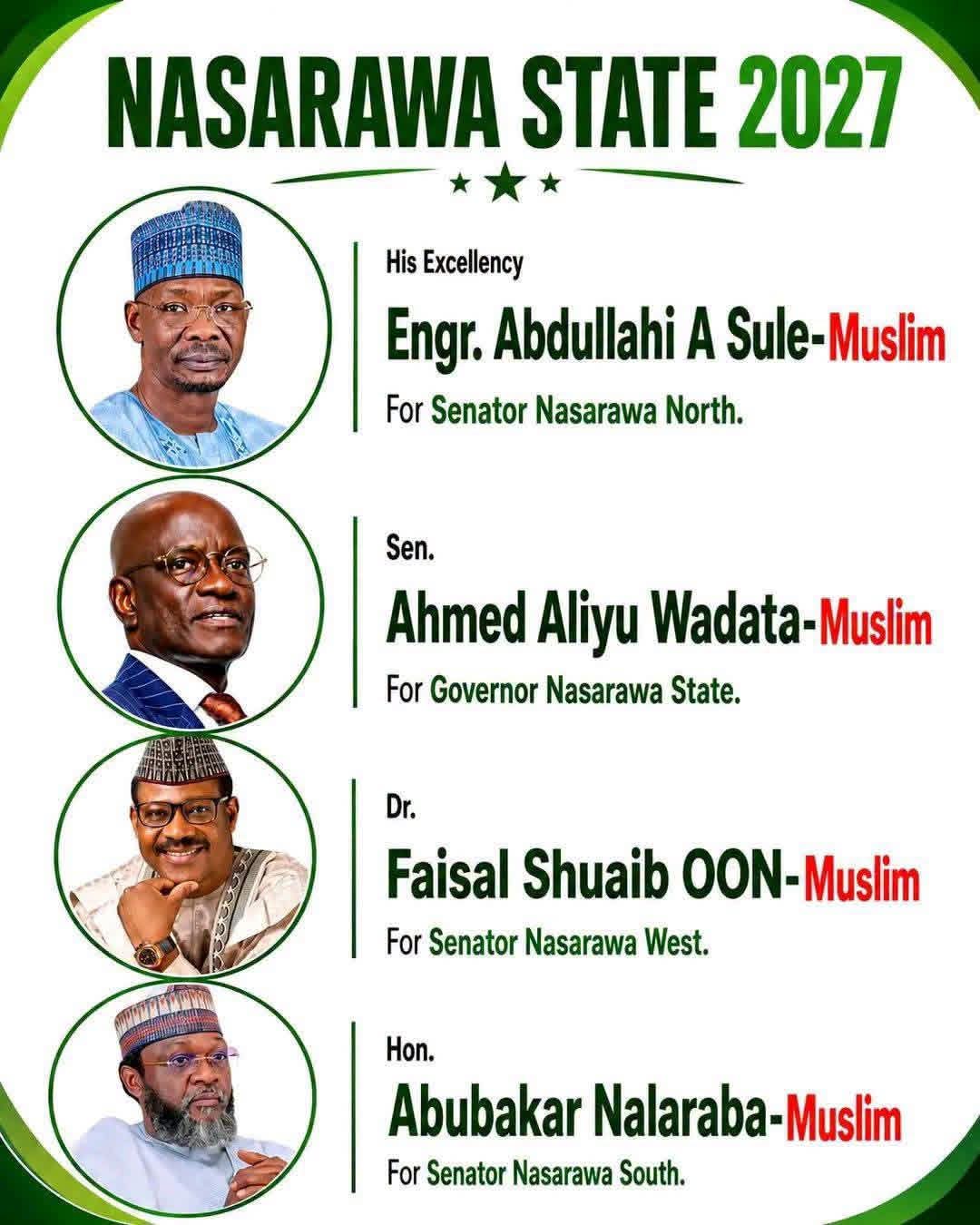
Christian leaders say the APC’s 2027 nominations shut out Christian contenders across key offices, warning that political exclusion could inflame tensions in Nigeria’s conflict‑prone Middle Belt.
By Ekani Olikita
LAFIA, Nigeria — Political tensions are rising in Nigeria’s predominantly Christian Nasarawa State amid allegations that the ruling All Progressives Congress (APC) manipulated its 2027 primary elections to favor Muslim candidates.
Christian community leaders, traditional authorities and civil-society activists say the pattern of recent political decisions has deepened fears of religious exclusion, while warning that the controversy could trigger a wider political realignment before the 2027 elections.
The allegations center on the claim that the APC has positioned Muslim politicians to control the governorship and all three senatorial seats, despite Christians constituting a larger share of the state’s population. Nasaraw is an agrarian and a Christian majority State in the Nigerian Middle Belt (55% Christians, 40% Muslims and 5% traditional worshippers), according to Tanko Barnabas, Senior Special Aide to Doma County Chairman.
Nasarawa is a home to numerous ethnic communities, including the Alago, Eggon, Agatu, Afo, Bassa, Gbagyi, Gwandara, Hausa, Jukun, Migili, Mada, Tiv and others. The state has four emirate councils predominantly associated with Muslim traditional rulers and 18 chiefdoms headed by traditional rulers from other ethnic groups.
Disputed Political Changes
The controversy over candidates intensified following the death of Senator Mrs. Godiya Akwashiki, a Christian who represented Nasarawa North, on December 31, 2025.
During the June 20, 2026, bye-election to replace her, Christian political activists alleged that Mrs. Angela Aya Bako, described as the leading female Christian contender, was disqualified or otherwise prevented from securing the APC nomination. Danladi Halilu-Envulu Anza, a Muslim, subsequently emerged as the APC candidate and won the seat.
His victory marked the first time a Muslim politician has represented Nasarawa North in the National Assembly, according to local political observers.
The controversy continued in the APC’s 2027 senatorial primaries.
Governor Abdullahi Sule, a Muslim, was declared the APC’s consensus candidate for Nasarawa North after his tenure as governor expires, effectively displacing former Deputy Governor Silas Ali Agara, a Christian, according to party critics.
In Nasarawa South, Deputy Governor Emmanuel Agbadu Akabe, a Christian, reportedly won the APC senatorial primary but was later replaced by Muslim candidate Abubakar Nalaraba.
Dr. Faisal Shuaib, also a Muslim, emerged as the APC candidate for Nasarawa West.
Christians Completely Denied from Governing Nasarawa State
Credit: Nasarawa State Political Update.
The Marginalization of Christians is most pronounced in the race for the Governor’s seat of Nasarawa State as no Christian had governed the State since its creation on October 1, 1996, as all the past democratically elected Governors from Abdullahi Adamu (1999-2007) to Aliyu Akwe Doma (2007-2011), Umar Tanko Al-Makura (2011-2019), Abdullahi Sule (2019-present date) were all Muslims.
Another Muslim and the incumbent Senator representing Nasarawa West, Sen Ahmed Aliyu Wadada has been selected by APC to succeed Governor Sule in 2027.
Critics therefore argue that Muslims could control all three senatorial districts as well as the governorship if the APC retains power in 2027.
The APC and Governor Sule have not, in the material reviewed for this report, publicly acknowledged that the party’s candidate-selection decisions were based on religion or intended to marginalize Christians.
Traditional Leaders Raise Alarm
Chief Mandy Dave, National President of the Eggon Cultural and Development Association Worldwide, condemned what he described as the marginalization of Christians in a phone interview with TruthNigeria.
“This manipulation stands condemned. This is a harbinger of disunity and shouldn’t be allowed,” Chief Mandy said.
Mandy also pointed to the state’s governorship, noting that no Christian has served as governor since Nasarawa was created on October 1, 1996.
“Since the creation of the state, Christians have never occupied the governorship. That alone should make every citizen concerned about fairness and political inclusion,” Mandy told TruthNigeria.
John Abu, a resident of Lafia, said many Christians believe their long-standing political tolerance has been mistaken for weakness.
“Since the creation of Nasarawa State, the Muslims are hellbent never to allow a Christian to lead the state as Governor even though we are more than them in population and we never complained.”
He added: “This latest marginalization by the APC government won’t stand. We shall unite and vote for candidates of other parties who are Christians in 2027″, he told TruthNigeria
Alago, Migili Leaders React
Oso Donald, an Alago tribal leader in Doma County, who spoke to a TruthNigeria Correspondent, said the controversy extends beyond Christianity and threatens the traditional balance among Nasarawa’s ethnic communities.
“What is happening is bigger than one political party. When one religious bloc appears to dominate the most important elective positions, other communities begin to feel that their voices no longer matter. That is dangerous for the unity of Nasarawa.”
A Migili tribal leader in Keana, Bala Oseni similarly warned that political exclusion could create ethnic and religious resentment.
“We want leaders chosen because of competence, integrity and broad acceptance—not because of religion. If people believe elections are being manipulated against them, confidence in democracy will suffer”, Oseni told TruthNigeria
Security Implications
Dennis Bulama, a Conflict Resolution Analyst with Nasarawa State University, who follows conflicts in the Middle Belt said the political dispute should not be dismissed as ordinary electoral rivalry.
“Religious and ethnic exclusion can become a security issue when communities already feel economically or physically threatened. If political grievances are allowed to combine with existing communal tensions, the result could be protests, polarization and potentially violence,” Bulama told TruthNigeria
The analyst urged political parties and electoral authorities to ensure transparent primaries and credible dispute-resolution mechanisms before the 2027 elections.
Civil Society Condemns Alleged Exclusion
The Integrity Youth Alliance, a sociocultural organization in Nasarawa, has also accused the APC of marginalizing Christians through its candidate-selection process.
“The recent political developments within the APC have created widespread concern among many Christians who feel increasingly excluded from the party’s power-sharing arrangements,” the organization said in a statement attributed to its spokesperson, Danjuma Lamido.
The allegations now place Nasarawa’s 2027 elections under heightened scrutiny.
For the United States and other international partners monitoring Nigeria, the dispute is significant because political exclusion along religious lines can compound existing concerns about democratic governance, freedom of religion and communal stability in the country’s conflict-prone Middle Belt.
Ekani Olikita is a conflict reporter for TruthNigeria.
Related


2027: Nigerians Would Have Known Him For Four Years – ADC Spokesperson Reveals How Atiku Will Defeat Tinubu

Private Business Claims Linked to Permanent Secretary John Chidiebere Ezeamama in Violation of Code of Conduct for Civil Servants – Secrets Reporters Nigeria

Evening recap: Tinubu targets $1tn economy, police rescue NYSC members, IPOB threatens 2027, other top stories

Backlash as Governor Oborevwori Allegedly Distributes Billions to Council Chairmen, Vice, Councilors Amid Economic Hardship
Atiku’s Absence At Coalition Talks For Single-candidate Should Not Be Interpreted As Boycott – Phrank Shaibu

Tinubu’s Old Certificate and U.S. Forfeiture Controversies Resurface Ahead of Nigeria’s 2027 Election

You’ll get lawsuit – Abati, Rufai clash on live TV over comment against presidential candidate [VIDEO]

Transfer deadline: Enzo completes City move, Chelsea loan Sanchez, Mudryk, Fofana joins Sunderland, others

“My baby come use English explain give this people” – Hilarious moment Peller calls Jarvis to defend him during tiktok live dispute

N10 Billion Paid To Six Months Old Company And Four Ghost Companies: Inside Fmr Minister Wale Edun, NRS Chairman Zaach Adedeji And Perm. Sec Lydia Jafiya’s PCNGI Contract Heist – Secrets Reporters Nigeria
Trump raises doubts over support for Britain in Falklands dispute with Argentina

Katsina Strike Tests Nigeria’s Progress Against Bandit-Terrorists Before Elections

FG Picks 5 States, FCT For Pilot National Ranching Programme
Trump turns to a dual economic and military approach in latest attempt to squeeze Iran

IGP Disu Presents N2.32bn Welfare Benefits To Families Of Fallen Officers

Appeals court says Bowe Bergdahl's conviction stands

Denmark sends conscripts to Greenland, signalling aim to boost Arctic defences

BBNaija S11 Week 6: Nomy’s Sudden Switch-Up Sets House On

Tooro PM Urges Unity, Restraint Ahead of Ugandan King’s Burial

NDLEA arrests 68 suspects, seizes 7,500kg of drugs in Edo

 Headlines10 hours ago
You’ll get lawsuit – Abati, Rufai clash on live TV over comment against presidential candidate [VIDEO]
- News17 hours ago
A Satellite Agency Building Roads And Community Halls: Inside MD Jane Egerton-Idehen N2236 Million Mandate Violation At NIGCOMSAT – Secrets Reporters Nigeria
- News6 hours ago
Exclusive: How NSIA MD Aminu Umar-Sadiq Started Assets Construction Project With N363 Million And Jumped To N44.8 Billion In One Year – Part 1 – Secrets Reporters Nigeria
- News9 hours ago
Cash In Hand: The Multi Million Naira Olubunmi Tunji-Ojo Federal Ministry Of Interior Money Paid Directly To Individual Staff Accounts Without Vendors – Secrets Reporters Nigeria
- Metro9 hours ago
“Politics Is My Business” — Ebonyi LG Chairman Threatens Political Opponents After Nwifuru Warns Chairmen Against Losing Their Councils
- Headlines4 hours ago
Electricity: Nigerian university campuses will be taken off national grid — Education Minister Alausa

 World22 hours ago
U.S. energy secretary approves ‘3 large corporate deals’ in Venezuela, feels hopeful about NABEP deal
- Entertainment10 hours ago
“Big man pikin dey cry say poor men children dey hail themselves” – Erigga fires back at Davido