Metro
Nigeria, India Target $15bn Trade as Modi Seeks Renewed Crude Purchases

Nigeria and India have agreed to deepen their strategic economic relationship, with Indian Prime Minister Narendra Modi seeking renewed purchases of Nigerian crude as both countries work to rebuild bilateral trade towards its previous peak of nearly $15 billion. In a statement signed by Stanley Nkwocha, Senior Special Assistant to……
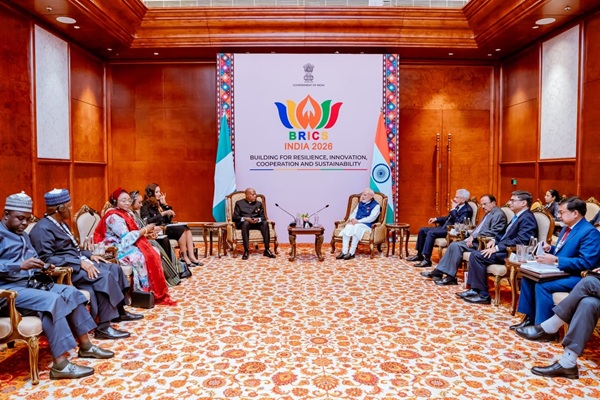
Nigeria and India have agreed to deepen their strategic economic relationship, with Indian Prime Minister Narendra Modi seeking renewed purchases of Nigerian crude as both countries work to rebuild bilateral trade towards its previous peak of nearly $15 billion.
In a statement signed by Stanley Nkwocha, Senior Special Assistant to the President on Media and Communications, Office of the Vice President, the development followed a bilateral meeting between Vice President Kashim Shettima and Prime Minister Modi on the sidelines of the just-concluded BRICS Leaders’ Summit in New Delhi.
Bilateral trade between Nigeria and India stood at about $14.95 billion in the 2021–2022 financial year before declining largely due to reduced Indian purchases of Nigerian crude. It fell to $7.13 billion in 2024–2025 but recovered to about $9 billion in 2025–2026, according to figures disclosed by the Indian High Commissioner to Nigeria, Abhishek Singh.
Modi made a case for renewed crude purchases from Nigeria, saying stronger energy trade could help return commercial exchanges between both countries to previous levels.
Responding, Shettima said, “Nigeria would examine the request as part of broader efforts by President Bola Ahmed Tinubu’s administration to attract investment and build strategic partnerships capable of expanding the country’s productive capacity.”
Read Also: Nigeria, India Reaffirm Bilateral Relations At BRICS Summit
The Vice President identified pharmaceuticals, defence, digital technology and the creative industries as areas of particular interest to Nigeria, stressing the need for partnerships that create jobs, transfer skills and open opportunities for the country’s large youth population.
The two leaders also discussed expanded cooperation in renewable and clean energy, power, healthcare, capacity building, financial technology and other emerging sectors.
Shettima said, “the President Tinubu administration is particularly interested in moving Nigeria’s relationship with India beyond the traditional exchange of commodities towards investments that support domestic production and value addition.”
The renewed push builds on a longstanding economic relationship in which crude oil has historically accounted for a significant share of India’s imports from Nigeria.
Modi also expressed appreciation for Nigeria’s hospitality towards the sizeable Indian community living and doing business in the country.
Both leaders agreed that stronger private-sector engagement would be central to the next phase of Nigeria-India relations, particularly in industries where Indian companies already possess considerable expertise and Nigerian demand remains strong.
Discussions also covered greater collaboration in fintech and digital technology, building on both countries’ expanding digital economies and earlier agreements on digital public infrastructure.
Shettima said President Tinubu’s objective was to ensure that international partnerships translate into investment, technology transfer, industrial growth and tangible economic opportunities for Nigerians.

Nigeria and India also expressed commitment to sustaining high-level political and economic engagement through the India-Africa partnership framework and other multilateral platforms.
Speaking on the sidelines of the engagement, Minister of Women Affairs, Imaan Sulaiman-Ibrahim, said Nigeria was drawing lessons from India’s women-led self-help group model to strengthen financial inclusion and grassroots enterprise.
She said the approach was being adopted through the Nigeria for Women Programme Scale-Up, using Women Affinity Groups to connect women to finance, skills and markets.
According to her, the programme forms part of the Federal Government’s wider drive to expand women’s participation in productive economic activity while strengthening social protection and interventions against Sexual and Gender-Based Violence.
“Women’s economic empowerment is fundamental to our ambition of building a $1 trillion economy. We must deliberately bring millions more Nigerian women into productive economic activity,” the minister added.


ALERT: Nigerian Army Warns of Possible Coordinated Terrorist Attacks on Churches, Schools and Youth Camps

EPL: Why I played Ola Aina as centre-back in 2-1 win over Aston Villa – Nottingham Forest boss, Glasner

Verydarkman shares first video of Poco Lee and Burna Boy following his alleged release from UK prison

Evening recap: Bamanga Tukur dies at 90, Dangote projects N10,000 refinery shares, 54 countries offer eVisa, other top stories

Nigeria Offers ₦30 Million Bounty for Separatist Commander ‘Gentle the Yahoo,’ Sparking Sharp Regional Divide

Morning recap: Terrorists plot attacks on Osun worship centres, Lagos crackdown raises child protection concerns, other top stories

Foreign Minister, Hon Okudzeto Ablakwa Presents Chop Boxes, Beds And 100 Bicycles To North Tongu Students Ahead Of SHS Resumption

We Won’t Release You Until The Network Improves — Residents Tell Telecom Employee As They Tie Him To A Pole Over Poor Network

“Is NELFUND Upkeep Meant To Feed The Student Or Her Family?” — APC Campaign Spokesman’s ₦10,000 Example Raises Questions

UK Court Allows Niger Delta Community to Sue Shell Over Alleged Evidence Destruction » Apples Bite Int’l Magazine

Oyo APC Questions Makinde’s Surveillance Aircraft After Fresh Bandit Attack

Dangote refinery IPO rush overwhelms two investment sites

APM Flags Off Bauchi By-Election Campaign Ahead September 19 Poll

“Why would you transfer the money back to my Opay?” — Man questions lady after she refunds mistaken ₦800k

“Thank you for the man I’ve become and the man I’m still becoming” — Basketmouth marks birthday with heartfelt message

Oman-hosted Gulf nations meeting canceled for now as Yemeni war heats up

Potential new TB vaccines could save millions of lives – Expert

I saw people run mad, dead bodies on streets — Fireboy DML on Lagos culture shock

Two Reps Members Defect To APP Ahead of 2027 Elections

VIDEO: I Will Be President Of This Country – Natasha Idibia Declares

 Entertainment23 hours ago
“I bookmarked it” – Simi Sanya recalls X user’s prediction about her relationship with Femi Dapson before marriage
 News17 hours ago
Five Islamic Clerics Abducted After Prayer Meeting At Yari’s Zamfara Residence » Apples Bite Int’l Magazine
- Metro16 hours ago
BTO4PBAT27 at One: How A Grassroots Political Movement Built A Statewide Structure For Tinubu’s 2027 Re-election
- Entertainment20 hours ago
“I already paid ₦7m” – Lady breaks down in tears over alleged nude blackmail by Germany-based Nigerian lover
- Viral19 hours ago
Ogoni Liberation Initiatives Demands Answers on $300m, Bori State, Clean-Up Before Ogoni Oil Resumption Deal
- Special Report21 hours ago
Pray Before You Eat — Residents Tell Thief As They Serve And Force Him To Eat Garri And Soup To Get Extra Energy For More Beatings
- Politics7 hours ago
They Abuse Tinubu On Social Media Like Kindergarten Fighting Over Groundnuts – APC Chieftain Mocks Opposition
- News5 hours ago
Ex-USCIS Officer Made $1.7m Bribes Approving Fake Green Cards for Nigerians, Others — FBI » Apples Bite Int’l Magazine