World
Researchers reconstruct face of man who lived through Norman Conquest

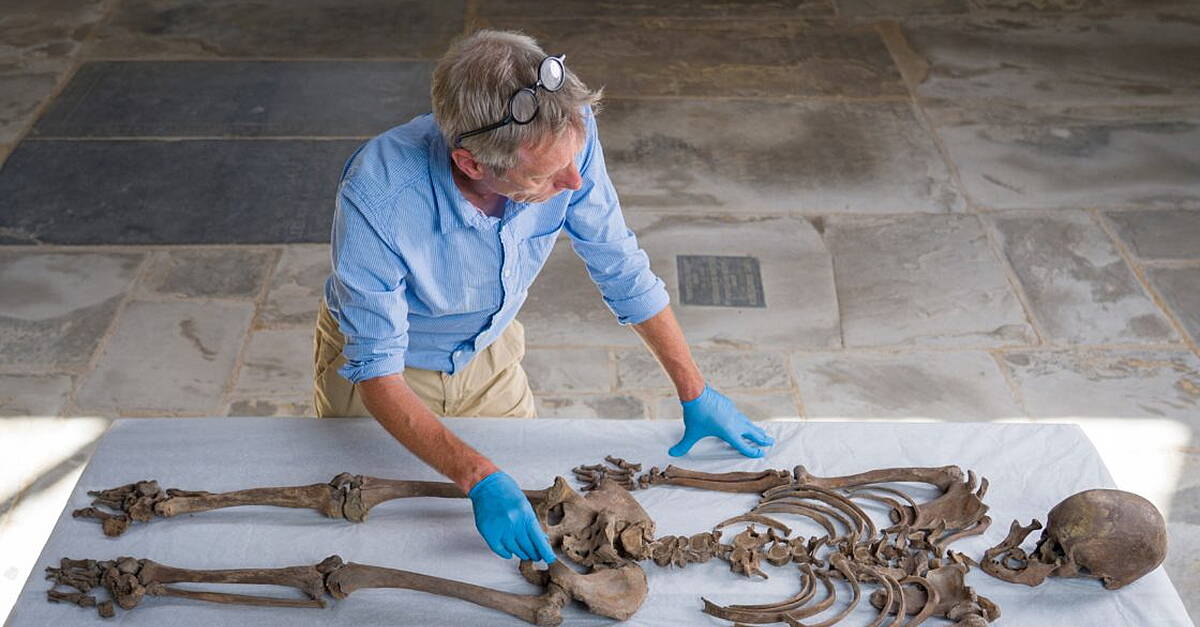
New research has revealed what a man who lived through the Norman Conquest may have looked like, uncovering new details about his life more than 1,000 years ago.
Known as Conquest Man, his remains were analysed by researchers from English Heritage and Heritage England using osteological analysis, ancient DNA and isotope testing, alongside a digital face reconstruction.
The results from his DNA suggests he had substantial ancestry from continental Europe.
He was described as “stocky and muscular”, more than five feet tall and around 50 to 60 years old with evidence of multiple healed fractures.
He was also given a privileged burial in a Norman church then owned by one of William the Conqueror’s knights, St Peter’s in Barton-upon-Humber, and laid to rest in a coffin made from an oak tree felled around 1079.
His arms were folded with his head supported on a grass pillow and kept from falling sideways by two lumps of local chalk. Three apple wood staffs – which were seen as sacred in Scandinavian tradition – were by his side.
Ahead of the Bayeux Tapestry exhibition opening and Battle of Hastings re-enactment, English Heritage partnered with researchers from Historic England, the Crick Institute, the British Geological Survey, the University of Southampton, muVIS and FaceLab to examine Conquest Man.
Kevin Booth, English Heritage head curator of collections, who co-ordinated the study, said: “I’ve been fascinated by this individual – this man of the Conquest – for 20 years. Who was he, what did he experience, could he have been at the Battle of Hastings, what sort of person might he have been?
“With this new analysis, it feels like we can really get close to him. To be able to now look at his face is to feel we can almost speak to him.

“He’s a fascinating survivor of a cataclysmic period in history, born in the reign of Viking King Cnut, he survived the Norman Conquest to be buried with honour next to a pre-Conquest church, part of the new Norman world.
“It seems to me his legacy is of survival, resilience and adaptation and I hope that by sharing his story in this way, when people go to our Battle of Hastings re-enactment or visit the Bayeux Tapestry – of course they can cheer on who they like – but maybe he can help us not to pigeonhole those who fought and died there, but to understand them as human above all.”
Conquest Man can be seen at St Peter’s Church, Barton-upon-Humber in Lincolnshire on September 20th from 12pm to 4pm.


Benue: Alia’s interventions restoring peace, accelerating development in Agatu – Council chairman, Melvin Ejeh

“Establish How Government System Weaknesses Were Exploited” — Tinubu Orders Forensic Audit Of IPPIS, FG Bodies

“False Affidavits Used To Rewrite Identities For Alleged Organ Harvesting” — Police Probe Lawyers, Doctors Over Abuja-Nasarawa Network

NPC chairman, Aminu Yusuf, dies at 66, eight months after assuming office

EFCC Extradites Two Nigerians To US Over Alleged Child Exploitation, Sextortion

Tinubu orders forensic audit of IPPIS, federal agencies

Former Borno Senator Yale Dies

RUGA, Water Resources Bill: IPOB Credits Nnamdi Kanu for Mobilising Resistance

EFCC extradites two Nigerians to US over alleged sextortion of minors

2 workers at Germany's Frankfurt Airport die from what is known as 'airport malaria'
Police rescue Sarkin Noman Kano after foiling kidnap attempt

Police rescue Sarkin Noman Kano after foiling kidnap attempt

FG Plans Medical Simulation Centres Across Six Geopolitical Zones

Nigeria Records $947m July Remittances, Nears CBN’s $1bn Target

Niger: CAN seeks permanent security presence in Borgu over Mosque abductions

Harry accuses security body chair of not informing his staff of al Qaida threat

Olivia Rodrigo’s inaugural all-women festival raises nearly €17 million

At least 7 dead after ferry carrying nearly 270 passengers and crew capsizes off northern Cyprus

Researchers reconstruct face of man who lived through Norman Conquest

Anniversary of Diana’s death comes just days after Harry and Meghan’s return

 Headlines21 hours ago
Benue: Alia’s interventions restoring peace, accelerating development in Agatu – Council chairman, Melvin Ejeh
- Metro17 hours ago
“False Affidavits Used To Rewrite Identities For Alleged Organ Harvesting” — Police Probe Lawyers, Doctors Over Abuja-Nasarawa Network
- Metro23 hours ago
Police Foil Bandits’ Attack on Zamfara Highway
- Special Report11 hours ago
Adeleke orders probe into Osun killings, sets up panel

 World23 hours ago
Russian strike on a Ukrainian warehouse kills 37 in the war's deadliest attack this year
 World24 hours ago
Israeli strikes and fire kill 3 Palestinians in Gaza, and other Middle East news
- World22 hours ago
Far-right British provocateur Milo Yiannopoulos has been deported after his immigration arrest in US
- Politics18 hours ago
Army Confirm Hack Of Official X Account, Warns Public Against Fake Posts