Metro
Osun Decides 2026: The Figures, Battlegrounds, Risks Behind The Election

The Osun State governorship election is being decided against the backdrop of a large electorate, a fiercely contested political landscape and concerns over security, logistics and the credibility of the electoral process….
The Osun State governorship election is being decided against the backdrop of a large electorate, a fiercely contested political landscape and concerns over security, logistics and the credibility of the electoral process.
At stake are the votes of 2,339,233 registered voters spread across 30 local government areas, 332 wards and 3,763 polling units. Of the registered voters, 1,906,391 collected their Permanent Voter Cards, representing an 81.5 per cent collection rate.
The election is largely viewed as a battle between incumbent Governor Ademola Adeleke and the All Progressives Congress candidate, Bola Oyebamiji, although other candidates, including African Democratic Congress candidate Najeem Salaam, are also seeking to upset the leading camps.
Recent reporting has described the race as highly competitive.
But beyond the personalities and party structures, the numbers as contained in a fact sheet produced by YIAGA Africa reveal where the real battle could be won or lost.
Turnout could be the decisive factor
Osun’s registered electorate has grown significantly over the years.
The fact sheet puts registered voters at 1,407,222 in 2014, 1,682,495 in 2018, 1,955,657 in 2022 and 2,339,233 in 2026.
That represents a substantial expansion of the potential voting population.
Yet the historical trend shows that registration growth has not translated into higher turnout.
Governorship turnout fell from 53.3 per cent in 2014 to 45.6 per cent in 2018 and 42.2 per cent in 2022. Presidential turnout in 2023 was even lower at 38.7 per cent.
The turnout for the 2026 governorship election remains to be determined.
This makes voter mobilisation one of the most important factors in Saturday’s election.
A large register means little if voters do not turn up.
For the leading candidates, the challenge is therefore not merely winning support during the campaign but getting supporters physically to polling units, accredited and voting.
The Ife axis: a potential electoral powerhouse
Perhaps the most striking figure in the fact sheet is the concentration of voters around the Ife axis.
Ife Central has 122,454 registered voters, Ife East 128,515, Ife North 65,718 and Ife South 66,255.
Together, the four contiguous local government areas account for 382,942 registered voters, equivalent to 16.4 per cent of the entire Osun electorate.
That is an enormous voting bloc.
It means that the performance of the major candidates across these four LGAs could have a significant impact on the statewide result.
The arithmetic is straightforward: a candidate who performs strongly across the Ife axis can accumulate a substantial advantage before the results from other parts of the state are fully considered.
The key question, however, is turnout.
If participation is low, the numerical advantage of the axis could be reduced. If turnout is high and one political camp dominates, the effect could be substantial.
The battleground is wider than two candidates
Although Adeleke and Oyebamiji dominate much of the attention, the presence of other candidates means the election is not simply a two-name contest.
Recent reports have identified Adeleke, Oyebamiji and Najeem Salaam as the principal contenders, with the three drawing support from different political networks.
That makes vote splitting an important variable.
In a closely fought election, even a relatively modest percentage secured by a third candidate could alter the margin between the two leading contenders.
The eventual winner may therefore be determined not simply by how many votes the front-runner attracts, but by how votes are distributed among all the candidates.
The political geography matters
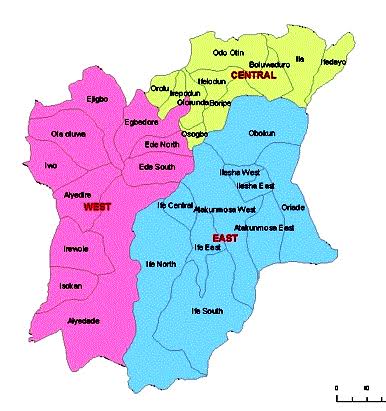
Osun’s three senatorial districts each contain 10 LGAs.
Osun West has 756,122 collected PVCs, covering Ayedaade, Ayedire, Ede North, Ede South, Egbedore, Ejigbo, Irewole, Isokan, Iwo and Ola-Oluwa.
Osun Central has 783,413 collected PVCs, covering Boluwaduro, Boripe, Ifedayo, Ifelodun, Ila, Irepodun, Odo-Otin, Olorunda, Orolu and Osogbo.
Osun East has 799,698 collected PVCs, covering Atakumosa East, Atakumosa West, Ife Central, Ife East, Ife North, Ife South, Ilesa East, Ilesa West, Obokun and Oriade.
The figures show that no single senatorial district can simply be ignored.
The distribution is sufficiently large across all three zones that a statewide victory will require broad geographic performance.
Osun’s electoral history offers a warning
The 2022 governorship election was decided by a relatively narrow margin.
Ademola Adeleke defeated the then incumbent Gboyega Oyetola with 403,371 votes against 375,027, a difference of just 28,344 votes. The election recorded turnout of about 42.2 per cent.
That history is important because it demonstrates how a relatively small difference in votes can determine control of the state.
With more than 2.3 million registered voters now on the register, the 2026 election could again be decided by margins far smaller than the total size of the electorate.
Four major risks
The fact sheet identifies four major risks that could affect the integrity and smooth conduct of the election.
1. Late logistical changes
A late court order requiring the inclusion of the SDP candidate reportedly forced INEC to reprint ballot papers and result sheets only two days before the election.
The fact sheet warns that the compressed timeline could increase the risk of “logistical errors, delayed deployment and late commencement of polls.”
The concern became particularly relevant because sensitive materials were only distributed to the 30 LGAs shortly before election day.
Kimpact Development Initiative senior programme manager Umar Mohammed described the arrival of materials as encouraging but acknowledged the earlier logistical difficulties.
“We were worried after the court pronouncement, which led to the addition of SDP to the ballot. This created a logistical challenge for INEC,” he said.
2. BVAS and accreditation
The second major concern is technology.
The fact sheet says INEC’s mock accreditation exercise exposed problems involving the BVAS, including difficulties recognising some voters’ fingerprints, facial features and older voter records.
That matters because accreditation problems can create queues, frustration and arguments at polling units.
The fact sheet’s warning is blunt:
“Technology must facilitate voting, not become a barrier to participation or a source of distrust in the election.”
3. Security
Security is perhaps the most sensitive issue surrounding the election.
The fact sheet identifies Osogbo, Irewole, Boripe, Obokun, Ilesa West, Ife Central, Ife North, Iwo, Ede North, Ifedayo, Ilesa East, Isokan and Irepodun among the areas requiring particular attention.
The concern has been reinforced by reports of election-related violence during the campaign period. Kimpact Development Initiative reported 73 election-related violent incidents resulting in 29 deaths in the build-up to the election.
The fact sheet says the security challenge has moved beyond ordinary political rivalry to incidents capable of directly disrupting electoral activities.
It warns:
“Election security must protect the process, not become part of the contest.”
The police have responded with a substantial deployment across the state, including air surveillance, Police Mobile Force units and other tactical formations.
4. Vote buying
The fourth concern is voter inducement.
The fact sheet says Yiaga Africa documented the distribution of money and gift items by political actors, raising concerns about attempts to influence voters.
The significance of vote buying becomes greater in a close election.
Where margins are narrow, even a relatively small number of influenced votes can affect the final outcome.
The fact sheet captures the democratic principle at stake:
“Votes must be earned through persuasion, not purchased through inducement.”
What the numbers are really saying
The numbers suggest that Osun is entering a potentially close election with a much larger electorate than in previous cycles.
There are 2.34 million registered voters, but only 1.91 million collected PVCs. There are 30 LGAs, but voter strength is unevenly distributed. And while the Ife axis alone accounts for 382,942 voters, the three senatorial districts each have substantial voting populations.
The most important number, however, may ultimately be the turnout figure.
The 2022 election had about 42.2 per cent turnout. If turnout rises significantly in 2026, the enlarged voter register could produce a much bigger pool of actual voters. If turnout remains low, the election could again be determined by relatively small but highly organised voting blocs.
What to watch as results emerge
Four things will provide early clues about the direction of the election.
First, turnout in high-registration LGAs. The Ife axis should attract particular attention.
Second, the performance of the major candidates in their traditional strongholds.
Third, the margins in swing or closely contested LGAs.
Fourth, the number of rejected, disputed or cancelled votes and whether the collation process proceeds smoothly.
The election will not necessarily be won by the candidate who dominates every part of Osun.
It will be won by the candidate who assembles the most effective coalition of votes across the state’s 30 LGAs.
More than an Osun election
The significance of the election extends beyond the state.
Osun is one of the final major electoral tests before the 2027 general elections, putting INEC, the police, political parties and voters under a national spotlight.
For INEC, the test is whether it can manage logistics, technology and collation under pressure.
For security agencies, it is whether they can maintain order while remaining neutral.
For political parties, it is whether they can mobilise supporters without resorting to violence or inducement.
And for voters, the central question is whether they will turn the impressive size of Osun’s voter register into actual participation.
Ultimately, the 2,339,233 registered voters are the headline figure. But the election will be decided by those who actually turn up, cast valid ballots and have those votes accurately counted.
As the fact sheet puts it, “Stronger participation, a brighter Osun.”
The numbers point to a competitive race. The battlegrounds show where the decisive votes may come from. The risks show what could derail the process.
What happens at the 3,763 polling units across Osun will determine whether the state’s next governor emerges from a genuinely voter-driven contest.


Federal Energy Centre at UNILAG Under Scrutiny Over ₦29.8m Procurement and Financial Irregularities – Secrets Reporters Nigeria

‘Dapper, your cup don finally full’ – Singer T.I Blaze questions music executive over N1.2bn royalties

Izeze Remains High-Spirited, Pays Fines for Inmates at Warri Custodial Centre – Secrets Reporters Nigeria

EXCLUSIVE: SecretsReporters Uncover Unaccounted ₦75m Cash Advance in Hannatu Musa Musawa’s Ministry – Secrets Reporters Nigeria

Kidnapped Christian Worshipers in Southern Nigeria Describe Weeklong Torture by Fulani Terrorist Gang

“Legal Education Extends Beyond The Classroom” — Obra Foundation Interns Visit Enugu CP, Gain Insights On Policing, Leadership

“If they ask for money, call IGP” – Police officer warns Nigerians against paying for bail, shares complaint numbers

“I returned your ₦5m birthday money” – Diadem calls out Dabota Lawson, alleges she uses bloggers to attack people

NNPC Spends ₦393.45m on Three-Years Office Rent for NNPC Board Accommodation Under the Leadership of Bala Wunti in NAPIMS – Secrets Reporters Nigeria

Akwa Ibom Governor Commits To Operation Of Maintenance Facility At Victor Attah Airport, Expansion Of Ibom Air

Osun Governorship Election: Adeleke, Oyebamiji, Salaam In Crucial Battle As Voting Begins

Jowizaza’s father regains freedom after abductors allegedly demanded N1.5bn ransom

Osun Election: Davido Raises Alarm Over Alleged Move to Stop Him From Entering State

Engr. Bassey E. Nkposong, Cross River Basin Development Authority Leadership Mired in ₦4.9bn Financial Irregularities – Secrets Reporters Nigeria

Trump Dismisses Crew Welfare Concerns as US Faces Iran Standoff Over Hormuz

Voting Disrupted At Aregbesola’s Polling Unit In Osun

Osun election: Men dressed as police officers allegedly disrupt material distribution with teargas [Video]

Troops Intercept Courier With Explosive Materials in Zamfara
Israeli airstrike on southern Lebanon kills 7 people, Lebanese state media say

Osun Police Arrest Lawmaker, 146 Suspected Electoral Mercenaries In Ikire

 Headlines18 hours ago
‘Dapper, your cup don finally full’ – Singer T.I Blaze questions music executive over N1.2bn royalties
- Politics16 hours ago
Kidnapped Christian Worshipers in Southern Nigeria Describe Weeklong Torture by Fulani Terrorist Gang
- Politics15 hours ago
Akwa Ibom Governor Commits To Operation Of Maintenance Facility At Victor Attah Airport, Expansion Of Ibom Air
- Metro22 hours ago
Tinubu Calls For Peaceful Election In Osun, Charges Security Agents To Protect Voters, INEC Officials
- Politics14 hours ago
Adekunle Adebiyi: Abuja Move ‘One of Our Best Decisions’ As Squash In Diaspora Tournament Hits Semifinals
- Entertainment18 hours ago
“I don’t want their money”- Peller shares why he intends to collaborate with Dangote, Femi Otedola and Bill Gates
- Entertainment23 hours ago
“Your social media noise put us in this mess” – Kidnapped businessman’s daughter accuses brother Jowizaza over ₦1.5bn ransom
- Entertainment17 hours ago
“Peter Obi was already ahead of us in Class Three” – Former classmate opens up on his early school hustle