Metro
“Only The Roof Was Visible” — Lagos–Ore–Benin Flood Video Sparks Questions Over FG’s Lagos–Calabar, Badagry–Sokoto Projects

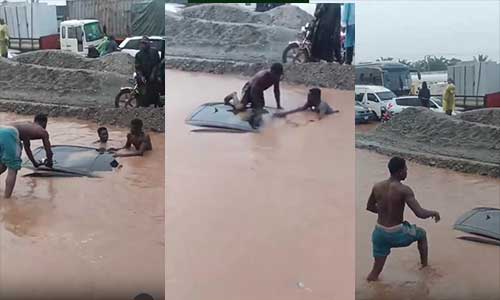
A viral video showing a vehicle almost completely submerged in muddy floodwater on a road said to be the Lagos–Ore–Benin federal highway has triggered fresh criticism of the Federal Government’s infrastructure priorities, with calls for urgent rehabilitation of existing highways before committing resources to new mega road projects.
The footage, which circulated widely on social media, shows several men wading through deep floodwater around a largely submerged vehicle while attempting to assist its occupants and retrieve some of their belongings.
Only the upper section of the vehicle is visible above the water at some points in the video, underscoring the depth of the flooding.
Other vehicles and motorcycles can also be seen around the affected area, while heaps of sand and construction materials line portions of the roadside.
The exact location and circumstances of the incident could not be independently confirmed from the footage alone, although the video was circulated as having been recorded along the Lagos–Ore–Benin highway.
A distressed voice heard in the footage complained about the severity of the situation and the resulting traffic congestion, claiming that the gridlock had extended for a considerable distance.
The speaker further alleged that some vehicles had remained trapped along the route for as long as three days with little or no movement.
Those claims could not be independently verified at the time of filing this report.
Sharing the footage, an X user identified as @Ekwulu questioned the Federal Government’s infrastructure priorities, arguing that existing federal highways should receive urgent attention before massive new projects are prioritised.
The poster specifically referenced the Lagos–Calabar Coastal Highway and the Badagry–Sokoto Superhighway, contending that government should first address deteriorating roads already being used daily by motorists.
He described several existing federal roads as “death traps” and questioned the justification for committing enormous resources to new highways while critical routes remain in poor condition.
The footage also generated reactions from other social media users, some of whom described major new infrastructure schemes as “white elephant” projects and argued that funds could instead be directed towards repairing and maintaining existing highways.
Those descriptions represent the views of the commentators and not an established assessment of the projects.
The incident has again drawn attention to persistent flooding, drainage deficiencies and road deterioration along major transport corridors across Nigeria, particularly during periods of heavy rainfall.
The Lagos–Ore–Benin corridor is a major interstate route linking Lagos and parts of the South-West with Edo State and other parts of southern Nigeria, making prolonged obstruction along the highway capable of disrupting passenger travel, commercial transportation and the movement of goods.
The viral footage has consequently renewed debate over whether the government should place greater emphasis on maintaining and rehabilitating existing federal roads alongside the construction of new infrastructure.
As of the time of filing this report, there was no official statement confirming the precise location shown in the video, the number of vehicles affected, whether anyone sustained injuries, or the claim that motorists had remained stranded for up to three days.


“The bullet struck exactly where she was sleeping” – Nigerian doctor recalls sister’s miraculous escape from death

Financial Mismanagement Rocks Federal College of Education, Yola, as SecretsReporters Uncovers ₦38.07m Worth of Financial Irregularities – Secrets Reporters Nigeria

“Stop Making False, Defamatory Statements About Me And My Family” — Sheggz Reportedly Serves Bella Okagbue Cease-And-Desist Notice Amid Messy Breakup

“Tinubu Names Yari DG, Uzodimma Secretary Of 2027 APC Presidential Campaign Council” — Akpabio, Gbajabiamila, Oshiomhole Get Key Roles

“Is This What Lagos Housing Crisis Has Become?” — Viral Video Of People Living Under Flyover Sparks Outrage, Disbelief

How Obasanjo Considered Abandoning Second-Term Bid After South African President Got Wind Of Coup Plot – Donald Duke

“I hope she won’t end up paying” – Phyna reacts to Sheggz’s legal action, asks fans to pray for Bella

“NDLEA Asks Court To Deny Bail To Three Mexicans, Seven Nigerians In ₦480bn Meth Lab Case” — Alleges Flight Risk

NBET Exposed: ₦259m Unrecovered, $69.3m Power Debt, Missing Vehicles as Agency Operated Without Audited Accounts – Secrets Reporters Nigeria

“Protect Your Sources And Methods, But Do Not Protect The Truth From Nigerians” — Atiku Tells FBI Over Tinubu Records

Awujale stool: Ruling house sues Abiodun, kingmakers over delayed selection

I missed a big opportunity, Bunmi Nelson regrets ignoring Funke Akindele

Kwara APC Loses 12 Executives After Senator Mustapha’s Defection

Ogun SUBEB hails Abiodun over N12bn counterpart funding payment

US Supreme Court clears the way for Trump mail voting order in advance of midterms

Dutch broadcaster to boycott Eurovision for a second year, calling it a 'platform for division'

Adult, betting, AI websites dominate Nigerian web traffic in July – Report

Police nab 68, 70-year-old men over attempted assault of 12-year-old girl

APC Campaign Council: Edu, Olejeme Get Key Roles Despite Corruption Cases

NUPENG Faults Atiku’s Promise to Restore Petrol Subsidy

 Politics20 hours ago
How Obasanjo Considered Abandoning Second-Term Bid After South African President Got Wind Of Coup Plot – Donald Duke
- News15 hours ago
NBET Exposed: ₦259m Unrecovered, $69.3m Power Debt, Missing Vehicles as Agency Operated Without Audited Accounts – Secrets Reporters Nigeria
- Entertainment16 hours ago
“My brother Davido, I love you” — Gov. Okpebholo’s aide who banned Davido from entering Edo apologises
- News13 hours ago
Morning recap: KWAM1 breaks down in tears over Ogogo’s death, govs face questions as FAAC payouts hit N47tn, other top stories
- Entertainment7 hours ago
“A governor once gave Wizkid a bag full of dollars” – Kizz Daniel’s bouncer reveals what singer allegedly did next
- Politics8 hours ago
‘It Is A Disgrace Tinubu Doesn’t Trust Anyone’ – Melaye Slams President’s Self-Appointment As Campaign Chairman
- Viral11 hours ago
Hon Ereyitomi Congratulates Chief Ayiri Emami, Stella Okotete on APC Presidential Campaign Council Appointments
- Entertainment8 hours ago
“I spent months praying for God to take my husband’s money away” — Woman opens up on painful marriage