World
Once shaped by court rituals, China’s imperial cuisine lives on today

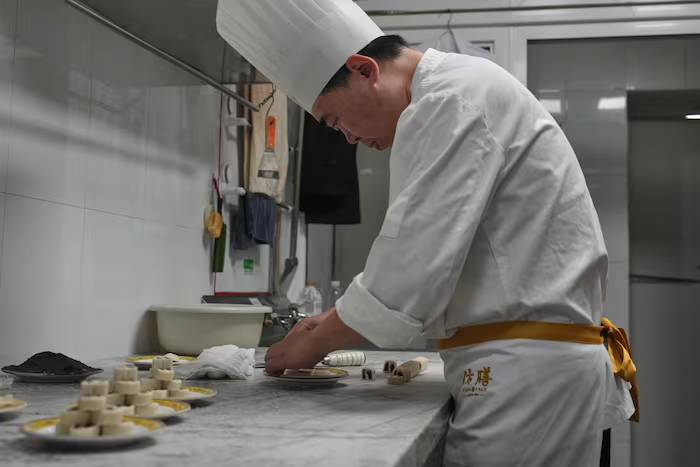
BEIJING (AP) — It is said that Empress Dowager Cixi once dreamed of a pastry during the final decades of imperial China.
The same treat was served to her at breakfast the following morning. Delighted, she summoned her chef and rewarded him with a silver ingot.
“It was originally called ‘minced pork pancake,’ but because it had fulfilled her dream, it later became known as ‘dream pastry,’” said Zhou Tong, a chef at Fangshan Restaurant in Beijing.
Fangshan specializes in imperial cuisine, preserving dishes like the one associated with Cixi and other culinary traditions from China’s imperial court. The restaurant was founded in 1925 by former chefs from the Qing Dynasty at Beihai Park, a garden where royals from several dynasties rested, handled government affairs and performed ritual sacrifices.
“The name Fangshan literally means ‘imitating the imperial cuisine,’” said assistant general manager Di Xin.
A handful of other Beijing restaurants also serve versions of imperial cuisine, while the Palace Museum preserves Qing-dynasty objects tied to court dining, including pastry molds.
Every meal comes with its own rules
Imperial cuisine encompasses the meals emperors ate daily and the feasts their courts held throughout the year.
Each had its own rituals. Drinking milk tea, for instance, was an important first step at Qing-dynasty banquets, said Teng Deyong, a researcher at China’s Palace Museum.
During the banquet, the emperor bestowed wine or food on princes and officials. Recipients performed rites and paid their respects to him before they ate or drank.
Aside from banquets, sacrificial rituals were held. They followed a separate system and could involve meat offerings.
“At the Palace of Earthly Tranquillity, there was the eating of sacrificial pork, which we know was one of the most important rituals of the Qing imperial court,” Teng said.
In that ritual, fatty pork was boiled without salt. After the ceremony, it was distributed among guests, and receiving the sacrificial meat was considered a great honor.
Unseasoned food also appears in earlier Chinese ritual traditions. Wandi Wang, a professor of Chinese at Lehigh University in Pennsylvania, said the “Book of Rites,” a classical work on rites and ceremonies, describes a meat broth known as “grand stew” that was served without seasoning during sacrificial ceremonies.
“The absence of added flavoring was itself meaningful: the unseasoned dish evoked an earlier and simpler way of cooking and thus expressed a ritual ideal of honoring antiquity and remembering cultural origins,” Wang said.
Traditional techniques keep imperial pastry-making alive
Pastries were key to imperial cuisine, and the court had an institution specialized in making them.
Sweets made at Fangshan by Zhou include Cixi’s dream pastry and a small steamed corn bun. Their recipes are rooted in the imperial court.
“When customers visit, our servers often tell them the stories behind these dishes,” Zhou said. “People enjoy them even more because they carry such meaningful history.”
He learned his pastry-making technique from a master who had also learned from a mentor. It’s a craft that has been passed from one generation to the next.
Traditional imperial methods mean cooking must be done by hand — no blenders or food processors are allowed. Ingredients like beans are pulverized using sieves and certain flours are handled in custom-made copper pots.
“A machine may be more convenient, but the texture is completely different,” Zhou said. “You lose the delicate graininess and sandy mouthfeel that handcrafted pastries are supposed to have.”
Among Fangshan’s bestselling delicacies are the pea flour cake and the red bean roll. During the busy season, customers order more than 200 of the cakes per day.
Balancing ancient cooking methods with a changing world
When he joined Fangshan as a kitchen apprentice, now-executive chef Fan Liangliang had to relearn everything he was taught at culinary school. Rather than employing techniques that allowed him to work quickly, he embraced slower processes he had never heard of.
One of them is “Nizihuo,” which Fan said involves mincing ingredients such as fish, shrimp or chicken into a smooth paste. It is then reshaped into decorative forms such as frogs, birds and flowers.
“This is one of the hallmarks of imperial cuisine,” Fan said. “Every dish had to be innovative, visually beautiful, nutritious and worthy of presentation on the imperial dining table.”
Rare ingredients such as bear paws are no longer served. Fan said adaptations are made to retain the spirit of each dish.
Chinese cuisine has long reflected cultural values, politics and ideals
A celebrated Chinese poet once wrote about cold noodles made with pagoda-tree leaves.
“The poem is not simply a description of a dish,” Wang said. “Du Fu turns the verdant, fresh, yet modest dish into an expression of his political loyalty and thwarted ambition to serve the emperor.”
She added that Chinese cuisine has historically carried meaning beyond food, reflecting broader ideas about politics, culture and aesthetics that have evolved as circumstances changed.
“Preserving a culinary tradition begins with taking its history seriously,” Wang said. “Culinary heritage tells us not only how people ate in the past, but also how people in the present choose to remember and give meaning to that past.”
Chef Fan said that at the heart of Fangshan’s imperial cuisine is a fusion of Manchu and Han culinary traditions, bringing together the culture of the Qing rulers and that of China’s majority population.
“It’s not simply a collection of dishes from the two cultures,” he said. “It represents the blending of their different approaches to food into a unified cuisine.”
Some inherited techniques such as stir-frying, braising and stewing have survived. And while some ingredients have been substituted both for availability reasons and to suit modern tastes, Fan said his team’s commitment to Chinese heritage remains strong.
“When people dine at Fangshan Restaurant, I hope they experience more than just a meal,” Fan said. “They experience the weight of history.”
___
AP video journalist Wu Jia contributed to this report.
___
Associated Press religion coverage receives support through the AP’s collaboration with The Conversation US, with funding from Lilly Endowment Inc. The AP is solely responsible for this content.
Copyright 2026 The Associated Press. All rights reserved. This material may not be published, broadcast, rewritten or redistributed without permission.


Scammers Hijack Car Dealer’s Identity, Forge CAC Certificate Photo, and Open Fraudulent Moniepoint Account, Exposing Deep Flaws in Fintech KYC – Secrets Reporters Nigeria

FAAN Spent N158.59bn against N98.39bn Limit, Audit Demands N60.2bn Refund – Secrets Reporters Nigeria

₦367.99m in Financial Irregularities Uncovered in FCT Social Development Secretariat Under the Leadership of Hajiya Safiya Umar – Secrets Reporters Nigeria

Osun 2026: INEC Under Scrutiny As Money Politics, Violence, Security Threats Test Nigeria’s Road To 2027

₦35.46m Financial Irregularities Mars Dr. Aishatu Abubakar-Baju (AIG), Veterinary Council of Nigeria Leadership – Secrets Reporters Nigeria

Investigation Reveals NOTAP Channelled ₦138.8 Million Public Revenue into Staff Welfare, Sponsored Non-Staff Weddings and Approved Unauthorised Foreign Trips in Questionable Transactions – Secrets Reporters Nigeria

“The most powerful person in a house is the housemaid” — Man questions billionaire’s maid’s ₦180K salary

“I paid for his visa, flight, hotel, rent, but he broke up with me 4 months after arriving UK” — Woman reveals

Ministers, Governors, Lawmakers You Rely On Are Not Working In Your Best Interest – Jonathan Vatsa Warns Tinubu

Nigeria’s Atomic Energy Commission Paid ₦34m Without Documents, Lost Track of Store Items and Let a Former Chairman Drive Off With Official Toyota Camry – Secrets Reporters Nigeria

South Korean and US militaries shorten drills by about half after Trump ordered a reduction
South Korean and US militaries shorten drills by about half after Trump ordered a reduction

Trump says US has no talks planned with Iran and other news from the Middle East
Once shaped by court rituals, China’s imperial cuisine lives on today
Archaeologists unveil skeletal remains believed to be ritual offering in Peru

Liberia agrees to take 1,200 third-country deportees from the US

US hits ICC president and senior prosecutor with sanctions in another move against the court

UAE accuses Iran of launching 2 ballistic missiles targeting maritime traffic

Turkey's Erdogan signs law offering conditional pardon for thousands of PKK militants

Trump and Carney hold urgent talks as steep 50% US tariffs on Canada loom

 Politics18 hours ago
Ministers, Governors, Lawmakers You Rely On Are Not Working In Your Best Interest – Jonathan Vatsa Warns Tinubu
- News20 hours ago
Nigeria’s Atomic Energy Commission Paid ₦34m Without Documents, Lost Track of Store Items and Let a Former Chairman Drive Off With Official Toyota Camry – Secrets Reporters Nigeria
- Entertainment18 hours ago
“If you can’t pay for your flight ticket and don’t have a job, don’t marry” — Female pastor advises ladies
- Entertainment16 hours ago
“Your prayer point is different from mine” – Businessman says as he proudly flaunts his thriving business
- Entertainment15 hours ago
“He tried to lure me into having sex with him, but I refused” — Funke Etti recounts alleged ordeal with movie director
- News10 hours ago
Vehicle in Custody of Ghanaian Government Authority Used in Reportedly Foiled Labone Bank Robbery as Ghana Police Face Mounting Questions Over Nigerian Involvement Narrative – Secrets Reporters Nigeria
- Entertainment17 hours ago
“She stole his clothes and ran” — Lady recounts how student exposed lecturer after he demanded an affair for better grades
- Entertainment6 hours ago
“You’ll fly her in, lodge her and still give her ₦3m” – Lady questions men’s spending on women for sexual pleasure