News
Musicologists seek economic reforms, better monetisation of music sector

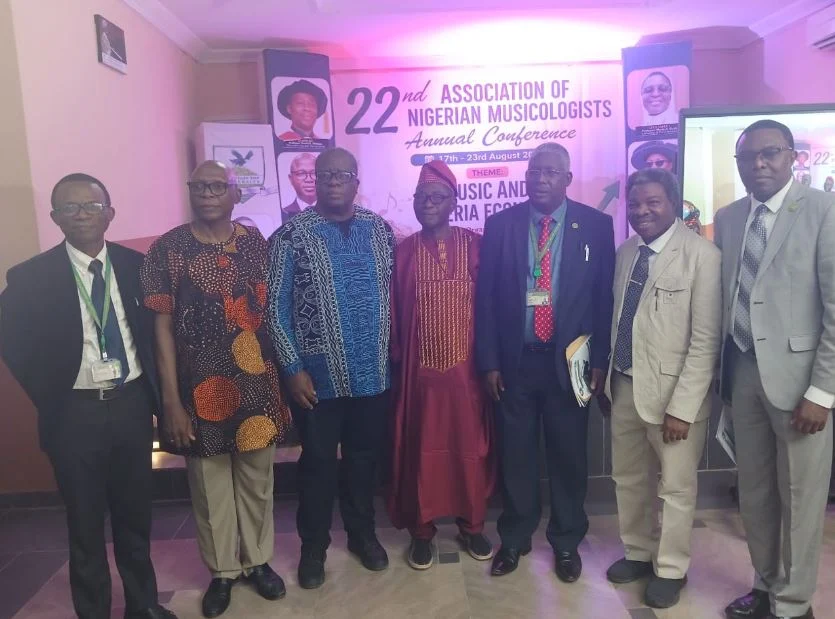
The Association of Nigerian Musicologists has said Nigeria must urgently reposition its music sector as a major contributor to the national economy through improved monetisation, music education, technology, tourism and stronger policy support.
The President, Association of Nigerian Musicologists, Prof. Femi Abiodun, stated this on Tuesday at the opening ceremony of the association’s 22nd Annual Conference held at Mountain Top University, Ogun State, at the conference, themed “Music and Nigeria’s Economy in the 21st Century.”
Present at the conference were music scholars, practitioners, composers, performers, educators, creators and other stakeholders.
Abiodun challenged music scholars and practitioners to move beyond academic discussions and begin to demonstrate how music composition, performance, education and technology could translate into measurable economic value.
He said, “We will be looking at theories, themes, compositions and performances, but we must ask a fundamental question: How does your composition contribute to Nigeria’s economy?
“If you compose or perform for the military, how does that performance contribute to Nigeria’s economy? Is it simply about marching? We come out in the morning, perform military music and march—is that all?” he asked.
Abiodun identified music tourism as another largely untapped opportunity, stressing that Nigeria had yet to adequately develop its rich musical heritage into a sustainable tourism economy.
He also called for a review of the country’s music curriculum, asking why Nigerian music was not sufficiently integrated into educational programmes, and asking, “Where is Nigerian music in our educational curriculum? That is another challenge.”
On music technology, the ANM president urged Nigerian institutions to move from teaching theories to producing musical instruments and technologies that could generate employment, revenue and export opportunities.
According to him, Nigerian polytechnics and universities should be producing high-quality musical instruments for local and international markets.
Abiodun further challenged stakeholders to consider when the music industry would become economically competitive with traditional sectors such as oil and gas.
“When will the music sector outpace traditional sectors such as oil and gas? When will music generate more economic value than oil?” he asked.
He also decried the poor monetisation of creative work in Nigeria, noting that society often placed a higher financial value on physical products than intellectual and creative services.
“We have a serious problem with how society values creative work. People are willing to pay enormous amounts for shoes, clothing and cars. But when it comes to music, performance, composition or other creative services, people often want to negotiate the price down to almost nothing,” Abiodun said.
He challenged music educators to rethink their curricula to ensure that graduates could convert their knowledge and skills into sustainable livelihoods.
“When will our music curriculum equip our graduates with the capacity not only to perform music but also to create economic value from their knowledge and skills? I am challenging my colleagues,” he said.
The ANIM president said the conference should not end with academic papers and discussions alone, but should produce practical solutions capable of transforming Nigeria’s music sector.
In a virtual message, the Chancellor, Mountain Top University, Dr Daniel Olukoya, said music was more than entertainment, describing it as a ministry, culture, education and an important component of the economy.
Olukoya, who was represented at the event, said the university was committed to supporting platforms that advance scholarship, creativity and the transformative power of music.
He said the institution’s support for the conference reflected its commitment to the development of music and the arts, adding that the gathering should generate ideas capable of creating jobs, promoting industry growth, preserving culture and contributing to national development.
Also speaking, the university’s Vice-Chancellor, Prof. Elijah Ayolabi, represented by the Deputy VC, Prof. Gabriel Ajayi, said Nigeria’s music industry had become one of the country’s most visible cultural exports.
He said Nigerian music, including Afrobeats, gospel, highlife, Fuji, Juju and hip-hop, had attracted global audiences while creating economic activities in recording, live performance, broadcasting, film, fashion, digital streaming, tourism, advertising and event management.
However, he challenged stakeholders to go beyond asking whether music contributes to the economy and focus on how much value the music ecosystem generates, who benefits from it and how creative professionals could better monetise their intellectual property.
The VC also identified copyright protection, royalty collection, piracy, digital ownership and equitable remuneration as challenges requiring urgent attention in the era of digital streaming and social media, as he urged musicologists to connect scholarship with industry, entrepreneurship and national development, stressing that music education must increasingly connect theory with practice.
The Dean, College of Humanities, Management and Social Sciences, MTU, Prof. Babatunde Oni, described music as “infrastructure for identity, education, diplomacy, cultural preservation and economic development,” adding that the university’s music department had grown into a centre for music training, research and performance.
Others present at the conference include a Professor of African Music, University of Venda, South Africa, Prof. Madimabe Mapaya, who gave the keynote address; and Head of the Department of Music, MTU, Dr Bayo Ogunyemi.






Scammers Hijack Car Dealer’s Identity, Forge CAC Certificate Photo, and Open Fraudulent Moniepoint Account, Exposing Deep Flaws in Fintech KYC – Secrets Reporters Nigeria

FAAN Spent N158.59bn against N98.39bn Limit, Audit Demands N60.2bn Refund – Secrets Reporters Nigeria

₦367.99m in Financial Irregularities Uncovered in FCT Social Development Secretariat Under the Leadership of Hajiya Safiya Umar – Secrets Reporters Nigeria

Osun 2026: INEC Under Scrutiny As Money Politics, Violence, Security Threats Test Nigeria’s Road To 2027

₦35.46m Financial Irregularities Mars Dr. Aishatu Abubakar-Baju (AIG), Veterinary Council of Nigeria Leadership – Secrets Reporters Nigeria

Investigation Reveals NOTAP Channelled ₦138.8 Million Public Revenue into Staff Welfare, Sponsored Non-Staff Weddings and Approved Unauthorised Foreign Trips in Questionable Transactions – Secrets Reporters Nigeria

“The most powerful person in a house is the housemaid” — Man questions billionaire’s maid’s ₦180K salary

“I paid for his visa, flight, hotel, rent, but he broke up with me 4 months after arriving UK” — Woman reveals

Ministers, Governors, Lawmakers You Rely On Are Not Working In Your Best Interest – Jonathan Vatsa Warns Tinubu

Nigeria’s Atomic Energy Commission Paid ₦34m Without Documents, Lost Track of Store Items and Let a Former Chairman Drive Off With Official Toyota Camry – Secrets Reporters Nigeria

Musicologists seek economic reforms, better monetisation of music sector

Tinubu, Akpabio in closed-door meeting at Aso Rock

WHO chief warns DR Congo Ebola outbreak ‘far from being under control’

In Spain’s Ceuta, migrant women tell of sexual harassment: ‘it’s really bad’

Peta releases Hayden Panettiere dolphin campaign filmed weeks before death

ZZ Top star Frank Beard hailed as ‘innovative drummer’ after death aged 77

Conor Kennedy, son of Robert F. Kennedy Jr., placed on Russia's wanted list for service to Ukraine

Osun Will Reject APC In 2027 – Hakeem Baba-Ahmed

₦3.26bn in Revenue and Account Irregularities Uncovered Under Mr Abdullahi O. Attah as Chairman – Secrets Reporters Nigeria

“For 30 minutes”- Woman shares how she met her husband during heavy rainfall

 Politics15 hours ago
Ministers, Governors, Lawmakers You Rely On Are Not Working In Your Best Interest – Jonathan Vatsa Warns Tinubu
- News17 hours ago
Nigeria’s Atomic Energy Commission Paid ₦34m Without Documents, Lost Track of Store Items and Let a Former Chairman Drive Off With Official Toyota Camry – Secrets Reporters Nigeria
- Entertainment16 hours ago
“If you can’t pay for your flight ticket and don’t have a job, don’t marry” — Female pastor advises ladies

 World24 hours ago
Iranian Army Chief Offers $30,000 Bounty for Killing or Capturing US Soldiers, Doubles Reward for Women
- Entertainment13 hours ago
“Your prayer point is different from mine” – Businessman says as he proudly flaunts his thriving business
- Entertainment12 hours ago
“He tried to lure me into having sex with him, but I refused” — Funke Etti recounts alleged ordeal with movie director
- Entertainment14 hours ago
“She stole his clothes and ran” — Lady recounts how student exposed lecturer after he demanded an affair for better grades
- Entertainment14 hours ago
“Omo! She no turn back o” — Lady shares friend’s shocking decision after father died before flight to Canada