Metro
Gas Utilisation Still Less Than 50% Capacity Despite Growing Infrastructure – NMDPRA

Nigeria has large natural gas reserves and growing demand from power plants, businesses and industries….
Nigeria has large natural gas reserves and growing demand from power plants, businesses and industries.
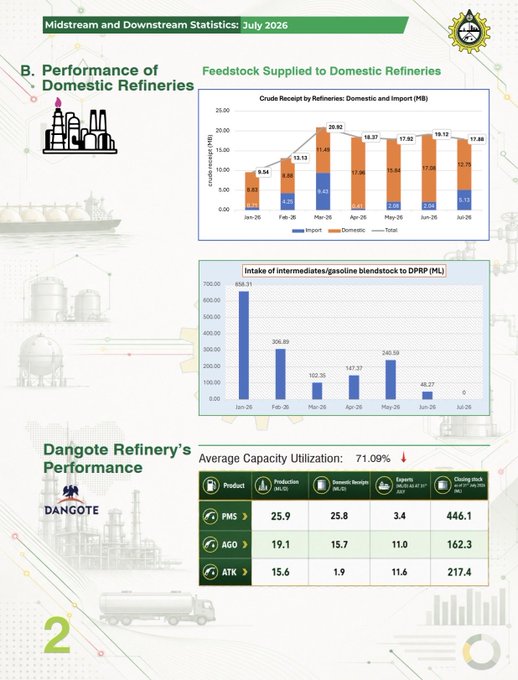
But July 2026 data from the Nigerian Midstream and Downstream Petroleum Regulatory Authority (NMDPRA) shows that much of the country’s gas-processing capacity remains unused.
Nigeria supplied an average of 4.723 billion cubic feet of gas per day in July.
Of this, 2.695 billion cubic feet per day went to Nigeria LNG, while 2.028 billion cubic feet per day supplied the domestic market.
Domestic gas was used by power plants, commercial businesses and gas-based industries.
Power generation received 0.534 billion cubic feet per day. Commercial users received 0.507 billion cubic feet, while gas-based industries received 0.552 billion cubic feet.
However, major gas-processing facilities operated at only 49.21 per cent of their capacity.
The facilities processed an average of about 7.966 billion standard cubic feet of gas per day.
This means Nigeria does not only need to produce more gas. It must also make better use of the infrastructure already available to process and transport it.
Several major projects are intended to improve gas supply across the country. They include the Ajaokuta-Kaduna-Kano pipeline, OB3 River Niger Crossing, Odidi-Warri Expansion Project, Escravos-Odidi Pipeline and ELPS Midline Compressor Project.
These projects are important because gas must be moved from production sites to power plants, factories, businesses and export terminals.
Gas reserves have limited value if the fuel cannot be processed and delivered to users.
The government is also considering measures to increase domestic gas supply and reduce costs. These include proposed domestic crude and gas swap arrangements and stronger enforcement of supply obligations.
Nigeria has abundant gas, but many homes and businesses still face unreliable electricity and energy supplies.
The July figures show that the main challenge is not simply finding more gas. It is completing infrastructure, ensuring reliable supply, setting workable prices and connecting producers with consumers.
Nigeria’s priority should therefore be to use more effectively the gas and infrastructure it already has.


“A governor once gave Wizkid a bag full of dollars” – Kizz Daniel’s bouncer reveals what singer allegedly did next

‘It Is A Disgrace Tinubu Doesn’t Trust Anyone’ – Melaye Slams President’s Self-Appointment As Campaign Chairman

“I spent months praying for God to take my husband’s money away” — Woman opens up on painful marriage

Hon Ereyitomi Congratulates Chief Ayiri Emami, Stella Okotete on APC Presidential Campaign Council Appointments

Economic Impact of Extracted Precious Metals from Electronic Waste in South Western, Nigeria; Review of Extraction Methods

BAECC Reaffirms Commitment to the Timely Delivery of the Benin-Asaba Expressway Project Following Recent Protest

23 years of operation: Globacom as the architecture of value and the audacity to never settle for less

₦394.86m Financial Irregularities: Nigeria’s Bata Consulate Paid Unapproved Subsidy, Retained Public Funds – Secrets Reporters Nigeria

Ogun community raises alarm over alleged destruction of farmlands by land grabbers, begs Gov Abiodun to intervene

“Okpebholo Signs Edo Judiciary, Assembly Financial Autonomy Bills Despite JUSUN Protest” — Capital Funds Return To Executive Control

NSCDC Arrests 2 Suspects – The Trumpet Newspaper Nigeria

Dolly Parton: US lowers flags for one week

Laliga: Things To Know As Real Madrid Welcome Real Sociedad In Matchday Two

NRS tax revenues jump 113% to N27tn in three years – Report

Tinubu Celebrates Hausa Community On Hausa Day

‘It was Aisha Yesufu that called Tinubu illegitimate President, not me’ – Daniel Bwala
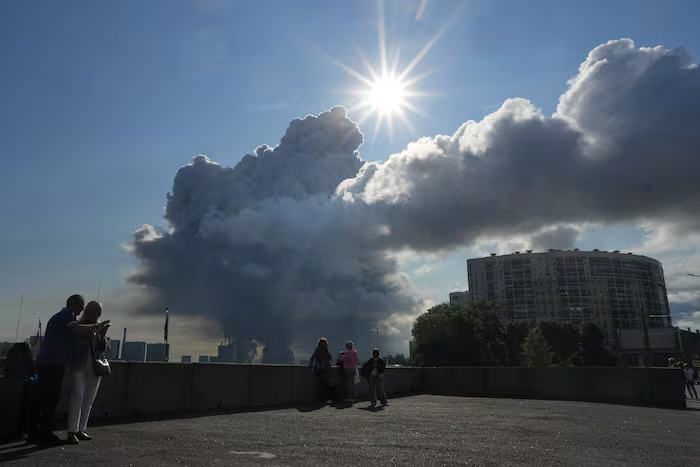
A Wildberries depot in Russia is hit again and destroyed as Ukraine extends its drone campaign

“When I Said I Would Return Subsidy, I Will” — Atiku Disowns Aide’s Remarks, Reaffirms 2027 Petrol Subsidy Plan

Two Killed, Scores Injured As Cultists Attack ESSN Office In Edo

Chicago-Switzerland flight diverts to Portuguese island after odor sickens 6

 News21 hours ago
BAECC Reaffirms Commitment to the Timely Delivery of the Benin-Asaba Expressway Project Following Recent Protest
- Headlines16 hours ago
Ogun community raises alarm over alleged destruction of farmlands by land grabbers, begs Gov Abiodun to intervene
- Headlines13 hours ago
‘He didn’t speak on my authority’ – Atiku counters aide, insists on total restoration of fuel subsidy
- News11 hours ago
Evening recap: Falana faults NBA over George Weah invitation, Poco Lee’s management clears drink-spiking claims, other top stories
- Politics15 hours ago
Fuel Subsidy: They Don’t Have Patience To Study What Atiku Is Proposing – Ologbondiyan Knocks Tinubu’s Govt
- Viral21 hours ago
“And this guy collected my 1k” — Man discovers ‘young boy’ he gave transport money was actually the groom
- News8 hours ago
Exclusive: NFIU Places Tinubu’s Campaign DG Abdulaziz Yari Under Secret Investigation For Laundering $500,200 Through New Bank Account In 7 Days – Secrets Reporters Nigeria
- Viral20 hours ago
“Something no clear here” — Lady recounts how friend ended relationship with millionaire ex after strange setbacks