Politics
A new chapter in Nigeria’s campaign against substance abuse…

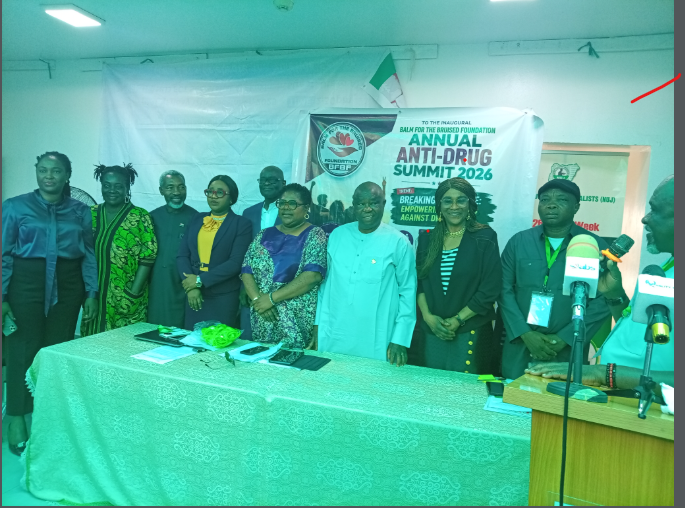
A new chapter in Nigeria’s campaign against substance abuse was opened with the inauguration of the BALM for the Bruise Foundation Annual Anti-Drug Summit 2026, a humanitarian initiative aimed at empowering families to prevent drug abuse before it starts.
Key Highlights
- The BALM for the Bruise Foundation Annual Anti-Drug Summit 2026 was inaugurated in Abuja to strengthen efforts against substance abuse.
- The summit focused on empowering families to prevent drug abuse before it starts, with emphasis on parents, guardians and mentors.
- Founder Princess Ekwi Ajide called for stronger family and community action, stressing that prevention is more effective than treatment.
- The foundation launched a publication titled “Impending Crisis: Drug Use Among Women in Nigeria,” highlighting the growing impact of substance abuse among women.
- Keynote speaker Prof. May Nwoye urged Nigerians to prioritise education and mentorship alongside enforcement in tackling drug abuse.
Held under the theme: “Breaking the Cycle: Empowering Families Against Drug Abuse,” the summit held in Abuja on Monday, brought together policymakers, educators, health professionals, anti-drug advocates, journalists, parents, youth leaders, and development partners to address one of Nigeria’s most pressing social challenges.
With the sub-theme: “The Family Factor: Preventing Drug Abuse Before It Starts,” speakers unanimously agreed that the fight against substance abuse must begin in the home, where parents, guardians and mentors play a critical role in shaping the values and choices of young people.
Convener of the summit and Founder of the BALM for the Bruise Foundation, Princess Ekwi Ajide, described the event as the beginning of a movement dedicated to protecting families and restoring hope to communities affected by addiction.
She noted that the gathering is more than a conference, describing it as a platform for collective action to safeguard the next generation.
“Drug abuse has become one of the most pressing social challenges of our time. Too many dreams have been cut short, too many futures have been placed at risk, and too many parents continue to ask where things went wrong,” she said.
Ajide maintained that hope begins within the family through parents who listen, teachers who guide, faith leaders who mentor and communities that care.
She stressed that prevention remains far more effective than treatment, urging parents to equip themselves with the knowledge, communication skills and support needed to become the first line of defence against substance abuse.
According to her, the summit was designed to move beyond discussions by promoting practical solutions, stronger partnerships and community ownership of the anti-drug campaign.
The foundation also officially launched its new publication, titled: “Impending Crisis: Drug Use Among Women in Nigeria,” a research-based booklet examining the growing prevalence of substance abuse among women and its implications for families, children and society.
Ajide said the publication seeks to stimulate research, policy reforms and informed public conversations on an often-overlooked dimension of Nigeria’s drug challenge.
Delivering the keynote address, Prof. May Nwoye urged Nigerians to look beyond arrests and enforcement, arguing that education and mentorship remain the country’s strongest weapons against drug abuse.
She described Nigeria as a youthful nation blessed with enormous human and natural resources but burdened by economic hardship, unemployment, family instability and social inequality that leave many young people vulnerable to substance abuse.
According to her, preventing addiction requires understanding rather than condemnation.
“Drug abuse is rarely just a matter of poor choices. Many young people are searching for relief from emotional pain, stress, anxiety and hopelessness,” she said.
Prof. Nwoye explained that quality education equips young people with critical thinking skills, confidence and sound judgement, while mentorship provides encouragement, direction and positive role models capable of transforming lives.
Read also:
Sharing a moving illustration, she recounted the story of two boys from the same neighbourhood in Lagos who grew up under similar circumstances.
Both were introduced to drugs during secondary school. One accepted the offer, became addicted and eventually lost his educational opportunities and future prospects.
The other rejected drugs after receiving guidance from a caring teacher who later connected him with an engineer who mentored him throughout his academic journey.
Today, she said, the young man is a successful engineer, proving that sometimes “one caring adult can completely change the direction of a young person’s life.”
She challenged participants to mentor at least one child within their families or communities, describing mentorship as one of society’s most effective interventions against drug abuse.
“Our collective responsibility is to protect the dreams of young people before they are destroyed,” she added.
Speaking at the summit, communication expert and marketplace entrepreneur Dr. Ike Neliaku applauded the initiative, describing substance abuse as a national development challenge that demands collective responsibility.
Neliaku praised Princess Ajide for her commitment to social impact and also commended the Chairperson of the Nigeria Union of Journalists (NUJ), FCT Council, Grace Ike for supporting the programme.
Chairperson of the NUJ FCT Council, Grace Ike, challenged media practitioners to move beyond crime reporting and become active partners in drug prevention through responsible journalism.
She emphasised that journalists have a duty to promote evidence-based reporting, reduce stigma surrounding addiction and amplify stories of recovery that inspire hope.
According to her, prevention begins with sustained public education through schools, families, faith-based organisations and community institutions.
She also advocated stronger parenting support systems, increased access to rehabilitation services, improved government investment in treatment programmes and stronger collaboration between government agencies, healthcare professionals, civil society organisations and the media.
“Addiction is a health challenge, not a moral failure,” she said, urging governments to invest in prevention and rehabilitation with the same commitment devoted to infrastructure development.


‘Atiku Will Definitely Lose 2027 Election, Peter Obi-Kwankwaso Have 70 Percent Chances’ – Babachir Lawal

Buhari Had Intelligence Reports on Tinubu’s Education, Genealogy, Complained About It – Former SGF Lawal Reveals

EFCC: ‘I’ve been in pain since I publicly supported you’ — Former NSIPA CEO cries out to Tinubu [Video]

What Exactly Is The Interest Of This Man?– Lere Olayinka Reacts To Gumi’s Warning To Niger Governor Bago

“I had to clean poop from the Uber with my bare hands” – Man recounts embarrassing ordeal after date with talking stage

“I Am A Citizen, I Can’t Carry My ID Everywhere I Go” — South African Man Breaks Down After Being Mistaken For A Foreign National

“No be the same person wey say marriage no be achievement?” Fans react as Geh Geh’s alleged secret wedding surfaces online

𝐑𝐞𝐧𝐞𝐰𝐞𝐝 𝐇𝐨𝐩𝐞 𝐒𝐭𝐮𝐝𝐞𝐧𝐭 𝐀𝐦𝐛𝐚𝐬𝐬𝐚𝐝𝐨𝐫𝐬 𝐇𝐨𝐥𝐝𝐬 𝐒𝐭𝐮𝐝𝐞𝐧𝐭 𝐋𝐞𝐚𝐝𝐞𝐫𝐬 𝐓𝐨𝐰𝐧𝐡𝐚𝐥𝐥 𝐌𝐞𝐞𝐭𝐢𝐧𝐠 𝐎𝐧 𝐕𝐨𝐭𝐞𝐫 𝐄𝐝𝐮𝐜𝐚𝐭𝐢𝐨𝐧 𝐚𝐧𝐝 𝐂𝐢𝐯𝐢𝐜 𝐄𝐧𝐠𝐚𝐠𝐞𝐦𝐞𝐧𝐭 𝐈𝐧 𝐎𝐠𝐛𝐢𝐚

“When did public opinion become stronger than the altar?” – AY Makun reacts following withdrawal from church programme

“I won’t be alive to see Christ humiliated” – Pastor David Ibiyeomie blasts government over bus preaching ban

Philippine president slams China in veiled rebuke in his state of the nation speech

Bayelsa Traditional Ruler – The Trumpet Newspaper Nigeria

Davido Mocks MC Oluomo Over Opposition to Adeleke’s NURTW Ban

UK’s new PM Burnham welcomes Zelensky as first foreign visitor

Geh Geh’s videos not real marriage…

Tinubu, Atiku Dispute Distracting Nigerians – Sumner Sambo

UNILAG Warns Female Students: ‘Do Not Shake Hands Anyhow With Any Man’ in Safety Advisory

Complete Portharcourt-Enugu road, rail projects, revive eastern seaports now – Ohanaeze to Tinubu

Cardoso, Okonjo-Iweala To Lead Dialogue At 7th Africa Emerging Markets Forum

BBNaija 11: Tempers Flare Early As Housemates Exchange 1st Heated Words Over Wager Task

 Viral20 hours ago
𝐑𝐞𝐧𝐞𝐰𝐞𝐝 𝐇𝐨𝐩𝐞 𝐒𝐭𝐮𝐝𝐞𝐧𝐭 𝐀𝐦𝐛𝐚𝐬𝐬𝐚𝐝𝐨𝐫𝐬 𝐇𝐨𝐥𝐝𝐬 𝐒𝐭𝐮𝐝𝐞𝐧𝐭 𝐋𝐞𝐚𝐝𝐞𝐫𝐬 𝐓𝐨𝐰𝐧𝐡𝐚𝐥𝐥 𝐌𝐞𝐞𝐭𝐢𝐧𝐠 𝐎𝐧 𝐕𝐨𝐭𝐞𝐫 𝐄𝐝𝐮𝐜𝐚𝐭𝐢𝐨𝐧 𝐚𝐧𝐝 𝐂𝐢𝐯𝐢𝐜 𝐄𝐧𝐠𝐚𝐠𝐞𝐦𝐞𝐧𝐭 𝐈𝐧 𝐎𝐠𝐛𝐢𝐚
- Entertainment20 hours ago
“I won’t be alive to see Christ humiliated” – Pastor David Ibiyeomie blasts government over bus preaching ban
- Viral20 hours ago
IYC CENTRAL ZONE ELECTION: PROTEST BREWING OVER ALLEGED DELEGATES LIST MANIPULATION BY GOVERNOR’S BROTHER.
- Politics10 hours ago
They Set Labour Party On Fire To Burn Me, Now They Have Carried Same Fire To NDC – Peter Obi Slams APC
- Viral20 hours ago
ALLEGED AVIATION SCHOLARSHIP SCAM: SECOND SUCCESSFUL CANDIDATE SUES DR ERUANI AZIBAPU AND AZIKEL GROUP FOR 1.9 BILLION NAIRA
- Entertainment24 hours ago
“If my wife cheats it’s over, but if I cheat, she’ll forgive me” – Man shares controversial take on infidelity
- Viral19 hours ago
IYC Directs Central Zone to Suspend Planned Solidarity March Over Kiriyai Case, Seeks Amicable Settlement
- Special Report7 hours ago
“Nkwasiafoɔ, Who Will Play The Instruments?” — Nana Agradaa Sacks Instrumentalists After Mass Altar Call For Travel Prayers