Politics
Nigerian Bishop Warns: ‘Total Elimination of Christians Is Underway’

Congressional Testimonies and 4,216 Deaths Refute Abuja’s Denial of Targeted Persecution
By Mary Kiara
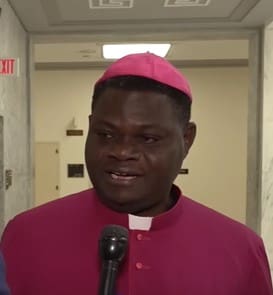
BENUE, Nigeria – Bishop Wilfred Anagbe has told the U.S. Congress four times that Christians face genocide in Nigeria. New data shows one killed every 86 minutes.
For Reverend Anagbe, Catholic Bishop of Makurdi, the ongoing bloodshed across his diocese reinforces a persistent pattern of displacement aimed at erasing indigenous Christian farming communities.
“The total elimination of the Christian population is underway,” Bishop Anagbe told TruthNigeria.
“The attackers follow a recurring pattern: killing civilians, destroying churches, burning farmland, and driving entire communities from their villages before occupying the abandoned land. This is a calculated strategy of Islamization.”
Anagbe has carried that warning beyond Nigeria, appearing before the U.S. House Foreign Affairs Committee in July 2023, February 2024, March 2025, and again in November 2025.
His argument has remained consistent: The violence is not simply a series of isolated attacks but a pattern that has driven Christian families from communities where they farmed, worshiped and raised their children.
Anagbe’s warning comes as new field research directly refutes claims by officials in Abuja that security conditions are improving.
Statistical Evidence Refutes Federal Defense
The Nigerian federal government continues to reject characterizations of targeted religious violence. Government spokespersons attribute the crisis to multi-causal clashes between herders and farmers, citing military deployments as evidence of progress.
“The national crisis is a complex mosaic comprising resource-based herder clashes over grazing land,” presidential deputy spokesperson Philip Agbese claimed in statements defending the administration.
However, field tracking data compiled by Equipping The Persecuted (ETP) reveals that 4,216 Christians were killed in Nigeria between January 1 and September 8, 2026. That rate equals an average of 16.8 deaths per day, or one Christian killed every 86 minutes. At this rate, the annual death rate of Christians will be over 6,000 by year’s end.
“When attacks are framed only as farmer-herder clashes, the actions of generalized rural violence or mass persecution may be misinterpreted as merely a development problem or a policing failure,” ETP noted in its report, Crisis in the Middle Belt: Religious Persecution and Security Failure in Nigeria.
Independent scholars confirm that while central Nigeria faces multiple security threats, targeted anti-Christian aggression remains a primary driver of the crisis.
“Do I believe that Christian communities in Nigeria’s Middle Belt and North are being systematically targeted? Yes, I do,” Dr. Christopher Wadibia, an independent scholar and expert on Nigerian religious movements, told TruthNigeria.
“Nigeria consistently ranks as a global epicenter of targeted anti-Christian violence. The data consistently supports this.”
Arms Pipelines and Communication Blackouts
Security analysts contend that military deployments will continue to falter unless authorities dismantle illicit weapons pipelines and fix severe rural communications gaps.
“Interceptions alone are not enough; there should be deeper investigations into those behind shipments of illegal arms, as well as arrests and prosecutions,” security analyst Dennis Amachree told TruthNigeria, citing recent customs seizures along major transit corridors.
“Smaller-scale smuggling remains a problem, with weapons concealed in vehicle imports. But bulk shipments deserve urgent government-to-government scrutiny.”
Amachree also highlighted how infrastructural failures prevent vulnerable agricultural communities from calling for help when attacks begin.
“How do residents say something when they see something?” Amachree said, noting that spotty mobile network coverage regularly delays security responses during multi-hour village sieges.
The Policy of Permanent Displacement
The violence has produced one of Africa’s largest internal displacement crises. Senior analysts from the ACLED Exploration Portal note that the second quarter of 2026 stood out as the most violent single quarter recorded in Nigeria since the database began tracking the country in 1997. Targeted attacks on civilians surged by 30 percent.
Data from the UN Refugee Agency (UNHCR) places Nigeria’s internally displaced population at over 3.71 million, with more than 2 million concentrated in Benue State alone.
Despite ongoing violence, official initiatives to close internally displaced persons (IDP) camps and relocate victims away from their ancestral lands have drawn sharp criticism from Church officials.
Human-rights advocates warn that permanently resettling victims outside their original villages effectively legitimizes land seizures by armed militias.
“We must move beyond the ‘camp culture’ and restore the dignity of the people in order to restore the entire social and economic fabric,” Fr. Remigius Ihyula of the Makurdi Diocese told TruthNigeria.
“The objective is simple: to help our people become self-reliant on the lands of their ancestors, where they have their roots and which they have cultivated for centuries.”
Ihyula emphasized that prolonged displacement severely degrades social structures, noting that school dropout rates in IDP camps exceed 90 percent while basic healthcare and trauma support remain non-existent.
International Scrutiny Increases
International religious freedom monitors point out that successful recovery requires restoring victims to their original homelands under state protection rather than institutionalizing camp life.
“In Iraq, ACN and its Church partners made history when more than 50 percent of internally displaced people returned to nine villages that ISIS had destroyed,” Mark von Riedemann, ACN Director of Public Affairs, noted in an international report.
“The same success could be achieved in Nigeria if the government worked closely with local Church structures and received international support.”
Mary Kiara reports on Terrorism and Religious Freedom Policy for TruthNigeria.
Related


FUTA Under Vice-Chancellor Adenike Oladiji Spent ₦49.8 Million on External Lawyers Without Required Attorney-General Approval

U.S. State Department Confirms TruthNigeria’s Findings on Plateau Massacres, Pledges Protection for Christians

NECO: ₦5.8bn Irregularities Exposed in 2024 Financial Records Under the Leadership of Professor Ibrahim Dantani Wushishi

“We Are Not Aware Of Any Supreme Court Judgment Barring Pantami” — Gombe PDP Insists Ex-Minister Can Contest Fresh Primary

Special Report: N4.18 Billion of Nigeria’s Money Left Aso Rock In 2025 To Unknown Account And Nobody Knows Where Yet

“If your tribe can’t give you a better life…” – Laide Olabanji drums support for Peter Obi ahead of 2027 election

“I built this house with over ₦120m, but I want to sell it for ₦5m” – Man cries out over heavy flooding

₦10.5 Billion Road To Nowhere And ₦294 Million In Private Accounts: The Agriculture Ministry Scandal Headed by Sabo Nanono

“My mother died 2 days ago and I feel nothing” – Lady reveals why she won’t attend her own mother’s funeral

“I’m not saying that I’m…” — Apostle Arome Osayi breaks silence over “Nigeria’s revival calling” controversy

Stakeholders call for stronger investment in health sector as MSF clocks 30 years in Nigeria

“I have disgraced you” – Ex-Muslim lady recalls mother’s reaction after she became Christian

UNL: Norway players speak on revenge on Bernardo Silva as Odegaard’s injury update emerges

Borno’s Multi Billion-Naira Rehabilitation Scheme Refueling Boko Haram?

Troops neutralise suspected terrorist, arrest another in Benue

Nigerian Bishop Warns: ‘Total Elimination of Christians Is Underway’

2027: ‘Let The Competition Be Intense’ – Akpabio Tells Politicians

Kano village head found dead days after abduction
U.S. Commends Nigeria for Defending Plateau State Christians as Attacks Continue

Alleged Coup: Court Sets December 7 to Rule on Admissibility of Defendants’ Statements

 Viral23 hours ago
“I’m not saying that I’m…” — Apostle Arome Osayi breaks silence over “Nigeria’s revival calling” controversy
- Viral18 hours ago
“Is this how you will kpai like mumu?” — Isaac Fayose blasts Tinubu’s supporters over ₦1,500/litre fuel
- News11 hours ago
Nigerian Embassy In Ankara Moved ₦503 Million Between Budget Lines Without Approval, Federal Review Finds
- Metro13 hours ago
“Introducing AI Into A System Yet To Account For Existing Failures Is Not Electoral Reform” — Obidient Movement Rejects INEC’s 2027 Plan
- Viral21 hours ago
Caucasian woman calls out popular network provider over poor coverage, claims it’s affecting her marriage
- News13 hours ago
Exclusive: NASENI DG Khalil Halilu Pays N8 Billion To A Company That Was Registered Five Weeks After His Appointment By Tinubu
- News9 hours ago
Exclusive: How Taraba State Governor Agbu Kefas Borrowed N15 Billion To Build Roads But Secretly Turned The Loan Into Paying WAEC Fees and NUC Accreditation
- News4 hours ago
University of Calabar Under Former Vice-Chancellor Florence Obi Fails to Remit ₦264 Million, Cannot Account for ₦47.7 Million in Cash Advances