Politics
2027: APC Deputy Chairman Rejects Wike’s Rainbow Coalition

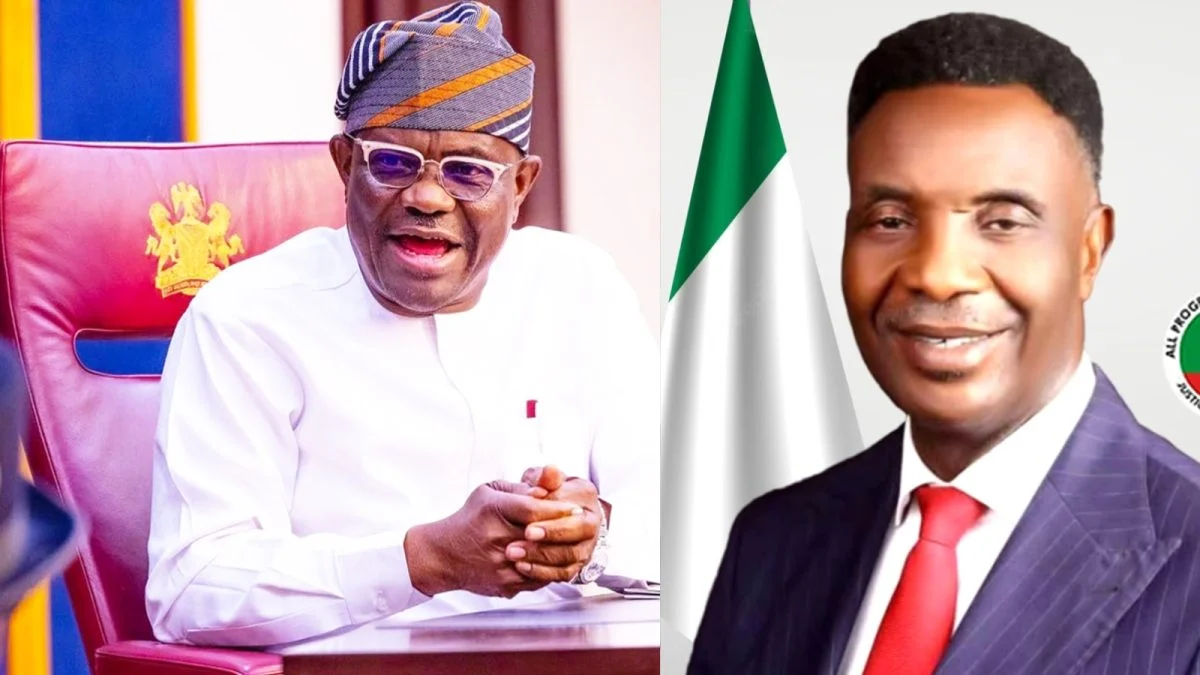
The Deputy National Chairman of the All Progressives Congress (APC), South, Dr Ben Nwoye, has rejected the idea of a cross-party “Rainbow Coalition” being promoted by Minister of the Federal Capital Territory, Nyesom Wike, ahead of the 2027 general elections.
Nwoye said political cooperation across party lines would create complications if politicians support President Bola Tinubu for re-election while backing candidates from other parties in the National Assembly and state elections.
He spoke in Enugu while addressing selected stakeholders and political supporters on the 2027 elections.
Wike, who remains a member of the Peoples Democratic Party (PDP), has repeatedly explained that his support for Tinubu does not amount to an agreement with the APC.
He has also maintained that the PDP can field candidates for governorship, National Assembly and State House of Assembly elections while members of different parties work together to support the President.
Nwoye, however, said such an arrangement could become difficult for the APC to manage because the party would expect its members and supporters to back its candidates across the ballot.
“Wike is not a member of the APC but he works for the government of APC,” Nwoye said. “It is in his own best interest to support the re-election of President Tinubu. Some of those things are also for self-preservation. Tinubu has to win for him to continue his employment as a minister. We understand. But as a party, we also worry about the effect it would have where one is telling the electorate to vote for this person for this position and to vote another person in different parties.”
Wike had recently defended the Rainbow Coalition and said the arrangement was not designed as an alliance with the APC.
He argued that Nigerian voters had already demonstrated that they could vote for different political parties in presidential and legislative elections held on the same day.
The minister cited the 2023 elections in states including Imo, Abia, Enugu and Ebonyi, where voting patterns differed between the presidential and National Assembly contests.
Nwoye also turned his attention to Anambra State Governor Chukwuma Soludo and comments about cooperation among progressive forces ahead of 2027.
He said political cooperation should be reflected in practical arrangements and not only statements of support.
“There is nothing wrong if it true that progressives are supporting Tinubu in Anambra State. But then we should have people of APC sitting in Soludo’s government. He should appoint them. At the federal level, President Tinubu did so. Bianca Ojukwu is of APGA. In Anambra government, we don’t have members of APC working with Soludo. If you say progressives are working together, you need to demonstrate it if it is real. In some instances where we have candidates, there should be no APGA candidates. If you have APGA candidates contesting against APC candidates for one position, who are you working together with?”
The APC leader said the party’s position in Anambra was to campaign for its candidates from the presidential election down to legislative contests.
He argued that supporting Tinubu without supporting APC candidates in other elections could create a divided political structure.
Nwoye said the situation could become problematic if a president elected under the APC had to work with legislators elected on opposing platforms.
“Soludo has to explain how, otherwise it is a fallacy and we have to call it out for what it is. If you say you are accepting the president, we buy that idea. But if you start selling the narratives that progressives are working together, when indeed progressives in Anambra are into competitive interests, where is the togetherness? We are open to walking together, but there must by discussion on that. There must be some layers of agreement, but if you don’t have understanding to the extent that in the grassroots, you are competing, there is a fallacy. We have to dissect it. Soludo can say that progressives of the APGA extraction are supporting President Tinubu’s re-election. Tinubu appointed many APGA people into his government. There is perhaps intentional or unintentional confusion that is being thrown in the midst. There is falsehood.”
Nwoye’s position is consistent with recent statements by APC leaders in the Southeast, who have called for support for the party’s candidates across the ballot.
At an Anambra Central stakeholders’ meeting in Awka, he also urged party members to adopt what he described as “top-to-bottom” voting.
He said the APC would need a strong legislative presence if the Tinubu administration is to continue implementing its programmes without political disagreements affecting its agenda.
“Nigeria practises functional democracy, which demands total allegiance. When people support candidates, and they are truly members of a political party, we demand top to bottom. You must not divide. As party managers, we remind them that in order for us to project our party agenda, we have to support our candidates top to bottom. If you are supporting Tinubu’s re-election, and you are not supporting candidates of his party for the National Assembly, if at the end of the election, he gets re-elected, and members of the NASS are from other parties, then there is a quagmire. The continuity of the Renewed Hope Agenda will have a snag because there could come a time that these people might be voting against Mr President’s agenda. You are going to make a mess of our system. We have to explain it. It is a contest with the language that the winner takes it all.”
The APC deputy chairman also addressed the political situation in the Southeast and urged voters in the region to consider what he described as national political engagement rather than ethnic or religious considerations.
He specifically mentioned Labour Party’s 2023 presidential candidate, Peter Obi, and argued that the Southeast could not produce a president with votes from the region alone.
“If you allow your votes to be controlled by ethnic and religious bigotry, bearing in mind that there is no pathway for him (Peter Obi) to become president, you throw away your votes. It means we can no longer negotiate as Ndigbo. When you go up there, they will tell you that you did not contribute in the victory. Your share of appointments and development is diminished. You will come back and cry marginalisation. We have to be thinking. It is about negotiation. If the entire Southeast vote, we can’t produce any president because we don’t have the number. We must reach out.”
Nwoye called for greater political engagement between the Southeast and other parts of the country.
He referred to former nationalist leaders, including Nnamdi Azikiwe and Michael Okpara, as examples of politicians who built relationships beyond their immediate ethnic base.
“There must be that handshake across the Niger. There must be cross-pollination. Our forefathers did that. Nnamdi Azikiwe did not become president by seeking the votes of Ndigbo and Christians alone. He started his political career from the West. MI Okpara did the same. When you look at where we were and where we are now, you find out that there is disservice being done by some of our leaders.
“Before now, we used to take part in the tripod holding Nigeria, either as president, vice president or the Senate president. The best we have now is deputy speaker. Igbos are usually the number one after the locals among ethnic nationalities in Nigeria. At times they are the number one. But we have to leverage on that, and play politics of national interest, and not individual. After the election in 2015, we couldn’t find a senator of an Igbo extraction from APC. There had to be unification, and that was how Ike Ekeremadu managed to emerge from PDP to become deputy Senate president. He stood his ground to remain PDP in an APC dominated National Assembly.”


“We Will Not Shield Anyone Found Culpable” — NSCDC CG Assures Families Over Deaths Of Miners, Others In Niger Custody

“Why Should Tinubu Fly To UNGA For A 15-Minute Speech?” — Jimoh Ibrahim Defends President’s Absence, Says Nigeria Still On Front Row

“Those Who Fought Jonathan Are Ganging Up Again Against Tinubu” — Okpebholo Says ‘No Vacancy’ In Aso Rock

“Obi Has The Right To Support Others, But Soludo Must Be Crucified For Doing Same?” — Anambra Govt Alleges Double Standards

“Account For ₦29bn Scholarship Funds” — Rivers Assembly Orders Arrest Of PAMO University VC, Prof.Smith Jaja

To Empty National Account Before New Year, NASENI DG Khalil Halilu Pushed N10.6 Billion to a Chinese Builder in the Christmas Week Rush for a N35.5 Billion Campus

“The Claim, As Presented, Is False” — Soludo’s Wife Says Margaret Obi, Not Peter Obi, Is Godparent To One Of Their Daughters

“Some Public Officers Enter With Less Than ₦100,000, Leave With Millions Of Dollars” — Olukoyede Says Nigeria Cannot Develop With Such Corruption

Thief in Uniform: How Police Detained Zone 17 IPO, Inspector Tolani Over ₦620,000 Extortion During Police Investigation

“Ebonyi Assembly Approves ₦450,000 Monthly Remuneration For Local Government Chairmen” — Vice Chairmen To Receive ₦400,00

Okonkwo reverses stance on Obi’s debt record, says ‘I was misled’

Suspected rabid dog bites 18 people in Kano

Otti Warns Against Political Violence As He Opens Abia For 2027 Campaigns

NASENI UNDER KHALIL HALILU: ₦10.65BN CHRISTMAS-WEEK PAYMENT TO CGC RAISES QUESTIONS OVER ₦35.5BN ABUJA CAMPUS CONTRACT

Tinubu: Credit guarantee scheme unlocks ₦46.95bn loans in first year

2027: APC Deputy Chairman Rejects Wike’s Rainbow Coalition

Adeyanju Demands Immediate Action From INEC Over Supreme Court Judgment

Resident doctors give Tinubu two-week ultimatum, threaten strike

Lagos Taskforce Denies Demanding Permit for ‘TRD’ Truck Inscription

Borno council chairman accused of shooting at man

 Politics23 hours ago
What Suffering Are You Bringing To Nigeria? – Yilwatda Tackles Atiku Over Proposed Fuel Subsidy Return
- News21 hours ago
Modibbo Adama University Under Professor Abdullahi Liman Tukur Asked To Account For Over ₦650 Million IGR Deficit And Unretired Advances
- News18 hours ago
Azaman: How Abdullahi As Energy Commission DG Handed Four Different Companies N1.2 Billion Each for the Same Streetlights on One Day
- News21 hours ago
NIETI, Geological Agency, Orthopedic Hospital Igbobi And Four Others Runs FG Street In Financial Recklessness
- Viral23 hours ago
“At this point, we have two fathers in this house” – Mother shares how son disciplines his toy rabbit like dad
- Entertainment23 hours ago
“I had no idea”- Man recounts encounter with Peter Obi on flight
- Society24 hours ago
Olojo Festival climaxes with pageantry, grand finale Monday
- Politics20 hours ago
Winners Emerge in Yobe LG Elections