Metro
Opposition Summit: Atiku, Obi, Kwankwaso, Amaechi Absent As Parties Begin 2027 Coalition Talks

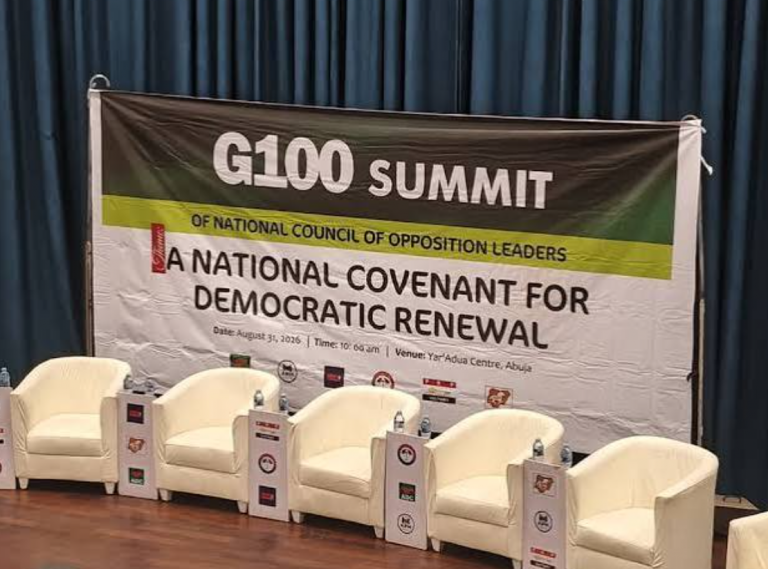
The much-anticipated opposition summit convened to forge a common front ahead of the 2027 general elections suffered a setback on Monday as several prominent opposition leaders failed to attend the gathering in Abuja. The summit, organised by the G100 in collaboration with the Minority Caucus of the House of Representatives,……
The much-anticipated opposition summit convened to forge a common front ahead of the 2027 general elections suffered a setback on Monday as several prominent opposition leaders failed to attend the gathering in Abuja.
The summit, organised by the G100 in collaboration with the Minority Caucus of the House of Representatives, was held at the Shehu Musa Yar’Adua Centre.
The organisers had proposed the development of a framework for the opposition parties to work towards a common presidential candidate and a four-year transition government.
However, the absence of former Vice President Atiku Abubakar of the African Democratic Congress (ADC), former Anambra State Governor Peter Obi, Senator Rabiu Musa Kwankwaso of the Nigeria Democratic Congress (NDC), and former Transportation Minister Rotimi Amaechi was noticeable at the event.
According to The Nation, no official explanation was given for the absence of the four prominent opposition figures.
Despite their absence, representatives of several opposition parties attended the summit, including the Social Democratic Party (SDP), Peoples Redemption Party (PRP), Democratic Leadership Alliance (DLA) and Allied Peoples Movement (APM).
READ ALSO: Opposition Parties Plan National Summit To Forge Alliance Against APC In 2027
Among those present were SDP presidential candidate Prince Adewole Adebayo and his running mate, Dr Usman Bugaje; PRP presidential candidate Donald Duke; DLA candidate Amb. Moses Olusola; and APM vice-presidential candidate Lawal Daura.
Speaking at the summit, Director-General of G100 and former Director-General of the Progressive Governors’ Forum, Salihu Mohd Lukman, warned that continued division among opposition parties could work in favour of the ruling All Progressives Congress (APC) in 2027.
Lukman said opposition parties had repeatedly contested presidential elections separately, allowing the APC to benefit from divided opposition votes.
He therefore urged the parties to first agree on rules for cooperation before discussing the issue of individual candidates.
Lukman proposed the establishment of a Central Leadership Committee, five working groups and an enforceable four-year “National Covenant for Democratic Renewal”.
The House Minority Leader, Frederick Agbedi, also called on opposition politicians to unite and put the difficulties facing Nigerians ahead of personal political ambitions.
“Nigeria is in pain. Nigeria is suffering. If we are united, we can repeat what the APC did in 2015. For us, there is no issue of a preferred candidate,” Agbedi said.
The ADC National Vice-Chairman (South-South), Usani Uguru Usani, who led his party’s delegation, said the opposition had an opportunity to work together to defeat the APC in the next election.
“This project is possible, and it is a case of now or never,” Usani said.
Similarly, the National Chairman of the PRP, Dr Hakeem Baba-Ahmed, said no opposition party could defeat the APC independently.
He described the coalition initiative as a “genuine sign of hope for Nigerians”.
Former Niger State Governor and member of the PDP Board of Trustees, Babangida Aliyu, urged the participants to sustain the process, expressing concern that personal and financial interests had often taken precedence over the national interest.
Aliyu also called for the engagement to be extended to the state and local government levels to ensure that grassroots members of the participating parties were carried along.
Despite the absence of some of the major opposition figures, the participating parties formally agreed to begin a structured negotiation process ahead of the 2027 elections.
The agreement was contained in a communiqué read by the spokesperson of the House Minority Caucus, Afam Victor Ogene, after national chairmen and principal leaders of the six participating parties signed the document.
The parties agreed to establish three standing coalition organs: a Central Leadership Committee, which would serve as the political arbiter; a Publicity and Communication Committee, responsible for coordinating joint messaging; and a Legal Committee, which would prepare the necessary constitutional and legal instruments.
They also constituted five working groups to prepare draft policy documents within 30 days.
The working groups will focus on a National Covenant for Democratic Renewal, Single-Term Transition Charter, National Reform Programme, Framework for Opposition Unity and a Roadmap to a Common Presidential Candidate.
Ogene said the participating parties had resolved to move beyond narrow political interests and work together to tackle insecurity, rising living costs and unemployment.
The communiqué further stated that the G100 would continue to serve as a facilitator and observer in the process and would not assume the authority of the political parties.
The participating parties are expected to reconvene at a second summit to review and formally adopt the frameworks to be produced by the various working groups.


“False Affidavits Used To Rewrite Identities For Alleged Organ Harvesting” — Police Probe Lawyers, Doctors Over Abuja-Nasarawa Network

DSS Directs Counsel To Seek Adjournment In Sowore’s Cybercrime Trial Until After 2027 Presidential Election

2027: Massive crowd storms Kaduna as ‘Relax, Tinubu Is Fixing Nigeria’ mobilises Northwest for Tinubu [PHOTOS]

“We Will Examine The Records And Investigate Any Credible Misconduct” : INEC Responds To NDC’s Allegation Of Smuggled Candidates

Tinubu challenges release of US records linked to alleged drug trafficking

Adeleke orders probe into Osun killings, sets up panel

Presidency tackles Atiku over claim Tinubu is 90

Ignore Atiku, subsidy can’t return, Yari tells Nigerians

Tinubu heads to Europe for three-week vacation

Indians Claim Three Titles At 9th Lagos International Badminton Classics

Incredible As Barefoot Indian Mother Wins Marathon To Fund
Hundreds feared stuck in hydropower tunnels as flood deaths surpass 950 in Nepal and China
Congo authorities report more than 6,000 confirmed Ebola cases and nearly 3,000 deaths

NEDC Kicks Off Maiden Football Tournament To Promote Peace

Police arrest BBNaija’s Tacha at Lagos residence
This principal in Nepal evacuated 900 students before flooding swept away their school
Leaders of China, Russia and India are among heads of state meeting to counter US influence

Kano Police Launch Probe Into Killing Of APC Ward Chairman, Resident

NFF: Why Seyi Tinubu should lead Nigerian football – Obafemi Martins

Greece: Dessers scores as Panathinaikos beat Levadiakos away

 Metro13 hours ago
“We Will Examine The Records And Investigate Any Credible Misconduct” : INEC Responds To NDC’s Allegation Of Smuggled Candidates
- Special Report16 hours ago
Kidnappers demand N20m ransom for abducted NYSC members
- Special Report16 hours ago
Access Holdings board approves H1 2026 financial statements
- Special Report15 hours ago
Sokoto: Bandits kill eight farmers, injure five in reprisal attack
 Viral8 hours ago
IPOB Gives Nigerian Government 14-Day Ultimatum Over Nnamdi Kanu’s Appeal, Threatens Election Boycott
- Special Report15 hours ago
Dangote Refinery halts petrol sales to importers over quality concerns
- Special Report10 hours ago
Embattled ex-Bayelsa gov, Timipre Sylva dumps APC, slams party’s leadership
- Special Report15 hours ago
Dangote Refinery halts sale of petrol to importers over quality concerns