World
Russia's central bank gingerly cuts rates, caught between business complaints and inflation


FRANKFURT, Germany — Russia’s central bank made a smaller-than-usual interest rate cut on Friday, a compromise move to support stagnating economic growth even as inflation fueled by war spending remains higher than the bank’s target.
The quarter-point cut to 14% shows the bank slowing its pace of rate cuts from a peak of 21% last year. The bank had been cutting by at least a half-percentage point until a quarter-point cut on June 19.
The slowing pace of cuts appears to be a compromise between complaints from Russia’s business lobby about high rates and the central bank’s aim of reducing inflation to its target of 4% annually. High rates combat inflation but make life more expensive for businesses that want to borrow to invest or cover expenses.
On Wednesday, Alexander Shokhin, head of the Russian Union of Industrialists and Entrepreneurs business association, warned of a wave of “autumn bankruptcies” if the central bank maintained its rate level.
Russia’s economy held up better than many expected despite Western sanctions after Putin launched the invasion of Ukraine. The budget has been supported by continuing exports of oil, while military orders kept factories running.
Inflation however has been fed by increased government spending on the war and more recently by higher fuel prices, the result of Ukrainian drone attacks that have disabled refineries and led to shortages in some areas. Unemployment however remains low and the central bank said that some of the current inflationary pressure was due to temporary factors.
Recent price inflation “was largely provoked by the situation in the fuel market,” Bank of Russia Governor Elvira Nabiullina said in a statement.
She said higher fuel prices were feeding into the prices of other goods, and into people’s expectations for inflation because gasoline is a significant portion of regular household and business expenses. She added however that “as the situation in the fuel market stabilizes, inflation expectations are likely to go down.”
Annual inflation stood at 5.9% as of July 20 and is forecast to be 6%-7% next year, still above the bank’s goal of 4%, while companies reported significantly lower expectations for demand and production.
Growth has slowed from over 4% per year in 2023-4 and 1% last year as the stimulus from increased federal spending on defense has worn off. The government has forecast 0.4% this year. In recent days the economy has faced further disruption from Ukrainian drone attacks on the warehouses of Wildberries, the country’s biggest online retailer and an outlet for hundreds of thousands of small businesses.


‘Atiku Will Definitely Lose 2027 Election, Peter Obi-Kwankwaso Have 70 Percent Chances’ – Babachir Lawal

Buhari Had Intelligence Reports on Tinubu’s Education, Genealogy, Complained About It – Former SGF Lawal Reveals

EFCC: ‘I’ve been in pain since I publicly supported you’ — Former NSIPA CEO cries out to Tinubu [Video]

What Exactly Is The Interest Of This Man?– Lere Olayinka Reacts To Gumi’s Warning To Niger Governor Bago

𝐑𝐞𝐧𝐞𝐰𝐞𝐝 𝐇𝐨𝐩𝐞 𝐒𝐭𝐮𝐝𝐞𝐧𝐭 𝐀𝐦𝐛𝐚𝐬𝐬𝐚𝐝𝐨𝐫𝐬 𝐇𝐨𝐥𝐝𝐬 𝐒𝐭𝐮𝐝𝐞𝐧𝐭 𝐋𝐞𝐚𝐝𝐞𝐫𝐬 𝐓𝐨𝐰𝐧𝐡𝐚𝐥𝐥 𝐌𝐞𝐞𝐭𝐢𝐧𝐠 𝐎𝐧 𝐕𝐨𝐭𝐞𝐫 𝐄𝐝𝐮𝐜𝐚𝐭𝐢𝐨𝐧 𝐚𝐧𝐝 𝐂𝐢𝐯𝐢𝐜 𝐄𝐧𝐠𝐚𝐠𝐞𝐦𝐞𝐧𝐭 𝐈𝐧 𝐎𝐠𝐛𝐢𝐚

“When did public opinion become stronger than the altar?” – AY Makun reacts following withdrawal from church programme

“I won’t be alive to see Christ humiliated” – Pastor David Ibiyeomie blasts government over bus preaching ban

They Set Labour Party On Fire To Burn Me, Now They Have Carried Same Fire To NDC – Peter Obi Slams APC

IYC CENTRAL ZONE ELECTION: PROTEST BREWING OVER ALLEGED DELEGATES LIST MANIPULATION BY GOVERNOR’S BROTHER.

ALLEGED AVIATION SCHOLARSHIP SCAM: SECOND SUCCESSFUL CANDIDATE SUES DR ERUANI AZIBAPU AND AZIKEL GROUP FOR 1.9 BILLION NAIRA

Trump's 'Guardians of the World' AI Blitz: Fantasy War Posters Targeting Iran Go Viral, Check Pictures Inside

A fugitive colonel is finally jailed in Chilean Víctor Jara's murder case, decades after the crime

2 People Killed, Several Injured In Shooting at Seattle Food Festival Near Space Needle
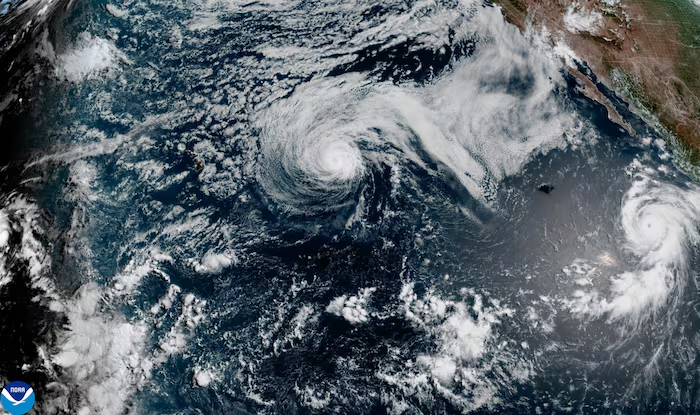
Major hurricane Genevieve roars in the Pacific as Hurricane Fausto nears Hawaii

Obi Is A Trader, Traders Have Short-term Calculation, They’re Not Into Longterm Projection-Oshiomhole

The Distance Between Tehran And Kyiv Is Less Than 2,000 Kilometers —Well Within Iran’s Range”Serdar

Trump administration urges Supreme Court to allow order targeting mail-in voting

IMF chief says Argentina is better positioned to meet debt obligations under Milei

“I Do Not Understand the Claim That President Tinubu Has Not Been Visible Enough– Adams Oshiomhole

Tinubu Inherited Economy Like Patient Battling Advanced Cancer That Needed Urgent Surgery–Oshiomhole

 Politics18 hours ago
They Set Labour Party On Fire To Burn Me, Now They Have Carried Same Fire To NDC – Peter Obi Slams APC
- Special Report16 hours ago
“Nkwasiafoɔ, Who Will Play The Instruments?” — Nana Agradaa Sacks Instrumentalists After Mass Altar Call For Travel Prayers
- Special Report16 hours ago
“This Place Is Like Our Home” — Galamseyer Videos Deep Underground Pit Where They Stay For More Than Three Months In Search Of Gold
- Entertainment16 hours ago
“My head just do gbam!” — Father recounts daughter’s unexpected response to cooking during family discussion
- Entertainment18 hours ago
“I want to relocate to Nigeria; I hear the economy is booming” — Moroccan businessman tells Reno Omokri
- Special Report7 hours ago
Three Women, Including Pregnant Victim, Injured in Paris Stabbing; Suspect Allegedly Made Chilling Claim
- Entertainment16 hours ago
“He gave her a knock” — Woman recounts hilarious moment fish seller reacted after customer priced ₦5,000 fish at ₦1,800
- News8 hours ago
AEDC Rewards 1,126 Employees with Promotions and Step Increments in Landmark Investment in Talent and Career Growth