Metro
What Encounter with a South African Editor Taught Me About Nigeria

I met him through Ferial Haffajee, a fellow judge on the CNN African Journalist of the Year panel for several years and also a fellow member of the board of the World Editors Forum in those early days.
Ferial is one of the most outstanding journalists on the continent, but this article is not about her. It’s partly about the lesson I learned from Tony Weaver, formerly of the Daily Maverick of South Africa, whom Ferial introduced to me many years ago.
Take it off?
I remember Tony because of a recent request by Nigeria’s Minister of Information, Idris Mohammed, and the Director General of the State Security, Adeola Ajayi, that the press should remove – or downplay – reports about banditry that have become a daily fare on the front pages of Nigerian newspapers. Mohammed and Ajayi are not journalists, and journalists hate outsiders teaching them how to do their job.
Their joint news conference on June 19,calling out journalists, reminded me of my encounter with Tony in the early days of the Israeli war in Gaza. I had written a piece for Daily Maverick that was very critical of the Hamas attack on Israel. I was unsparing of the Hamas and Palestinian leadership and would have given them a whooping if I could.
Paying a debt
After days of waiting in vain for Tony, the Op-ed editor, to use my article, I called.
“Azu,” he said, “Great piece, as usual. But you know, South Africans owe the Palestinians a lot for the role the PLO played in our struggle for freedom. DM does not support any premeditated violence against innocent people, but the sentiment in the country is hugely in favour of the Palestinians. I’m sorry we’ll be unable to publish your piece.”
That got me thinking. How many times have I written or published an article motivated more by anger and frustration with the system than by the consequences of the impact of what I have written or caused to be published? I thanked Tony and took the lesson to heart.
The sins of politicians
The thing is, if you mind politicians or public officials, you will offend God. Whether in the Middle East, Africa, Europe or America, politicians are mainly responsible for the mess we’re facing today, but are often quick to find scapegoats.
Take Nigeria, for example. Even though the situation in the Sahel, especially after the collapse of Libya, has worsened violent extremism in the northern parts of the country, the choices that our politicians – and I’m talking about Northern politicians exploiting culture and religion – have made in the last 27 years have also impoverished more citizens, and fertilised radicalism. Didn’t Samuel Johnson say patriotism is the last refuge of scoundrels?
Not everything is political, of course. Changes in climatic conditions and a weakened landholding framework, for example, have led to an increase in violent farmer-herder clashes in central Nigeria.
Yet, the arc of Nigeria’s insecurity has bent from mainly a north-east jihadist insurgency in 2015 to a fragmented national crisis 10 years later.Banditry and kidnapping are becoming as politically and economically destabilising as Boko Haram/ISWAP, mainly because of poor choices by politicians.
What can journalism do?
How can journalism turn a blind eye to such a travesty? As far as trust goes, a surprising 2023 report by the Reuters Institute for the Study of Journalism found that 57 per cent of Nigerians said they trusted most news most of the time, placing Nigeria 4th out of 46 markets surveyed worldwide.
Yet, there are concerns in some circles that it is not too much front-page reporting but too poor reporting – that is, reporting without context, meaning, and accuracy – that has enabled poor choices by politicians and those responsible for managing the crisis and endangered the lives of the troops.
It’s tempting not to take politicians’ complaints too seriously, especially since those in the ruling party, All Progressives Congress (APC), today easily forget how unkind and impatient they were toward their predecessors, who asked in vain for leniency and understanding for the same security challenges that nowseemoverwhelming.
What goes around…


‘Atiku Will Definitely Lose 2027 Election, Peter Obi-Kwankwaso Have 70 Percent Chances’ – Babachir Lawal

Buhari Had Intelligence Reports on Tinubu’s Education, Genealogy, Complained About It – Former SGF Lawal Reveals

EFCC: ‘I’ve been in pain since I publicly supported you’ — Former NSIPA CEO cries out to Tinubu [Video]

What Exactly Is The Interest Of This Man?– Lere Olayinka Reacts To Gumi’s Warning To Niger Governor Bago

“I had to clean poop from the Uber with my bare hands” – Man recounts embarrassing ordeal after date with talking stage

“I Am A Citizen, I Can’t Carry My ID Everywhere I Go” — South African Man Breaks Down After Being Mistaken For A Foreign National

𝐑𝐞𝐧𝐞𝐰𝐞𝐝 𝐇𝐨𝐩𝐞 𝐒𝐭𝐮𝐝𝐞𝐧𝐭 𝐀𝐦𝐛𝐚𝐬𝐬𝐚𝐝𝐨𝐫𝐬 𝐇𝐨𝐥𝐝𝐬 𝐒𝐭𝐮𝐝𝐞𝐧𝐭 𝐋𝐞𝐚𝐝𝐞𝐫𝐬 𝐓𝐨𝐰𝐧𝐡𝐚𝐥𝐥 𝐌𝐞𝐞𝐭𝐢𝐧𝐠 𝐎𝐧 𝐕𝐨𝐭𝐞𝐫 𝐄𝐝𝐮𝐜𝐚𝐭𝐢𝐨𝐧 𝐚𝐧𝐝 𝐂𝐢𝐯𝐢𝐜 𝐄𝐧𝐠𝐚𝐠𝐞𝐦𝐞𝐧𝐭 𝐈𝐧 𝐎𝐠𝐛𝐢𝐚

“When did public opinion become stronger than the altar?” – AY Makun reacts following withdrawal from church programme

“I won’t be alive to see Christ humiliated” – Pastor David Ibiyeomie blasts government over bus preaching ban

They Set Labour Party On Fire To Burn Me, Now They Have Carried Same Fire To NDC – Peter Obi Slams APC
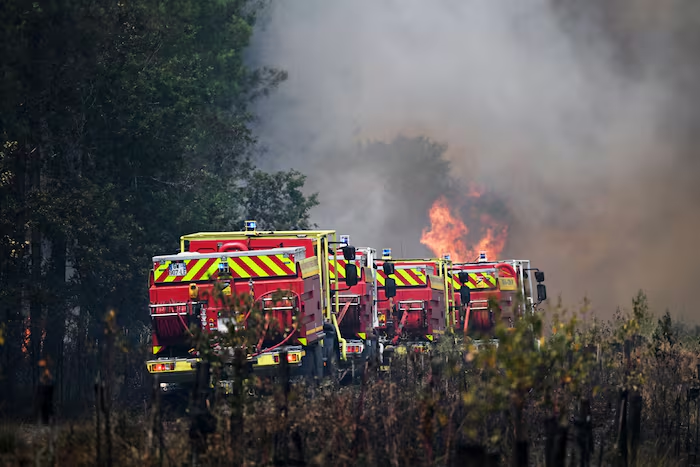
French president pledges support on visit to fire zone, vows: 'We will win this battle together'

Questions mount after deadly Berlin Pride attack. Here's what to know

Police probe killing of Ebonyi neighbourhood watch operative

Abacha’s death: Produce CCTV footage if you have any – Ex-DSS director dares Al-Mustapha
Abacha’s death: Produce CCTV footage if you have any – Ex-DSS director dares Al-Mustapha

US-Canada bridge opens in Detroit even as trade disputes test the neighbours’ ties

NPC Says Nigeria Records About Five Million Births Every Year

US-Canada bridge opens in Detroit even as trade disputes test the neighbors' ties

Hunger threatening Nigeria’s future – Olowu tells FG
Hunger threatening Nigeria’s future – Olowu tells FG

 Viral22 hours ago
𝐑𝐞𝐧𝐞𝐰𝐞𝐝 𝐇𝐨𝐩𝐞 𝐒𝐭𝐮𝐝𝐞𝐧𝐭 𝐀𝐦𝐛𝐚𝐬𝐬𝐚𝐝𝐨𝐫𝐬 𝐇𝐨𝐥𝐝𝐬 𝐒𝐭𝐮𝐝𝐞𝐧𝐭 𝐋𝐞𝐚𝐝𝐞𝐫𝐬 𝐓𝐨𝐰𝐧𝐡𝐚𝐥𝐥 𝐌𝐞𝐞𝐭𝐢𝐧𝐠 𝐎𝐧 𝐕𝐨𝐭𝐞𝐫 𝐄𝐝𝐮𝐜𝐚𝐭𝐢𝐨𝐧 𝐚𝐧𝐝 𝐂𝐢𝐯𝐢𝐜 𝐄𝐧𝐠𝐚𝐠𝐞𝐦𝐞𝐧𝐭 𝐈𝐧 𝐎𝐠𝐛𝐢𝐚
- Entertainment23 hours ago
“I won’t be alive to see Christ humiliated” – Pastor David Ibiyeomie blasts government over bus preaching ban
- Politics12 hours ago
They Set Labour Party On Fire To Burn Me, Now They Have Carried Same Fire To NDC – Peter Obi Slams APC
- Viral23 hours ago
IYC CENTRAL ZONE ELECTION: PROTEST BREWING OVER ALLEGED DELEGATES LIST MANIPULATION BY GOVERNOR’S BROTHER.
- Viral23 hours ago
ALLEGED AVIATION SCHOLARSHIP SCAM: SECOND SUCCESSFUL CANDIDATE SUES DR ERUANI AZIBAPU AND AZIKEL GROUP FOR 1.9 BILLION NAIRA
- Viral22 hours ago
IYC Directs Central Zone to Suspend Planned Solidarity March Over Kiriyai Case, Seeks Amicable Settlement
- Special Report10 hours ago
“Nkwasiafoɔ, Who Will Play The Instruments?” — Nana Agradaa Sacks Instrumentalists After Mass Altar Call For Travel Prayers
- Special Report10 hours ago
“This Place Is Like Our Home” — Galamseyer Videos Deep Underground Pit Where They Stay For More Than Three Months In Search Of Gold