Metro
OPINION: Onanuga’s Denial And The Crisis He Cannot See

There is a particular kind of blindness that afflicts those who ascend too high into the sanctums of power. And, it is a blindness not born of darkness, but of light. It is the blinding glare of privilege, the distorting comfort of official convoys, manicured briefings, and personal staff whose suffering, if it exists at all, dare not trouble the ears of those who employ them. It is in this light, or the absence of it, that one must examine the remarkable statement made by Bayo Onanuga, Special Adviser to President Bola Ahmed Tinubu on Information and Strategy, when he declared on Arise Television on June 23, 2026, that he does not see the level of hunger Nigerians are complaining about.
Speaking during the interview, Onanuga maintained that his personal observations and interactions do not reflect the scale of hardship often portrayed in public discussions. “I am a Nigerian,” he said. “I have people working for me privately. I don’t see the level of hunger people are talking about because I see them, and I keep asking them questions: how are things, how are they adjusting, what are the problems?” These are the words of a man who has confused proximity with comprehension, and domestic help with a representative sample of more than 220 million citizens. They are, at best, a monument to epistemic limitation. At worst, they represent an act of official falsification and a deliberate erasure of documented, measurable, catastrophic mass suffering.
The cruelty of Onanuga’s statement lies not merely in its condescension but in its direct contradiction of the positions held by the very principal that he serves, and by some of the most credible international development institutions on the planet. For Onanuga to deny the existence of the hunger, which solutions he was appointed to help communicate, is not merely a personal failure of imagination. It is an institutional contradiction of the highest order.
Let me begin with President Tinubu himself. In his own words, the President admitted that the reforms he introduced had triggered a sharp rise in the cost of living and placed enormous pressure on households and businesses across the country. “These decisions came with sacrifice,” he said. “The rising cost of living triggered by our measures placed enormous pressure on families, workers, and businesses. I remain deeply conscious of those sacrifices.” These are not the words of a man who believes hunger is a fabrication of opposition mischief or social media manipulation. They are the words of a President who has, on multiple occasions, publicly acknowledged the pain his own policies have inflicted on the Nigerian people.
On Nigeria’s 64th Independence Day, Tinubu said: “I am deeply aware of the struggles many of you face in these challenging times. Our administration knows that many of you struggle with rising costs and the search for meaningful employment. I want to assure you that your voices are heard.” Similarly, when nationwide protests erupted in August 2024, Tinubu addressed the nation. In that address, he said: “My dear Nigerians, especially our youth, I have heard you loud and clear. I understand the pain and frustration that drive these protests.” Taken together, these are not the pronouncements of a government that denies the existence of suffering. They are admissions. They say that no matter how carefully managed or denied, the suffering is real, acute, and widespread.
So, when Onanuga steps before a national television audience and announces that he personally does not see the hunger, he does not merely embarrass himself but also contradicts and faults his principal. He undermines the consistency of the government’s communications. He tells Nigerians, in effect, that whatever their president acknowledged as real pain was perhaps overstated.
He also suggests that a narrative shaped by a viral video in which a voice-over superimposed the Yoruba phrase “Ebi n pa wa”, meaning “we are hungry”, over footage of President Tinubu, was social media manipulation which significantly shaped public perception. “I think the President went to Lagos, he was coming from the Central Mosque, and somebody now did a voice-over saying ‘Ebi n pawa o,’ and that means we are hungry. Since then, people have been saying that,” he stated. Onanuga’s interpretation that the viral video is the engine driving Nigeria’s hunger narrative is not just dismissive but a rewriting of documented history with a breathtaking disregard for evidence.
That evidence comes, however, with devastating precision, from the World Bank. According to the World Bank’s Nigeria Development Update released in April 2026, the share of Nigerians living below the poverty line increased from 56 per cent in 2023 to 61 per cent in 2024, before rising further to 63 per cent in 2025. That suggests an equivalent of approximately 140 million people. This increase occurred even as inflation began to ease. This means that there is a disconnect between moderating prices and real income growth. Nigeria’s poverty crisis, in other words, is not a perception problem. It is a data problem, which worsens with each successive year.
Beyond monetary poverty, the picture painted by multidimensional poverty measures is even more harrowing. The National Bureau of Statistics (NBS) recorded that 63 per cent of Nigerians are multidimensionally poor. This encompasses deprivations not just in income but in sanitation, healthcare access, food security, and housing. Over half the population cook with dung, wood, or charcoal rather than cleaner energy, as indicated by the NBS. The World Bank has further warned that this multidimensional poverty directly threatens Nigeria’s economic potential, as moderate GDP growth in 2026 has failed to translate into improved living standards for most citizens, with wage growth lagging behind inflation and leaving real incomes under sustained pressure.


Namibia President hails Dangote’s $2.5bn investment as historic milestone for African industrialisation – The Witness Nigeria

Lower impairments, higher fees raise Access Holdings 9 months 2026 PBT to N667.4bn – The Witness Nigeria

JUST IN: Court removes David Mark-led ADC leadership, nullifies Atiku’s presidential ticket – The Witness Nigeria

“Any Algorithm Can Calculate, But It Cannot Care” — NMCN Registrar Warns Nurses Against Overreliance On AI

‘He’s closest to Lionel Messi’ – Rashford names player to win more Ballons d’Or than Cristiano Ronaldo

Power Outage: Tegbe assures Nigerians of swift restoration as electricity disruptions hit Lagos, Abuja

“I Didn’t Go To Court, I’m Not In APC” — Wike Denies Influencing Judgment Against Uzodimma, Explains Old Video With Okorocha

“Not To Own It, But To Give It Another Chance At Life” — Foreigner Rescues Sea Turtle From Lagos Sellers As NESREA Faces Enforcement Questions

RE: RESPONSE TO MISLEADING PUBLICATION ON THE PRESIDENTIAL AMNESTY PROGRAMME (PAP)

Investigate hijab controversy in Nigerian law schools immediately- MURIC to Council of Legal Education

Insecurity Will Cost Tinubu 2027 Election – Imasuagbon

2027: Atiku’s US Firm Takes Tinubu’s Alleged Rigging Plot To Trump

“Ibom Deep Seaport Is Approved” — Tinubu Grants Eno’s Request, Attacks Atiku, Obi, Promises Better Future As He Stumbles During Akwa Ibom Visit

Baze University boosts aviation school with two training aircraft

2026 U-17 WWC: Japan coach Shirai warns of tough challenge against Flamingos

Fear in Obi, Atiku’s camps as Middle Belt youths begin movement for Asiwaju

10 Key Things to Know about Justice Lifu’s Judgment Affecting ADC, Atiku

My Name Is Important – Amaechi Reveals Why He Refuses To Trade Words With Wike

Festac 77 movie signs landmark Afrexim agreement

College of Health Tech Takum suspends relationship activities over ongoing strike

 Politics7 days ago
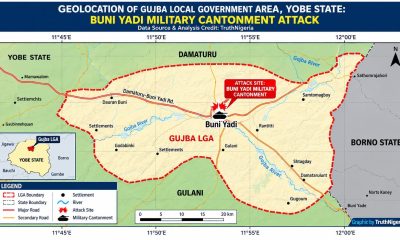
Over 200 Boko Haram Terrorists Are Moving To Attack Military Camp In Buni Yadi As Rockets Target Troops; IED Threat Raises Travel Concerns
- Metro6 days ago
“The Election Must Hold As Scheduled” — INEC Chairman Rules Out Postponement Of 2027 General Elections
- Metro6 days ago
“Publishing His Name Is Subject To The Final Outcome Of A Court Order” — INEC Leaves Gwarzo Off Updated Kano Governorship List
- Metro7 days ago
“Ebola Outbreak Is Not Yet Under Control” — Africa CDC Warns As Confirmed Cases Exceed 10,200, Death Toll Surpasses 5,000
- Metro7 days ago
“Death Benefits Will Be Fully Paid To Next Of Kin” — NAF Pledges Continued Salaries For Personnel Killed In October 5 Aircraft Crash
- Metro6 days ago
“Sowore’s Whereabouts Remain Unknown” — Armed Men Allegedly Abduct AAC Presidential Candidate In Ado-Ekiti, Damage Vehicles And Restaurant
- Metro6 days ago
“They Beat Me Like A Criminal” — Sowore Recounts Ekiti Attack As Govt Denies Involvement, Calls For Police Investigation
- Metro6 days ago
“21 Exotic Vehicles Affected, No Life Lost” — LASEMA Confirms Lagos Mechanic Workshop Fire, Averts Disaster At Nearby Filling Station