Politics
As Jihadists Slaughter Middle Belt Christians, Nigeria’s Wealthiest Megachurches Maintain a Politically Profitable Silence

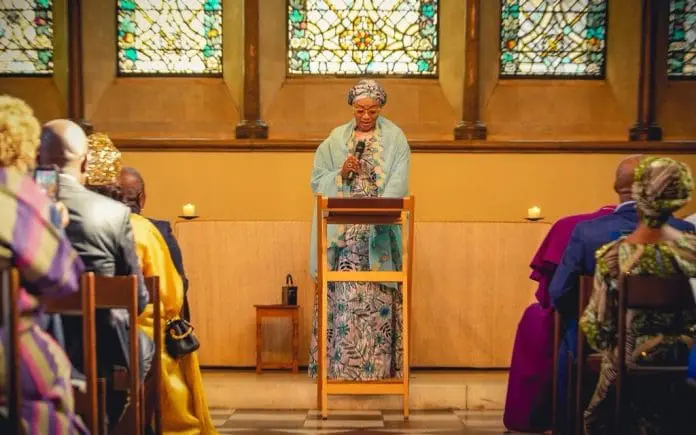
First Lady Oluremi Tinubu, an ordained RCCG pastor, has dismissed persecution claims as “propaganda” from Washington pulpits.
By Mary Kiara
ABUJA, Nigeria — When armed Fulani jihadists stormed a Catholic parish in northern Nigeria, mocking the identity of a kidnapped priest before driving him into forest captivity, they exploited a structural vulnerability that continues to paralyze the nation’s 109 million Christians: deep denominational division and political complicity.
For Rev. Stephen Ojapah, a Catholic priest and survivor of a grueling 2022 jihadist abduction, the cost of that division is not theoretical.
“They knew what I represented as a priest, and they came to attack my identity. There were so many times they mocked my faith as a priest and a Christian during captivity,” Ojapah told TruthNigeria.
Ojapah’s survival highlights a devastating paradox confronting Nigeria’s Christian leadership: While Catholic bishops and Middle Belt Protestants endure systematic massacres, targeted land seizures, and mass displacement across Benue and Plateau states, Nigeria’s largest southern Pentecostal institutions maintain a profitable, diplomatic alignment with the federal government.
Political Access in Aso Rock Silences Persecution Claims
The divide reaches the highest corridors of power in Abuja. First Lady Oluremi Tinubu is an ordained pastor in the Redeemed Christian Church of God (RCCG), Africa’s largest Pentecostal movement.
On international platforms, including the National Prayer Breakfast in Washington, D.C., the First Lady has repeatedly denied the existence of targeted anti-Christian persecution in Nigeria, framing the slaughter as generalized criminal insecurity.
That official narrative directly contradicts the reality on the ground. Research from Open Doors ranks Nigeria as the global epicenter of anti-Christian violence, accounting for over 70 percent of Christians murdered worldwide for their faith.
In Benue state, where 98 percent of the population is Christian, Catholic Bishop Wilfred Anagbe has emerged as one of the strongest voices challenging Abuja’s denials.
Under his leadership, local Catholic dioceses and Protestant bodies, including the Evangelical Church Winning All (ECWA), have established joint emergency relief operations and issued unified declarations.
Megachurch Microstates Prioritize Growth over Frontline Protection
Yet, this ecumenical unity remains largely localized to the killing fields of the Middle Belt. In contrast, southern megachurches operating out of Lagos and Ogun State possess sprawling international networks, private real estate empires, and millions of followers, yet refrain from leveraging their massive political influence to demand military protection for northern believers.
Dr. Christopher Wadibia, author of Political Pentecostalism and Faith-Based Development in Nigeria, noted that the RCCG stands apart even among large Pentecostal movements, financing over 300 schools and commanding 10 million members across 190 countries.
“The RCCG is unquestionably the largest Pentecostal movement in Nigeria, operating essentially as a Pentecostal microstate within a dysfunctional post-colonial context,” Wadibia told TruthNigeria. “No other religious movement in Nigeria has the access that the RCCG has.”
Wadibia pointed out that senior officials, including former Vice President Yemi Osinbajo and the First Lady, hold pastoral rank within the church. Yet RCCG General Overseer Enoch Adeboye has consistently maintained a cautious posture, framing the crisis as a purely spiritual battle requiring national fasting while declaring publicly that President Bola Tinubu is “trying his best.”
“The head of the RCCG, Adeboye, has always been characteristically reticent to criticize the government,” Wadibia said. “I think a large reason for this is because he recognizes that the government can frustrate the ministry of the RCCG movement greatly if it wants to. And political leaders in Nigeria have historically never taken kindly to individuals that criticize them. So there’s a bit of a diplomatic dance that goes on.”
“Given the level of political influence that the Redeemed Church has, what it’s done to date is not commensurate when it comes to elevating the plight of vulnerable Christians.”
In an official statement, RCCG rejected accusations of silence, saying Adeboye is “a clergyman and not the Commander-in-Chief of the Armed Forces.”
Geography and Fear Divide Northern and Southern Believers
This retreat into diplomatic neutrality infuriates clergy who have survived the frontline slaughter. Ojapah believes geography and political privilege have blinded southern church leaders to the existential reality facing northern Christians.
“A Christian in Sokoto and a Christian in Lagos are living in two different realities,” Ojapah said. “They are likely not to speak from the same platform.”
Rev. Joseph Hayab, Northern Chairman of the Christian Association of Nigeria, emphasized that state-sponsored fear has further muted northern voices.
“The poor management of violent jihadist attacks by the government has discouraged many Christians from speaking out because the laws won’t protect them. We need just leaders who will stand for justice.”
What True Christian Unity Could Achieve
Wadibia argues that real Christian unity requires moving past occasional corporate press statements toward pooled resources and unified international advocacy.
“If 10 of these churches pooled finances, it could be invested in early-warning technologies across the Middle Belt, alarms, GPS, radar that could keep these communities safe.”
“Could you imagine if it was Enoch Adeboye, and the Catholic Cardinals of Nigeria, and the leaders of the Anglican Communion, and the Baptist leaders, and they all went to Washington, Geneva, or London together?” Wadibia said.
“When you put all of those communities together, that is a significant religious bloc that collectively could truly articulate a powerful political voice.”
For survivors on the front lines, that unified defense cannot remain a theoretical concept.
“If Christian leaders speak with one voice, it’s going to be a very powerful tool,” Ojapah said.
“Imagine if something happened in Zamfara and an entire army of Christians from Lagos came to defend them. But we are not there yet.”
Mary Kiara reports on Terrorism and Religious Freedom Policy for TruthNigeria.
Related


“My girlfriend…” – Lady shares brother’s shocking response after siblings contributed ₦6m each for his UK relocation

Zamfara State Governor, Dauda Lawal, Flags Off Road in Tsafe, Says Infrastructure Will Enhance Connectivity, improve local economy

Exclusive: How Ondo Government Borrowed N30 Billion For Roads and Hospitals, Quietly Added an Unauthorised N15.2 Billion Private Loan, and Left N4.1 Billion Unaccounted For

Anyone Who Feels He Is Not Getting Anything Should Resign – Zamfara Governor Tells Dissatisfied Appointees

“I got my British passport in less than 16 months” – Man claims King’s convoy hit him, reveals alleged compensation

2026 Ballon d’Or: Donnarumma picks player to win award ahead of Yamal, Mbappe, Kane

JUST IN: Court orders INEC to upload Olawepo-Hashim as Accord’s 2027 presidential candidate – The Witness Nigeria

Interior Minister Olubunmi Tunji-Ojo Pays Hundreds of Millions To Unnamed Vendors Without Competition

“One Day Their Actions Will Haunt Them, Even After Retirement” — Buba Galadima Warns Judges, Says They Will Answer For Selfish Decisions

Exclusive: Lagos Governor Sanwo-Olu Builds Fence With N20 Billion, Buys Cars For His People With N15 Billion And Poured N79 Billion Into One Expressway in Three Months

2027: Rhodes-Vivour Reveals Presidential Candidate He Is Supporting

NPFL: Ukaegbu hails Enyimba’s home win against Plateau United

Nigeria Has A Bold Leader – Remi Tinubu Declares Ahead Of 2027 Polls

Hundreds Of French High Schools Shut As Student Protests Spread

“Now I’m homeless, suffering and alone” — Man narrates 13-year struggle after losing contact with family in canada

U.S. Signs Strategic Minerals Deal With Nigeria as Competition With China Intensifies

Ondo: Painful, heartbreaking tragedy — Shehu Sani reacts to Air Force crash

‘I Have No Regrets Supporting Peter Obi’ – Datti Baba-Ahmed

Jeremiah Fufeyin speaks amid Verydarkman, Apostle Arome saga

Portugal: ‘Ronaldo could have ended his career at World Cup’ – PFF President

 Politics15 hours ago
Anyone Who Feels He Is Not Getting Anything Should Resign – Zamfara Governor Tells Dissatisfied Appointees
- Viral22 hours ago
“I got my British passport in less than 16 months” – Man claims King’s convoy hit him, reveals alleged compensation
- Special Report8 hours ago
JUST IN: Court orders INEC to upload Olawepo-Hashim as Accord’s 2027 presidential candidate – The Witness Nigeria
- News12 hours ago
Interior Minister Olubunmi Tunji-Ojo Pays Hundreds of Millions To Unnamed Vendors Without Competition
- Metro7 hours ago
“One Day Their Actions Will Haunt Them, Even After Retirement” — Buba Galadima Warns Judges, Says They Will Answer For Selfish Decisions
- News10 hours ago
Exclusive: Lagos Governor Sanwo-Olu Builds Fence With N20 Billion, Buys Cars For His People With N15 Billion And Poured N79 Billion Into One Expressway in Three Months
- Viral7 hours ago
“Seriously, the entire budget is…”- Lady reveals talking stage’s estimate for a date, amount sparks buzz
- Metro5 hours ago
Ondo Igbokoda Aircraft Crash: Preliminary Count Puts Occupants At 32, Names And Condition Still Undisclosed