News
JUST IN: Protest Rocks Abuja Over Federal Government Borrowing

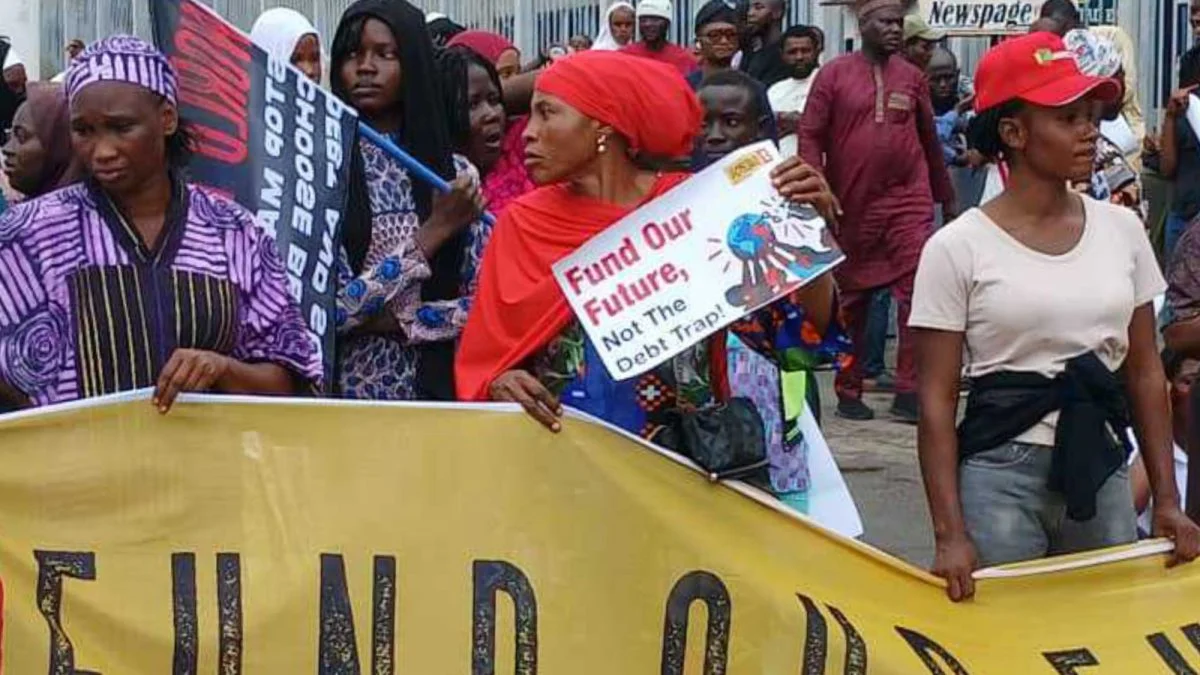
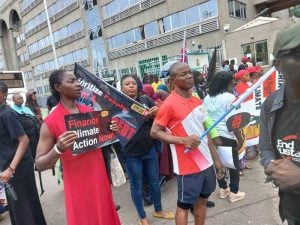
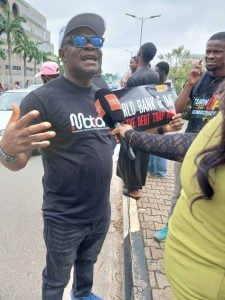
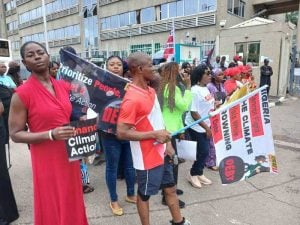
Protesters have stormed the Federal Ministry of Finance in Abuja, demanding an end to the Federal Government’s continued reliance on borrowing to finance development in the country.
The demonstration brought together ActionAid Nigeria, market women, university students and other civil society groups, who gathered at the ministry’s gate to raise concerns over Nigeria’s growing debt stock and the impact of government borrowing on citizens.
The protesters called on the Federal Government to reconsider plans for additional borrowing and urged the World Bank and International Monetary Fund (IMF) to stop extending further loans to Nigeria.
They also appealed to the international financial institutions to “let Nigeria breathe,” arguing that continued accumulation of debt could place a heavier financial burden on Nigerians.
The demonstrators said the country’s debt situation could not be viewed separately from the economic difficulties confronting households and businesses. They therefore urged the government to look beyond borrowing and develop alternative sources of financing while prioritising policies that would ease economic pressure on citizens.
In August, Minister of Finance and Coordinating Minister of the Economy, Taiwo Oyedele, criticised Nigerians who attacked the World Bank on social media over its decision to continue lending to Nigeria.
Oyedele said the backlash reflected a lack of understanding of how international development financing operates. He disclosed that some Nigerians had gone to the World Bank’s social media platforms to condemn the institution for approving loans to Nigeria, leading to the comment section being disabled.
“People went to the social media account of the World Bank to go and be abusing them that they’re giving Nigeria loan. World Bank just switch off the comments. We’ve gotten the loan because that’s not how the system works,” he said.
The minister used an automated teller machine (ATM) as an analogy to explain his position, saying people who did not understand how a system worked could wrongly direct their anger at the wrong target.
“Some people who have no knowledge of how it works. They said why is government allowing some people withdraw money here and they’re not giving to the rest of us,” Oyedele said.
He continued with the analogy by describing a situation in which people could mobilise against an ATM because they wanted access to money without understanding that funds first had to be available in the bank.
“So some leaders emerged from their group and said this is not fair government has to and then they went and destroyed the ATM, beat up some other people withdrawing money there and they were hailing their hero,” he said.
Oyedele added, “Yes, let everybody withdraw money from the ATM. They haven’t put money in the bank.”
He said destroying the ATM would not create the funds being demanded, stressing that the problem could not be solved by attacking the system through which money was accessed.
“After breaking the bank and the ATM and beating people up, they still can’t collect money ’cause that’s not how the system works,” he said.
The minister said the same principle applied to public discussions about the economy, stressing that citizens needed accurate information about government institutions and financial processes before deciding how to challenge policies.
“If you don’t understand how the system works, you waste energy,” Oyedele said.
He also linked economic knowledge to citizens’ ability to demand accountability from government.
“Part of your ability to hold government to account is having the right knowledge. If you don’t, you’re wasting your energy,” he said.
In May, the finance minister had also acknowledged the need for Nigeria to reduce its dependence on borrowing. He said the country needed to strengthen its fiscal system and improve domestic revenue generation so that infrastructure and other government priorities could be financed more sustainably.
The World Bank, meanwhile, continues to support projects and programmes in Nigeria covering areas such as electricity, social protection, education, healthcare and economic reforms.
In July, the Federal Government launched World Bank-backed programmes valued at $3.05 billion, with the initiatives targeted at vulnerable communities, human capital development and social protection.
The government has maintained that external financing is connected to specific programmes and development objectives rather than being obtained without defined purposes.




China Tightens Travel Rules, Bans Citizens Over National Security Concerns » Apples Bite Int’l Magazine

How Queen Elizabeth, Bill Clinton saved me from Special Forces arrest at Heathrow Airport – Dele Momodu

Dangote Says Having A Son Was Never His Priority, Praises His Three Daughters » Apples Bite Int’l Magazine
Edo State Healthcare Transformation: How Okpebholo Built And renovated 61 PHC’s in 18 LGA’s in less than two years in office

APC Governors Reject “Parallel Structures,” Warn Wike’s Rainbow Coalition Threatens Tinubu’s 2027 Bid » Apples Bite Int’l Magazine

“Fuel is ₦1,450, yet some Nigerians are focused on Peter Obi’s wife’s handbag” — Miss Goldilocks blasts critics

Kawas: Some People Sponsor Terrorism To Discredit Tinubu, As They Did Jonathan » Apples Bite Int’l Magazine

“He should be voted out” – Woman laments ₦35m agric sector loss under Tinubu, blames government policies

“Wike Cannot Tell PDP Members Not To Contest Governorship, National Assembly Seats” — Fayose Says His Commitment Is Limited To Presidency

Governor Dauda Lawal Attends UNGA in New York, set to engage Global investors on Zamfara’s Potential » Apples Bite Int’l Magazine

2027: Atiku Should Not Contest Presidential Election, Says Shehu Sani

Messi deserves to be considered for Ballon d’Or – Beckham

ADC: Tinubu’s Economic Policies Pushing Nigerians to Breaking Point as Petrol Hits N1,470/Litre

Shettima Clarifies Tinubu Support Claim, Says Northern Governors Rallied After APC Primary
Oriire Kidnap: Five Suspects Plead Not Guilty to Terrorism Charges

Shettima Leads FG Delegation To Adamawa Over Bamanga Tukur’s Death

Atiku Camp Blasts Power Minister over ‘Freezers Freezing’ Remark

Trump threatens to hit EU with new tariffs over Canada overture

Nigeria Targets Bigger Nordic Investments As Ambassador…

Ogun Water Corporation to clamps down on illegal connections, meter bypass

 News22 hours ago
Kawas: Some People Sponsor Terrorism To Discredit Tinubu, As They Did Jonathan » Apples Bite Int’l Magazine
- News21 hours ago
Governor Dauda Lawal Attends UNGA in New York, set to engage Global investors on Zamfara’s Potential » Apples Bite Int’l Magazine
- Entertainment18 hours ago
“How stingy can you be?” – Lady blasts landlord after building over soakaway collapses, destroys tenants’ belongings
- Viral19 hours ago
“NO WRITTEN LAW, NO CONVICTION” — THEN HE CONVICTED HIM UNDER A DEAD LAW: Inside the Judicial Gravedigging That Voided Nnamdi Kanu’s Trial
- Entertainment20 hours ago
“Use the rent to buy land” – Man shares how landlord surprises neighbour after 9 years in his compound
- Metro19 hours ago
Eight Feared Drowned In Cross River Boat Collision
- Viral22 hours ago
IPOB: CATALONIA HONOURED US AGAIN — THE PACT ONYENDU SIGNED IN 2014 STILL STANDS
- Entertainment24 hours ago
“He silently blocked me…” – Lady shares embarrassing experience after bedwetting at boyfriend’s house