Metro
From “Jonathan Must Go” to “How Dare You”: Nigeria’s Politics of Hypocrisy

When President Goodluck Jonathan was in office, opposition politicians, influential clerics, and many public commentators, including some who now occupy positions of power, took turns criticising his administration. At various times, they described him as clueless, demanded his resignation, and openly questioned his competence. Yet, the challenges facing Nigeria at that time were nowhere near the scale of the economic hardship, insecurity, and public discontent being experienced today.
Therefore, when Peter Obi recently called on President Bola Ahmed Tinubu to resign, citing developments in Britain where a Prime Minister stepped down, Presidential spokesman Bayo Onanuga dismissed the demand as “childish” and attempted to justify his position by arguing that Nigeria does not operate a parliamentary system of government.
That response misses the point entirely.
First, Peter Obi is fully within his democratic rights to call on the President to resign, just as many opposition figures, including those now in government, did during the Jonathan era. Such a call may be accepted or rejected by the President, but it is neither childish nor ignorant. What is childish is to suggest that citizens or opposition figures lose their right to demand accountability simply because the occupant of power has changed, or on account of the type of democracy that we practice.
Second, while it is true that Nigeria does not practise parliamentary democracy, that fact does not invalidate public demands for resignation. Democracies around the world, regardless of the system they operate, recognise the right of citizens and opposition leaders to express dissatisfaction with the performance of those in power.
The real issue is not whether Nigeria operates a parliamentary or presidential system. The real issue is political culture.
In many advanced democracies, political leaders view public office primarily as service to the nation. They understand that leadership is a trust, not a personal entitlement. When public confidence collapses or when they believe they have become a liability to governance, many choose to step aside. In such societies, public office holders are accountable not only at the ballot box but also to public opinion, party structures, and institutional checks.
Nigeria’s political reality is different. Here, resignation is often viewed as weakness rather than responsibility. Political office is fiercely protected, regardless of public sentiment. It is almost unthinkable for a ruling party to ask its leader to step aside, and even more unlikely for an incumbent president to resign in response to public pressure. That is not because our Constitution forbids resignation; it is because our political culture discourages it.
The same principle applies to some religious leaders who have suddenly discovered reasons why they should not criticise the current administration with the same intensity they deployed against the Jonathan government. Their explanations have not convinced many Nigerians.


Namibia President hails Dangote’s $2.5bn investment as historic milestone for African industrialisation – The Witness Nigeria

JUST IN: Court removes David Mark-led ADC leadership, nullifies Atiku’s presidential ticket – The Witness Nigeria

Lower impairments, higher fees raise Access Holdings 9 months 2026 PBT to N667.4bn – The Witness Nigeria

“Any Algorithm Can Calculate, But It Cannot Care” — NMCN Registrar Warns Nurses Against Overreliance On AI

“I Refused ₦500,000 In Dirty Money” — Soldier Gets ₦500,000 Reward For Rejecting Bribe From Kidnap Suspect

‘He’s closest to Lionel Messi’ – Rashford names player to win more Ballons d’Or than Cristiano Ronaldo

Power Outage: Tegbe assures Nigerians of swift restoration as electricity disruptions hit Lagos, Abuja

“I Didn’t Go To Court, I’m Not In APC” — Wike Denies Influencing Judgment Against Uzodimma, Explains Old Video With Okorocha

“Not To Own It, But To Give It Another Chance At Life” — Foreigner Rescues Sea Turtle From Lagos Sellers As NESREA Faces Enforcement Questions

Investigate hijab controversy in Nigerian law schools immediately- MURIC to Council of Legal Education

Terrorists have seized, shared my inherited lands among themselves – Rev. Dachomo alleges
Terrorists have seized, shared my inherited lands among themselves – Rev. Dachomo alleges

Fraudulent Project – Lawyer Slams Tinubu Over Ibom Deep-Seaport Approval

Power supply to improve in 72 hours — Minister

Five killed, eight injured as armed youths attack Lagos waterfront community
Five killed, eight injured as armed youths attack Lagos waterfront community

That’s How A Statesman Should Behave – Keyamo Praises Atiku For Not Disobeying Court Order Sacking Him As ADC Presidential Candidate

2026 U-17 WWC: Nigeria will never forget winning trophy – Flamingos captain Chidi

Portugal: Jorge Jesus makes seven changes after Ronaldo’s retirement [Full squad]

13 injured as bus overturns, crashes into barrier on Lagos-Ibadan Expressway

 Politics7 days ago
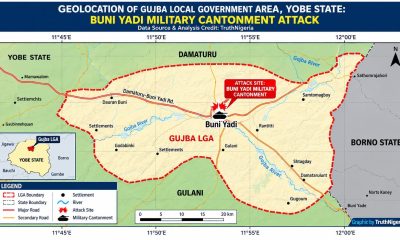
Over 200 Boko Haram Terrorists Are Moving To Attack Military Camp In Buni Yadi As Rockets Target Troops; IED Threat Raises Travel Concerns
- Metro6 days ago
“The Election Must Hold As Scheduled” — INEC Chairman Rules Out Postponement Of 2027 General Elections
- Metro6 days ago
“Publishing His Name Is Subject To The Final Outcome Of A Court Order” — INEC Leaves Gwarzo Off Updated Kano Governorship List
- Metro6 days ago
“Ebola Outbreak Is Not Yet Under Control” — Africa CDC Warns As Confirmed Cases Exceed 10,200, Death Toll Surpasses 5,000
- Metro7 days ago
“Death Benefits Will Be Fully Paid To Next Of Kin” — NAF Pledges Continued Salaries For Personnel Killed In October 5 Aircraft Crash
- Metro6 days ago
“Sowore’s Whereabouts Remain Unknown” — Armed Men Allegedly Abduct AAC Presidential Candidate In Ado-Ekiti, Damage Vehicles And Restaurant
- Metro6 days ago
“21 Exotic Vehicles Affected, No Life Lost” — LASEMA Confirms Lagos Mechanic Workshop Fire, Averts Disaster At Nearby Filling Station
- Metro6 days ago
“They Beat Me Like A Criminal” — Sowore Recounts Ekiti Attack As Govt Denies Involvement, Calls For Police Investigation